
Canadian Defence Signals
Readiness is becoming a sequence of visible gates
Editorial briefing snapshot
The Bottom Line
The movement forms a useful sequence: requirement, people and data, development, test, integration, acquisition and production. Canada has finalized a 26-launcher HIMARS path with delivery and readiness dates, while six program icebreakers now have a domestic construction horizon. Each step makes a different part of readiness observable before the final capability arrives.
In context
A Canadian ISR challenge now states the operating thresholds a supplier must meet, while allied workforce and data partnerships expose two inputs that conventional acquisition often leaves hidden. Dominion Scout has a pre-flight clock, SuperQ has entered a live field evaluation, and a follow-on RS4 order moves an existing vehicle integration into another delivery cycle.
In this edition
MINERVA turns an ISR need into supplier gates
The Canadian Army has opened a Phase 2 ISR UAS challenge with measurable cold-weather, endurance, stowage, sensor and data-integration thresholds for Canadian small and medium-sized businesses.
MINERVA converts a broad short-range surveillance need into a visible test card. The Phase 2 challenge accepts Canadian-SME solutions at TRL 5 through 9 and sets minimums including a six-kilometre operating radius, 60-minute endurance, operation from -20°C to +40°C, vertical take-off and landing inside two square metres, and stowage in a 70-litre pack. It also asks for Tactical Assault Kit interoperability and critical-component provenance.
Up to five contracts of $500,000 for as long as 15 months create a bounded prototype path rather than an open-ended expression of interest. The published thresholds let teams decide whether to bid, partner or stop early. They do not establish a winner, production quantity, follow-on procurement or field performance.
What the public record says
Innovative Solutions Canada opened the Canadian Army's Phase 2 MINERVA ISR UAS challenge on August 24 with TRL, environmental, endurance, sensor, stowage, interoperability and supply-chain requirements.
Why this may matter
A precise public requirement reduces discovery friction and gives Canadian suppliers a concrete basis for bid, partner and investment decisions before prototype funding is awarded.
Evidence limits
The page does not identify bidders, evaluation results, production quantities, follow-on procurement value or whether any proposed system has met the published thresholds in Army testing.
Practical next step
Compare candidate systems against every mandatory threshold, then track the award list and the final demonstration at Suffield before treating eligibility as capability proof.
Original source (1)
- Innovation, Science and Economic Development Canada: MINERVA Initiative – Intelligence Surveillance and Reconnaissance Uncrewed Air System (opens in a new tab)Challenge overview, mandatory outcomes, maximum value and eligibility sections
Australia opens a direct-entry path for cyber specialists
Australia has appointed the first direct-entry member of a Cyber Reserve Force designed to draw current expertise from industry, government and academia into Defence.
Australia built the Cyber Reserve Force in twelve months and has now marked its first direct-entry appointment. The model seeks experienced people in cyber operations, artificial intelligence, network engineering, cloud security, digital forensics, incident response, threat intelligence and strategy. Defence says the reserve will provide specialist advice, operational support and surge capacity while preserving entry standards.
The benchmark is an employment architecture, not a technology announcement. It shows one way to reach scarce expertise without requiring every specialist to follow a conventional full-time military path. The release does not publish applicant volume, clearance time, retention, utilization or mission outcomes, so the first appointment proves the pathway exists rather than that it scales.
What the public record says
The Australian Department of Defence says the Cyber Reserve Force made its first direct-entry appointment after establishing a specialist pathway that draws expertise from industry, government and academia.
Why this may matter
Direct entry makes specialist workforce access an inspectable readiness mechanism and offers Canada a concrete comparator for cyber reserve, surge and mid-career pathways.
Evidence limits
The release does not disclose force size, applicant numbers, security-clearance duration, service commitments, retention, deployment frequency or measured operational outcomes.
Practical next step
Compare Australia's entry, clearance and service model with Canadian reserve and civilian cyber pathways, then watch whether appointments expand beyond the first member.
Original source (1)
- Australian Department of Defence: Australia's cyber experts called to serve (opens in a new tab)Opening seven paragraphs and first direct-entry appointment statement
UK and Ukraine connect AI access to operating data
A new UK–Ukraine AI partnership gives British innovators access to Ukraine's Avengers AI Labs data while placing initial sensor and low-power computing projects on a shared development path.
The new UK–Ukraine agreement makes operating data part of the development infrastructure. The UK is the first international partner named for access to Avengers AI Labs, whose daylight and infrared sensors collect battlefield objects for model training. The release also identifies pilots with three British startups, including a fibre-optic perimeter-sensing deployment at a UK defence site and work on low-power AI chips for drones and robotics.
The consequence is a shorter route between operational observation and technical iteration. For Canadian planners, it is a benchmark for structuring allied access to data, users and test settings around a defined problem. The public release does not explain data-governance rules, security boundaries, model evaluation, procurement terms or pilot results.
What the public record says
The UK government says its August 24 agreement makes the United Kingdom the first international partner to access Ukraine's Avengers AI Labs and identifies several initial joint AI pilots.
Why this may matter
Access to operating data and named pilot environments turns an alliance relationship into a development mechanism that can be compared with Canada's own defence-innovation pathways.
Evidence limits
The release does not publish access controls, dataset scope, security classifications, model-performance results, intellectual-property terms, funding values or procurement commitments for the pilots.
Practical next step
Track the named pilots for evaluation results and procurement decisions, and compare their data-access rules with Canadian test, privacy and security requirements.
Original source (1)
- UK Government: New partnership set to see the UK and Ukraine develop battle winning technology as Britain secures access to Ukraine's Avengers AI Labs (opens in a new tab)Partnership terms, Avengers data description and initial pilot-project paragraphs
Dominion puts Scout on a pre-flight evidence clock
Dominion Dynamics says Scout is 24 to 30 months from first flight, with virtual prototyping next and a manufacturing partnership expected to be disclosed this fall.
Dominion says its sovereign autonomous collaborative platform has moved from the initial $50-million commitment into operational research, options analysis and simulation. The company places first flight 24 to 30 months away, says competing designs will enter virtual prototyping, and expects to say more this fall about a manufacturing partnership. Its stated design work emphasizes Arctic communications, cold soak, icing, ruggedized equipment and unimproved runways.
That clock creates useful checkpoints before anyone treats Scout as an aircraft program with demonstrated performance. Partner disclosure, design selection, prototype build and first flight are now the evidence sequence. The supply-chain, simulation and schedule claims come from Dominion; the page does not provide an airframe configuration, external test result, contract customer or government acceptance decision.
What the public record says
A Dominion press release hosted by Skies Magazine states that Scout is 24 to 30 months from first flight, with virtual prototyping next and a manufacturing-partner announcement expected this fall.
Why this may matter
A stated pre-flight schedule gives Canada's sovereign collaborative-aircraft ambition concrete evidence gates that can be tracked before design claims become operating claims.
Evidence limits
No selected design, manufacturing partner, prototype, flight-test plan, government customer, contract, independent simulation result or verified production capacity is public.
Practical next step
Watch for the manufacturing partner and design down-select, then verify prototype-build and first-flight evidence against the published 24-to-30-month clock.
Original source (1)
- Skies Magazine: Canada's first autonomous collaborative platform taking off (opens in a new tab)Program progress list, first-flight timing and advisory-board section
SuperQ enters a live field evaluation
SuperQ says its decision-support stack entered a U.S. contested-extraction exercise with explicit benchmarks for re-tasking speed, replanning continuity, encrypted transport and edge-to-command integration.
SuperQ entered a live field demonstration at Texas A&M's Bush Combat Development Complex through the Canada Q-Branch accelerator. Its release names a formal Memorandum of Observation and four test areas: sub-60-second re-tasking, continuity across at least three threat changes, encrypted satellite transport and bidirectional edge-to-command reporting. The company says Global Affairs Canada supported the Canadian participation.
This is a stronger evidence setting than an accelerator selection because evaluators, scenarios and performance thresholds are visible. It is still a test activity, not a result. No observer finding, measured latency, communications log, procurement decision or system acceptance has been published, and the account is issuer-supplied. The next signal is the evaluation record, not the company's description of intended performance.
What the public record says
SuperQ's August 21 issuer release describes a live contested-extraction demonstration with four stated evaluation benchmarks under a Memorandum of Observation at the Bush Combat Development Complex.
Why this may matter
Named field benchmarks turn a broad Canadian dual-use claim into a result-oriented watchpoint for allied testing, prime integration and defence procurement pathways.
Evidence limits
The source publishes no test results, independent evaluator statement, measured latency, encryption evidence, purchase decision, integration agreement or readiness determination.
Practical next step
Track the Memorandum of Observation and any evaluator or customer statement, then verify results before treating participation as field validation or market access.
Original source (1)
- SuperQ Quantum via Newsfile: SuperQ Quantum Deploys as Sole Canadian Tech Company in Live US Defence Operational Exercise at Bush Combat Development Complex (opens in a new tab)Live Field Evaluation and Memorandum of Observation benchmark sections
RS4 follow-on makes integration a delivery question

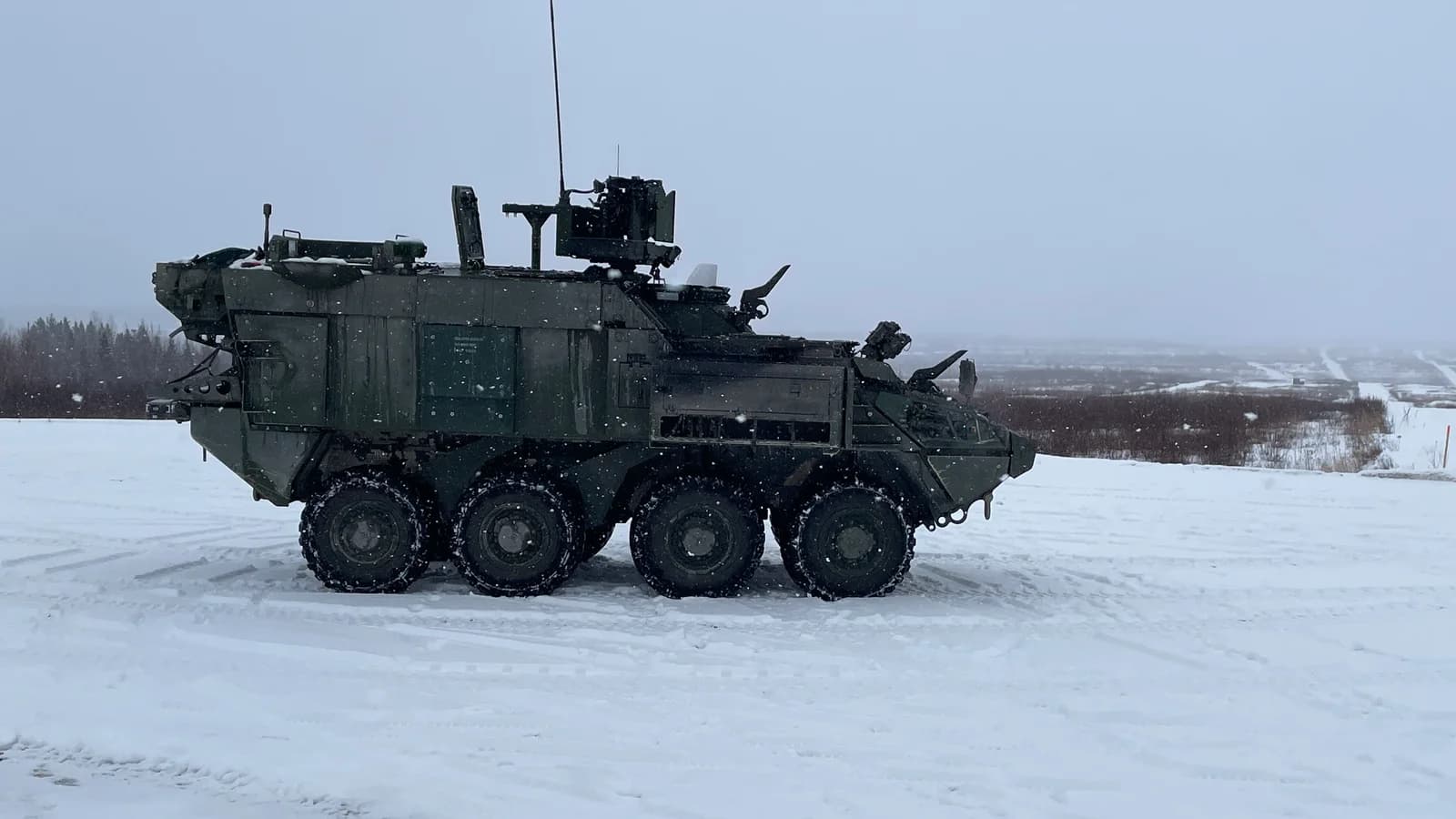
KONGSBERG has signed a NOK 1.1-billion follow-on contract with GDLS-Canada for PROTECTOR RS4 systems to be integrated on Canadian Army Armoured Combat Support Vehicles.
KONGSBERG has signed a NOK 1.1-billion order for more PROTECTOR RS4 remote weapon systems from General Dynamics Land Systems–Canada. The company describes it as a follow-on procurement for the Armoured Combat Support Vehicle program, building on RS4 deliveries already integrated on the same Canadian Army platform. That moves the signal beyond initial platform selection into a repeat integration cycle.
The contract makes supplier coordination, installation, acceptance and sustainment the practical questions. It also provides a visible piece of the ACSV delivery stack for teams mapping where Canadian vehicle work meets an allied subsystem. KONGSBERG does not disclose system quantity, delivery dates, Canadian workshare, installation location, acceptance milestones or sustainment terms, so contract value cannot be translated into fleet scale.
What the public record says
KONGSBERG announced a signed NOK 1.1-billion follow-on contract with GDLS-Canada for PROTECTOR RS4 systems to be integrated onto Canadian Army ACSV vehicles.
Why this may matter
A follow-on subsystem order makes the ACSV integration chain more concrete and shifts attention from selection to delivery, acceptance and sustainment evidence.
Evidence limits
The release omits system quantity, unit value, delivery schedule, Canadian content, installation location, acceptance milestones, subcontractors and long-term support terms.
Practical next step
Track GDLS-Canada and program disclosures for quantities, delivery and acceptance milestones, then map which Canadian suppliers support integration and sustainment.
Original source (1)
- KONGSBERG: KONGSBERG to deliver Remote Weapon Systems to Canada (opens in a new tab)Headline and opening five paragraphs
HIMARS turns long-range strike into a readiness calendar
Canada has finalized a $2.6-billion agreement for 26 HIMARS launchers and published a delivery-to-readiness path from no later than 2029 through full operational capability in 2034.
Canada has finalized the government-to-government agreement for 26 M142 HIMARS launchers, associated equipment, munitions, training and future options. The Army expects launcher deliveries to begin no later than 2029, initial operational capability in 2030 and full operational capability in 2034. It also describes a sensor-to-shooter architecture, a new 9th Rocket Regiment and support from Army Reserve units.
The useful signal is the capability system around the launcher. Target acquisition, command and control, precision munitions, training, infrastructure, air mobility and sustainment now sit on a dated readiness path. The source does not identify Canadian industrial participation, infrastructure awards, annual delivery quantities, munition inventories or acceptance criteria. A finalized agreement starts the execution clock; it does not compress it.
What the public record says
The Canadian Army says Canada finalized a $2.6-billion U.S. Foreign Military Sales agreement for 26 HIMARS launchers and expects delivery, initial and full capability milestones in 2029, 2030 and 2034.
Why this may matter
Published milestones turn long-range strike from a policy ambition into a trackable integration and readiness program spanning sensors, people, infrastructure, munitions and sustainment.
Evidence limits
Canadian workshare, delivery quantities by year, infrastructure contracts, munition inventory, acceptance criteria, training throughput and sustainment arrangements are not disclosed.
Practical next step
Track infrastructure, training and support awards against the 2029 delivery gate, and verify how sensor-to-shooter integration is tested before initial operational capability.
Original source (1)
- National Defence: Canadian Army on track to acquire critical long-range strike capability (opens in a new tab)Agreement, system architecture, force structure and delivery schedule paragraphs
Six icebreakers enter a Canadian production horizon
Canada will invest more than $11 billion for six Davie-built program icebreakers, with construction beginning in 2027, the first ship expected five years later and the full fleet in service by 2038.
The federal contract moves six Canadian Coast Guard program icebreakers into a design-and-build horizon at Chantier Davie. The Prime Minister's release puts the investment above $11 billion, says construction begins in 2027, places the first ship five years later and sets 2038 for all six to be in service. It also commits to Canadian steel and other domestic materials and estimates nearly 5,000 construction jobs.
The long schedule makes production capacity, design maturity, supplier qualification and workforce retention the decision variables. The ships are intended to replace aging heavy and medium icebreakers serving Atlantic Canada, the St. Lawrence, the Great Lakes and the Arctic. The release does not publish subcontract awards, detailed workshare, design-review gates, annual spend, contingency or acceptance milestones.
What the public record says
The Prime Minister's August 24 release announces more than $11 billion for six program icebreakers at Davie, with construction starting in 2027 and the complete fleet expected in service by 2038.
Why this may matter
A funded domestic fleet horizon creates a durable supplier, workforce and schedule watchpoint tied directly to Canadian maritime access, Arctic presence and Coast Guard readiness.
Evidence limits
The release does not disclose supplier awards, detailed Canadian workshare, design-review dates, annual spend, schedule contingency, acceptance criteria or the delivery cadence after the first ship.
Practical next step
Map the design and supplier-qualification gates, then track Canadian steel, equipment, workforce and subcontract awards against the 2027 construction start and 2032 first-ship target.
Original source (1)
- Prime Minister of Canada: Prime Minister Carney announces the largest shipbuilding contract in Québec's history (opens in a new tab)Contract value, domestic-content, vessel role and construction-schedule paragraphs
Carry the signal forward
Continue in True North Map
Follow the edition into the organizations, technologies, Defence needs and Mission areas already connected to its record.