
Canadian Defence Signals
Canada’s defence buildout now needs working systems
Editorial briefing snapshot
The Bottom Line
The strongest opportunities are becoming specific enough to investigate: an amended requirement, a funded integration task, a customer operating model or a support obligation. Suppliers should identify the piece they can deliver and the evidence that would make a buyer confident in it.
In context
The investment and alliance announcements of the past week are beginning to yield more specific questions for Canadian industry. Can a drone supplier demonstrate what the Army is actually asking for? Can a northern community support a larger military presence without overloading its power and public services? Can a satellite customer turn a faster downlink into a better decision?
Today’s evidence is unusually useful at that level. A newly amended MINERVA document changes how an acoustic requirement should be understood ahead of Monday’s deadline. NATO has made its resilience requirements public, while Nunavut’s premier describes the constraints on the ground. Sentinel has disclosed an industrial-benefits contribution behind its integration consortium, and MDA has set out the services that will accompany CHORUS. Two new RCAF trainers have arrived, with the work of building the training system still ahead.
These developments reveal a substantial Canadian opportunity in the work around major platforms: testing, instruction, power, ground systems, software integration and maintenance. The final two signals extend that picture into locally controlled AI and Canada’s proposed European partnership. Both could broaden industry’s options, provided their development and negotiation milestones turn into usable arrangements.
In this edition
MINERVA’s latest amendment gives drone suppliers a more precise test
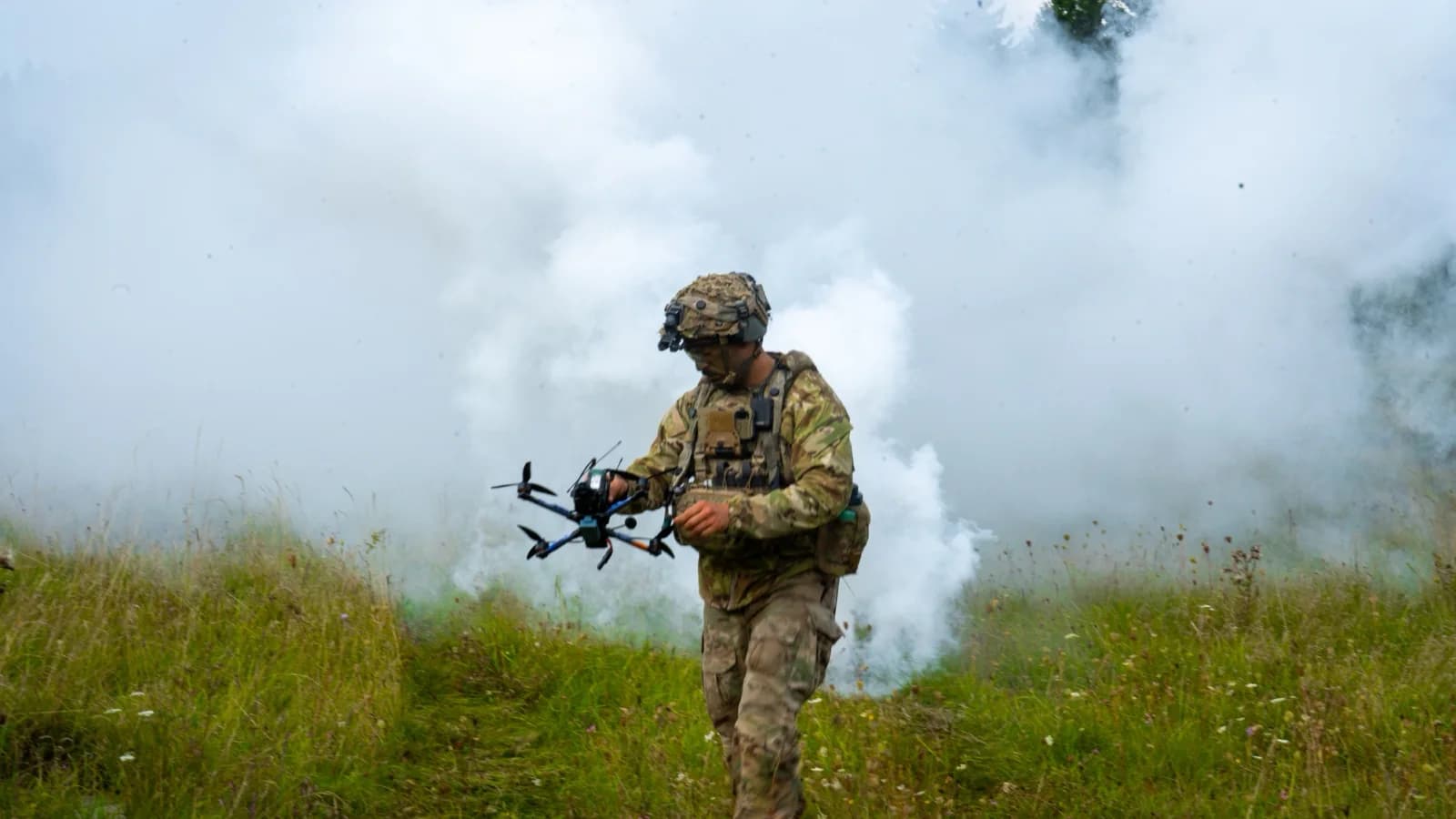
Two Army prototype calls close Monday. A new ISR-drone amendment clarifies the acoustic test, while the funding remains capped at C$500,000 per contract.
The useful update in the Army’s MINERVA program is in the paperwork. A September 16 procurement amendment clarifies the ISR drone’s quietness criterion: the aircraft’s contribution is to be measured relative to ambient noise at 500 metres, with a limit of five decibels above that background. The specified flight condition is hover. That clarification matters to a supplier designing a demonstration; an absolute sound-pressure limit and a rise above background are different tests.
The ISR challenge and ground cargo challenge close September 21 at 2 p.m. Eastern, or 3 p.m. Atlantic. Each estimates five Phase 2 contracts capped at C$500,000 apiece, lasting up to 15 months. Five awards at the maximum would total C$2.5 million for a challenge, spread across recipients. That is not the amount available to each applicant, an award already made, or a production commitment; Canada reserves its final award decisions.
For ISR applicants, the published requirements also distinguish mandatory capabilities from additional outcomes. Interoperability with the Tactical Assault Kit ecosystem and the quietness criterion appear among the additional outcomes; bidders should use the actual evaluation documents when allocating engineering effort. These are mature-prototype opportunities for eligible Canadian small businesses, with the ISR call specifying technology readiness levels 5–9.
There is a useful allied warning alongside the deadline. Carley Welch reports for Breaking Defense that the U.S. Army’s next constraint is training enough soldiers to use the drones it is acquiring. That does not establish a Canadian training shortfall. It does strengthen the commercial case for an offer that explains operator workload, instruction, maintenance and integration alongside aircraft performance. The following MINERVA deadlines are September 24 for Arctic UAS and October 5 for airborne cargo delivery.
What remains open
Selection, eventual contract values and any later production purchase remain undecided; applicants must also distinguish mandatory requirements from additional evaluation outcomes.
What comes next
Before Monday’s 3 p.m. Atlantic deadline, reconcile the submission against every amendment and make the acoustic test method explicit in the ISR response.
Evidence and assessment for MINERVA’s latest amendment gives drone suppliers a more precise test
What the sources establish
Amendment 002 clarifies the ISR noise requirement and hover condition. The ISR and ground-cargo calls close September 21; each estimates five contracts capped at C$500,000 per contract.
True North Map assessment
TNM assessment: credible test evidence and an affordable training-and-support approach could distinguish suppliers as the Army moves from demonstrations toward usable capability.
Original sources (6)
- Public Services and Procurement Canada: MINERVA ISR UAS: Solicitation amendment 002 (opens in a new tab)Direct recordEnglish page 1, questions and answers A1 and A2; amendment dated September 16, 2026
- Innovative Solutions Canada: MINERVA Initiative: Intelligence, Surveillance and Reconnaissance Uncrewed Air System (opens in a new tab)Direct recordChallenge overview, funding, eligibility and additional outcomes
- Innovative Solutions Canada: MINERVA Initiative: Uncrewed Ground System for Tactical Cargo Movement (opens in a new tab)Direct recordChallenge deadline and Phase 2 funding
- Innovative Solutions Canada: MINERVA Initiative: Arctic Uncrewed Air System (opens in a new tab)Direct recordChallenge closing date
- Innovative Solutions Canada: MINERVA Initiative: Uncrewed Air System for Cargo/Munition Drop (opens in a new tab)Direct recordChallenge closing date
- Breaking Defense: Army has enough drones for each unit, now it needs to train soldiers to use them (opens in a new tab)Original reportingCarley Welch, September 17, 2026; remarks by Col. Gregory Merkl
Sentinel shows how industrial benefits can finance integration
A disclosed $10 million Lockheed Martin contribution connects a Canadian integration consortium with research and manufacturing capacity; it is not a customer order for StarForge.
Sentinel Advanced Military Solutions’ September 16 announcement gives a concrete example of an industrial-benefits mechanism. The company describes a $10 million contribution from Lockheed Martin, associated with Canada’s HIMARS acquisition, supporting its consortium and Canadian intellectual-property development. Sentinel says the contribution carries neither equity transfer nor repayment.
The consortium was unveiled at CANSEC; this is a fuller public account of its backing and structure, rather than a newly invented organization. Sentinel is owned by manufacturer CMP Advanced Mechanical Solutions. The announced arrangement includes University of Alberta research capacity and Lockheed Martin’s VCSi command-and-control software. StarForge is presented as a deployable combination of sensing, communications, power and manufacturing, including production of parts in the field.
The useful industrial question is whether funding can carry several components through integration into a system an operator can sustain. TNM would look for demonstrated setup time, power and feedstock needs, approved part designs, quality assurance and a customer-led trial. Those details will decide where mobile manufacturing actually reduces a supply burden. The announcement establishes a funded development relationship as described by its participants; it does not establish a production order, a deployed military fleet or independent proof of the advertised performance.
What remains open
The release does not disclose disbursement milestones, each partner’s allocation, a production customer or independently demonstrated field performance.
What comes next
Potential partners should ask which integration work packages are funded, how resulting IP is owned, and what operator trial will determine the next procurement step.
Evidence and assessment for Sentinel shows how industrial benefits can finance integration
What the sources establish
Sentinel reports a $10 million Lockheed Martin ITB contribution, a University of Alberta research partnership and a consortium built around StarForge; it says no equity transfer or repayment is required.
True North Map assessment
TNM assessment: industrial-benefits funding can help Canadian suppliers pay for shared integration and intellectual-property development before a complete system wins operational orders.
Original source (1)
- Sentinel AMS via GlobeNewswire: Sentinel Advanced Military Solutions launches integrated defence ecosystem with University of Alberta and $10 million Lockheed Martin contribution (opens in a new tab)Attributed statementSeptember 16, 2026 issuer announcement; consortium history and ITB contribution terms
CHORUS turns the ground segment into part of the customer offer
MDA’s new service portfolio gives customers a clearer choice between buying imagery, hosting a regional downlink and buying finished intelligence products.
Marc Boucher’s reporting for SpaceQ identifies a significant step before CHORUS reaches commercial operation: MDA has explained how customers will use it. The portfolio separates archive access and tasking, a customer-based regional ground station, and derived intelligence products. That makes the commercial offer more tangible than another constellation progress update.
In MDA’s own product announcement, COMMAND handles access and tasking; COMMAND PRO adds a regional station within the customer’s operations for direct downlink and local processing. INTELLIGENCE covers outputs such as vessel detection, oil-on-water tracking, ground deformation and energy-infrastructure monitoring. The proposition spans the new C- and X-band satellites and the existing RADARSAT-2 capability. SpaceQ reports anticipated commercial operations in early 2027, following the planned launch later this year.
For Canadian industry, TNM sees two different kinds of work. One is installing, securing and sustaining the customer’s ground infrastructure. The other is making imagery useful inside an existing decision process: port monitoring, northern logistics, infrastructure inspection or maritime awareness. A fast downlink only becomes an operational advantage when the result reaches the person who can act on it. Integration with customer software, alert thresholds and human review can therefore matter as much as access to the image.
The distinction also helps buyers ask better questions. An archive subscription, a local ground station and an interpreted alert service have different capital, staffing, security and support requirements. The new portfolio establishes those choices; it does not yet demonstrate their delivered performance for a particular buyer.
What remains open
The cited material does not establish customer-specific pricing, delivered latency, service guarantees or the resources required to operate each tier.
What comes next
Start with the decision the buyer needs to make, then compare tasking priority, processing location, integration interfaces and support obligations across the three offerings.
Evidence and assessment for CHORUS turns the ground segment into part of the customer offer
What the sources establish
MDA announced COMMAND, COMMAND PRO and INTELLIGENCE on September 16. COMMAND PRO includes a customer-based regional ground station; SpaceQ reports commercial operations are anticipated in early 2027.
True North Map assessment
TNM assessment: direct downlink could expand work for Canadian ground-system, cybersecurity and geospatial application suppliers, while finished alerts may serve buyers without large imagery teams.
Original sources (2)
- MDA Space: MDA Space announces end-to-end MDA CHORUS product portfolio in advance of constellation launch (opens in a new tab)Attributed statementSeptember 16, 2026 release; COMMAND, COMMAND PRO and INTELLIGENCE service descriptions
- SpaceQ: MDA unveils CHORUS Earth observation portfolio ahead of launch (opens in a new tab)Original reportingMarc Boucher, September 17, 2026; product tiers and anticipated commercial operations
The first Siskins arrive; the next milestone is the training system
Canada has welcomed the first two of 19 ordered CT-157 trainers, with final delivery and instructor development still ahead.
SkyAlyne says the first two CT-157 Siskin II aircraft arrived in Canada on September 17. After the September 19–20 Gatineau air show, they are due to continue to Moose Jaw for final delivery to the RCAF and development and testing of the Future Aircrew Training program. Their early role includes training the instructors who will build that system.
That sequence matters. Arrival in Canada is a real delivery milestone, but it does not mean the full 19-aircraft fleet is present or that routine student training has begun. SkyAlyne, the CAE–KF Aerospace joint venture, is integrating a 25-year program across Moose Jaw, Southport and Winnipeg. The aircraft themselves include Pratt & Whitney Canada engines and Canadian avionics content.
TNM’s industrial reading is that aircraft acceptance opens a sustained period of work on courseware, simulators, instructor preparation, maintenance and availability. Success will ultimately show up in qualified aircrew and dependable training capacity. For suppliers, the useful question is which of those responsibilities still needs a partner, rather than assuming every task remains available because the aircraft are newly arrived.
What remains open
This arrival announcement does not give the full fleet’s acceptance schedule, the first routine student-course date or additional supplier opportunities.
What comes next
Watch the Moose Jaw acceptance and instructor-training milestones; ask SkyAlyne which support or training requirements remain open to suppliers.
Evidence and assessment for The first Siskins arrive; the next milestone is the training system
What the sources establish
SkyAlyne reports two aircraft arrived September 17 out of 19 ordered. Final RCAF delivery at Moose Jaw, instructor development and testing follow the Gatineau visit.
True North Map assessment
TNM assessment: the near-term ecosystem work is converting delivered aircraft into reliable instruction, maintenance and training throughput.
Original source (1)
- SkyAlyne: IN PHOTOS: Welcome to Canada, RCAF CT-157 Siskin II! (opens in a new tab)Attributed statementSeptember 17, 2026; first arrivals, 19-aircraft order and final delivery sequence
Mila and Mozilla target the hard part of local AI: running it
An open AI foundation could lower the engineering burden for firms that need control of their data, but the first working implementations remain a future milestone.
Mozilla and Mila’s September 17 initiative targets the work between downloading an open model and operating a useful system. The proposed foundation combines common interfaces with working software that organizations can run on their chosen machines, including governance and access controls. The partners expect initial reference implementations within six months.
BetaKit reports C$5 million from Mozilla and C$1 million from Hypertec. Keep those commitments separate from the federal government’s support: its funding arrangement with Mila is still being negotiated, according to BetaKit’s follow-up reporting.
For a smaller Canadian defence manufacturer, a plausible use is searching internal manuals, procedures and project records without moving them into a service it cannot control. The commercial opportunity also extends to local integrators that can manage deployment, permissions, evaluation and upkeep. TNM sees that operational support as central: installing an open model does not by itself make sensitive information safe or answers dependable.
The announcement is therefore a development and adoption signal. It establishes neither a finished defence product nor approval to process classified material. A worthwhile early trial would use a bounded, unclassified workflow and measure whether people get accurate answers with less effort.
What remains open
The final federal funding terms, released software, measured operating costs and suitability for specific sensitive workloads are not established by the announcement.
What comes next
Identify one unclassified internal workflow and its access controls now; evaluate the reference implementation against accuracy, maintenance effort and total operating cost when released.
Evidence and assessment for Mila and Mozilla target the hard part of local AI: running it
What the sources establish
Mila and Mozilla announced an open AI foundation and a six-month target for initial reference implementations. BetaKit reports C$6 million in sponsor commitments and separate federal funding negotiations.
True North Map assessment
TNM assessment: reusable deployment software could widen the market for Canadian AI integration and support, particularly among smaller firms with proprietary technical records.
Original sources (3)
- Mozilla: Mila and Mozilla announce new initiative to build trustworthy open source AI for everyone, with Canadian government support (opens in a new tab)Attributed statementSeptember 17, 2026; interface contracts, reference implementation and six-month milestone
- BetaKit: Mila and Mozilla announce plans to build open-source AI for businesses (opens in a new tab)Original reportingSeptember 17, 2026; Canadian-dollar sponsor commitments
- BetaKit: Mila negotiating new federal funding after being tasked with open-source AI file (opens in a new tab)Original reportingSeptember 17, 2026; minister and Mila CEO on funding discussions
Carney adds finance and compute to the European proposition
The European Parliament address gives the proposed partnership more commercial detail, while an ammunition supplier warns against treating diversification as a quick industrial separation.
Following this week’s associate-membership discussion, Carney’s September 17 address to the European Parliament adds specific proposals: pooled sovereign compute, stronger critical-mineral value chains and consideration of an integrated financial-services market. He also places defence industrial capacity, energy, space and payments within the proposed cooperation. Canada welcomes the ambition; the form of the alliance is still to be defined together.
For industry, that makes the discussion broader than access to a procurement list. A critical-minerals producer needs processing and committed customers. A compute operator needs capital, connectivity and users. A defence supplier needs qualified partners and predictable orders. TNM’s reading is that an effective agreement could join those needs across borders, but the speech itself changes none of their financing or eligibility rules.
There is a relevant counterweight in Tim Martin’s reporting on Nammo for Breaking Defense. CEO Morten Brandtzæg argues that rupturing Europe’s industrial ties with the United States could leave a capability gap lasting five to ten years. This is an interested manufacturer’s assessment; the publication discloses that Nammo paid for the reporting trip’s travel and accommodation. Its example of transatlantic rocket-motor production nevertheless illustrates how deeply existing supply chains connect.
For a Canadian company, the practical strategy is to examine additional European customers and partners while understanding the American content, intellectual property and approvals already embedded in its product. More routes to market can improve resilience. Replacing established industrial dependencies takes qualification, investment and time, and should not be assumed from a political announcement.
What remains open
The proposed alliance’s legal form, timetable and sector-specific terms remain to be negotiated; the speech creates no new company entitlement or financing approval.
What comes next
Map one plausible European partner or buyer against current component, IP and approval dependencies, then identify the concrete rule or agreement needed to make that opportunity executable.
Evidence and assessment for Carney adds finance and compute to the European proposition
What the sources establish
Carney proposed deeper cooperation including pooled compute and exploration of financial-services integration. Separately, Nammo’s CEO warned of a lengthy capability gap if Europe breaks industrial ties with the United States.
True North Map assessment
TNM assessment: firms should assess European capital and customer opportunities alongside the dependencies that make their present products deliverable.
Original sources (2)
- Prime Minister of Canada: Prime Minister Carney delivers an address to the European Parliament (opens in a new tab)Direct recordSeptember 17, 2026 speech; proposed alliance, pooled compute and financial-services integration
- Breaking Defense: Nammo CEO warns European rupture with US risks 10-year capability gap (opens in a new tab)Original reportingTim Martin, September 17, 2026; CEO assessment and disclosed company-funded travel