
Canadian Defence Signals
Canadian command and mine clearance show allied responsibility
Editorial briefing snapshot
The Bottom Line
Allied contribution becomes concrete through shared responsibility, complementary equipment and the information handed from one team to the next.
In context
Canadian teams have carried responsibility in an allied carrier screen and completed mine-clearance work with Danish specialists. A new Coast Guard aircraft purchase and a supplier’s harbour trial offer different views of the surveillance systems surrounding those missions.
In this edition
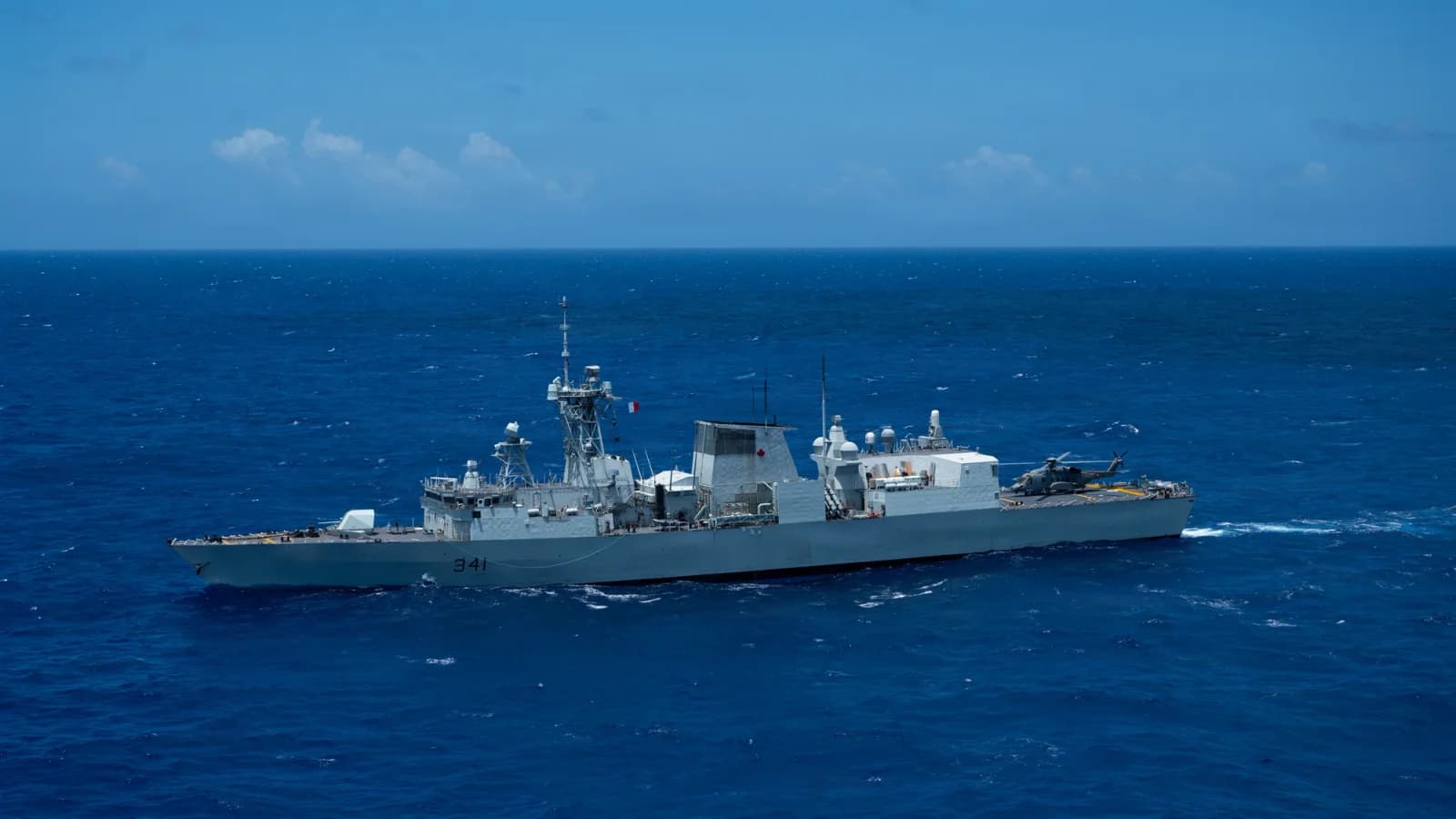
HMCS Ottawa returns after Canadian leadership in an allied task group
Ottawa’s completed deployment included Canadian command of a 14-ship allied screen and simulated Bering Sea maritime strikes with the U.S. Air Force.
An additional Canadian team embarked in HMCS Ottawa carried responsibility for protecting an American aircraft carrier. National Defence’s October 9 homecoming account says the team commanded Task Group 170.1 and served as Sea Combat Commander for 14 ships during RIMPAC, coordinating multinational assets screening USS Theodore Roosevelt against surface and subsurface threats. Ottawa also fired two Mark 46 torpedoes in anti-submarine training.
That is a concrete expression of allied professional trust. Canadian personnel were given a demanding coordinating role in a larger force, with other nations’ ships depending on shared procedures, a common picture and timely decisions. The release establishes the assigned responsibility and completed training; it supplies no combat-effectiveness measurement.
The more than four-month deployment also linked the Indo-Pacific to northern continental waters. After engagements with HMCS Regina and MV Asterix, Ottawa conducted simulated Bering Sea maritime strikes with the U.S. Air Force under Operation LATITUDE. Approximately 245 sailors, soldiers and aviators returned after some 25,000 nautical miles. Their contribution deserves attention both for the distance covered and for the responsibility Canada carried within the combined force.
What remains open
The release does not provide tactical performance data or describe a combat engagement.
Evidence and assessment for HMCS Ottawa returns after Canadian leadership in an allied task group
What the sources establish
DND reports completed Canadian sea-combat command of14ships at RIMPAC, two training torpedo firings and later Bering Sea simulated strikes with the U.S. Air Force.
True North Map assessment
Canadian leadership in an allied screen makes professional trust visible through assigned responsibility and shared operational work.
Original source (1)
- National Defence: HMCS Ottawa returns to Esquimalt following Operations HORIZON and LATITUDE (opens in a new tab)Direct record · Full October9 deployment completion release: RIMPAC torpedoes, Canadian sea-combat command, BeringSea simulated strikes and deployment scope.
Canadian-Danish mine clearance joins ships, sensors and divers
Two safe Canadian detonations close an operation whose Danish account explains the complementary equipment, expertise and seabed-data handoff.
HMCS Moncton and Edmonton contributed two safe detonations during the final phase of historical ordnance disposal off Denmark, National Defence reported on October 9. The September 28–October 1 operation brought the NATO group’s total to four. Fleet Diving Unit Atlantic worked with Danish explosive-ordnance specialists and other allies to locate, identify and address old mines and unexploded ordnance.
Denmark’s October 6 account explains the capability behind that result. Canadian ships hosted Danish sensors and diving expertise as an integrated two-nation package. It quotes both sides describing the complementarity; the Canadian commander says the group could not have completed its assigned tasks without the Danish contribution. This was a deployment that included exercises and real disposal work, with shared procedures developed through use.
The data had a second life. Participating vessels supplied their seabed observations to a new Danish naval analysis and mapping centre. Previously identified objects can then be separated from new contacts on a return visit. That is a practical connection between mine warfare and infrastructure protection: a better baseline helps operators decide where to concentrate the next investigation.
Danish leadership also proposes trying the containerised cooperation in Arctic conditions. The proposal is still future work. The immediate evidence is already useful for Canadian capability builders: vehicles, handling arrangements, divers, sensor interpretation and a persistent data record have to function together before a mine-countermeasures package becomes an operational contribution.
What remains open
The reports do not give detection or false-alarm rates or establish a completed Arctic deployment of this combined package.
What comes next
The proposed Arctic trial would test whether the same containers, sensors, handling procedures and personnel arrangements transfer to northern conditions.
Evidence and assessment for Canadian-Danish mine clearance joins ships, sensors and divers
What the sources establish
Canadian and Danish official reports establish the disposal results, integrated national contributions and transfer of collected data to Denmark’s seabed-analysis centre.
True North Map assessment
The completed operation demonstrates a usable coalition package, while the retained seabed baseline supports change detection on later missions.
Original sources (2)
- National Defence: Canadian ships clear historical ordnance (opens in a new tab)Direct record · Full October 9 CJOC account: September 28–October 1 historical ordnance disposal, Canadian and Danish divers, two Canadian safe detonations.
- Defence Command Denmark: Danish-Canadian mine countermeasures cooperation strengthens operational capabilities in the Kingdom (opens in a new tab)Direct record · Full original October 6 English account: complementary ships/sensors/divers, seabed-data handoff and proposed future Arctic cooperation.
The Coast Guard’s MQ-9B order defines a surveillance package

The U.S. Coast Guard’s US$247.8 million order buys four MQ-9Bs and their ground/support equipment; an advertised ASW option is a separate configuration question.
The U.S. Coast Guard announced a US$247.8 million purchase of four MQ-9B aircraft, ground-control stations and support equipment on October 9. Breaking Defense reports that a service spokesperson expects the aircraft to be unarmed. The selected role is long-range maritime awareness, including search and rescue and counter-trafficking missions.
The package matters as much as the aircraft count. Aircraft, control stations and support have to sustain a flow from a remote sensor to crews able to decide and act. A procurement value covering that package should not be read as a simple unit price for four airframes.
General Atomics describes SeaGuardian’s maritime radar, identification and electronic-support options, along with optional sonobuoy management and dispensing equipment. Its product page lists anti-submarine and mine-countermeasures possibilities. Those are supplier configuration claims; the Coast Guard announcement does not establish that it bought every option.
For Canadian readers following large remotely piloted aircraft, this is a useful buyer comparison: a common platform family can serve different military and civil missions, while the payload, operating permissions, ground segment and support arrangement determine the actual capability being purchased.
What remains open
The sources do not disclose the selected Coast Guard payload fit or establish purchase of the optional anti-submarine kit.
What comes next
A service configuration and fielding account would show how the procured aircraft, stations, sensors and support will operate as one surveillance system.
Evidence and assessment for The Coast Guard’s MQ-9B order defines a surveillance package
What the sources establish
Breaking Defense’s original October 9 report establishes the package value and relays the service’s unarmed expectation; GA-ASI separately describes optional maritime configurations.
True North Map assessment
Aircraft counts become more informative when the selected mission payload, ground system, training and support package are identified.
Original sources (2)
- Breaking Defense / Diana Stancy: Coast Guard places $248 million order for first MQ-9B drones (opens in a new tab)Original reporting · Full original report; service spokesperson says aircraft not expected to carry weapons.
- General Atomics Aeronautical Systems: MQ-9B SeaGuardian (opens in a new tab)Attributed statementFull substantive product page: maritime sensor options and optional sonobuoy management/dispenser systems; these are configuration claims,not the selected CoastGuard fit.
A working harbour tests acoustic detection beyond a clean demonstration
EvoLogics reports night-time drone tracking and collision reconstruction while leaving a possible diver contact unconfirmed.
A working fishing harbour gave EvoLogics a more demanding environment than a quiet demonstration area. In its October 9 REPMUS account, the company describes passive hydrophone arrays, active sonar, a seabed fibre-optic cable, day and thermal cameras, and ship-identification data feeding operators at a central server. Fibre and radio linked the sensor stations; classified contacts were passed into NATO reporting.
During the rougher of two night raids, the company reports continuous tracking of an underwater drone and classification and release of one surface-drone report 30 seconds after detection. A possible diver contact remained under analysis to exclude a false alarm. That distinction deserves to survive the headline: a detection alert and a confirmed diver are different results.
The same data helped reconstruct a fishing-boat collision with a sensor buoy by aligning acoustic signatures, sonar, AIS and video. For Canadian ports and naval facilities, the useful question is therefore how a network supports investigation and operator decisions amid legitimate traffic. These are supplier-reported exercise observations, with commercial availability planned for 2027; the account gives no full detection-probability or false-alarm dataset.
What remains open
The possible diver detection was unconfirmed; no complete detection-rate, false-alarm or Canadian site-validation dataset is provided.
What comes next
A trial report separating confirmed targets, missed targets and false contacts under busy-port conditions would make the operating case easier to assess.
Evidence and assessment for A working harbour tests acoustic detection beyond a clean demonstration
What the sources establish
The supplier reports underwater-drone tracks and a reconstructed buoy collision; it explicitly leaves the possible diver contact under analysis.
True North Map assessment
Combining underwater sensing with surface identification can help distinguish an incident from ordinary harbour activity and preserve evidence for reconstruction.
Original source (1)
- EvoLogics: Listening to the harbour: EvoLogics’ new harbour protection network at NATO Exercise REPMUS2026 (opens in a new tab)Attributed statement · Night raids: conditions, tracked UUVs, unconfirmed possible diver; real collision reconstruction; network configuration; announced2027 availability. Full article inspected.
Carry the signal forward
Continue in True North Map
Follow the edition into the organizations, technologies, Defence needs and Mission areas already connected to its record.