
Canadian Defence Signals
Launch contracts and shared data shape operational access
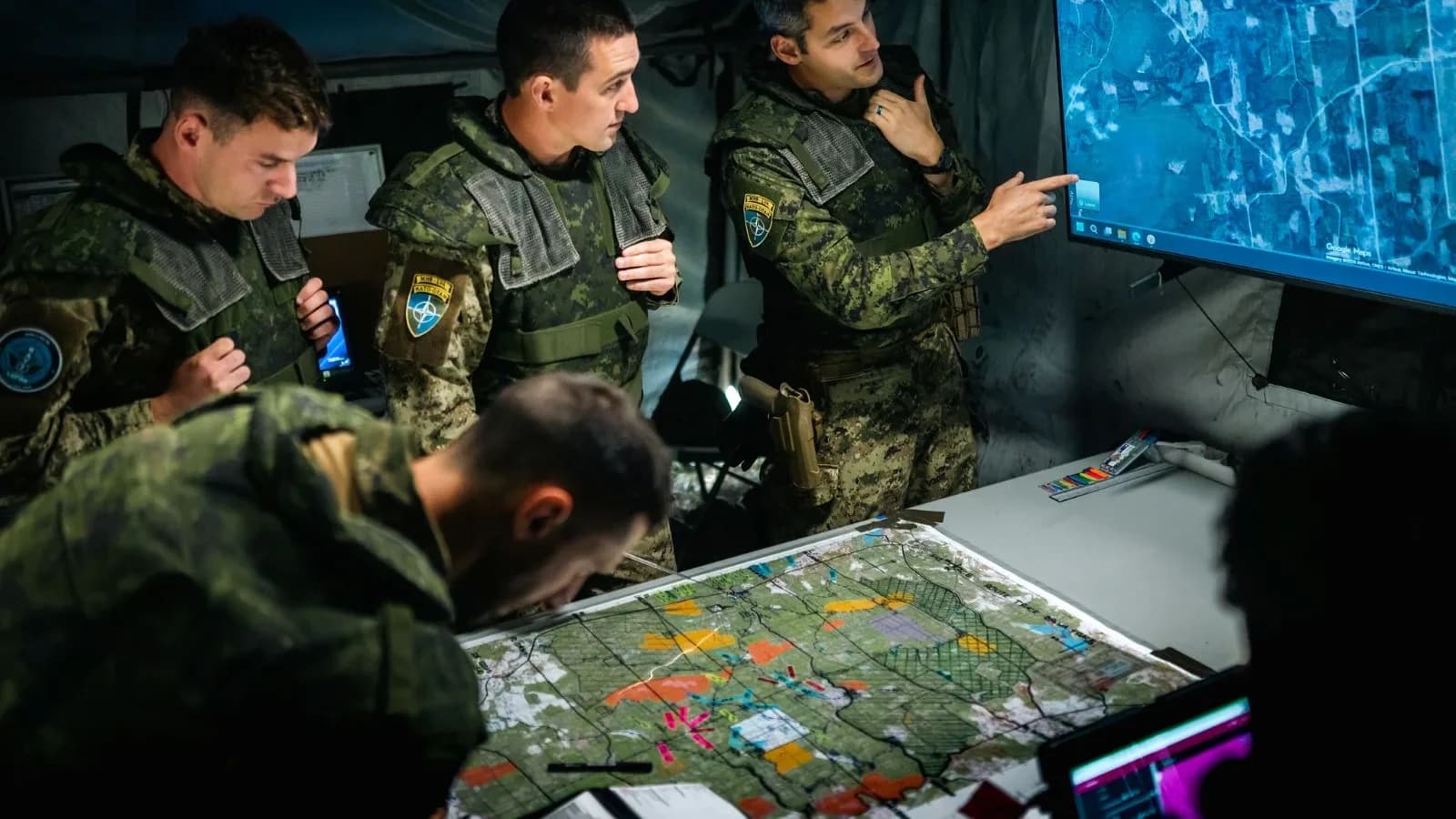
Editorial briefing snapshot
The Bottom Line
The edition distinguishes signed access, funded development, an integration experiment and a facility MOU. Each creates a different next milestone; none should be presented as a complete deployed service.
In context
Canada’s space agreements and Arcanus’ pending acquisition create defined commercial routes. NATO’s targeting experiment supplies a measured AI test design, while Bluebottle’s hybrid exercise tests the power assumptions behind persistent sensing. Rostock’s undersea network and Argentia’s proposed repair facility expose the relationships needed around hardware.
In this edition
Canada puts contracts behind launch access and optical relay
DND adds a ten-year NordSpace spaceport agreement and a two-year Kepler optical-link development contract, alongside full NATO STARLIFT membership.
Three separate pieces of the space operating chain are moving. DND has signed a C$20 million, ten-year agreement for access to NordSpace’s Atlantic Spaceport Complex. It has also awarded Kepler C$4.7 million for two years of development and testing of optical links between satellites. Canada’s full membership in NATO STARLIFT adds an allied coordination route for responsive launch.
These measures address different dependencies. A spaceport agreement secures an infrastructure relationship; it does not by itself provide a qualified launcher or an orbital delivery. An optical network can reduce reliance on repeated ground contacts, but this contract still funds development and test work. STARLIFT concerns access across an alliance, complementing the domestic route. For Canadian suppliers, the practical opportunity lies in the systems and people joining those pieces: payload integration, range and ground operations, communications and mission control. The release also announces a dedicated Space Mission Operator occupation, acknowledging that infrastructure requires an operating workforce.
What remains open
The release does not identify an initial operational launch date under the NordSpace agreement or optical-link acceptance results.
What comes next
Spaceport operating milestones and Kepler’s contracted test results will distinguish access, prototype maturity and usable mission service.
Evidence and assessment for Canada puts contracts behind launch access and optical relay
What the sources establish
DND announced a signed NordSpace access agreement, a Kepler optical communications development contract and Canadian full membership in STARLIFT.
True North Map assessment
The package creates named counterparties and work scopes across launch and in-space communications; none alone establishes end-to-end sovereign launch readiness.
Original source (1)
- National Defence: Minister McGuinty announces strategic advancements for Canada’s sovereign space capabilities (opens in a new tab)Direct record · Signed NordSpace spaceport agreement; Kepler optical links contract; STARLIFT membership
Arcanus pairs a pending acquisition with an immediate joint venture
The signed purchase agreement targets an existing Woodbridge engineering and support operation; the teams can start joint work before ownership transfers.
Arcanus has agreed to buy Infinit Drones, Nested Technologies and their subsidiaries, while appointing founder Pedram Nowroozi chief technology officer. The company describes a 7,000-square-foot Woodbridge operation combining engineering, manufacturing, flight testing, training and support. It also identifies an existing contracted Canadian customer, without naming the customer or order. The acquisition is pending. A separate joint venture takes effect immediately for sales, bids, demonstrations, engineering and production planning.
That separation gives the announcement a concrete near-term mechanism without assuming the purchase has closed. It could connect Arcanus’ licensed partner platforms and market access with a domestic team able to integrate payloads, train operators and repair equipment. Those through-life functions matter for a Canadian buyer assessing more than an aircraft catalogue. Price, closing conditions and scaled production output are not disclosed; the release’s broader claims about sovereign capacity remain the company’s case for the transaction.
What remains open
Purchase price, closing conditions, production output and the unnamed Canadian customer’s order scope are not disclosed.
What comes next
A closing notice and named joint delivery would establish the transferred capacity and how the JV becomes customer work.
Evidence and assessment for Arcanus pairs a pending acquisition with an immediate joint venture
What the sources establish
Arcanus reports a signed purchase agreement for the two Woodbridge companies and an immediately effective JV while the acquisition is completed.
True North Map assessment
The proposed industrial addition spans integration and sustainment as well as the aircraft themselves.
Original source (1)
- Arcanus Aerial Systems / CNW: Arcanus appoints Pedram Nowroozi CTO and agrees to acquire Infinit Drones and Nested Technologies (opens in a new tab)Attributed statement · Signed share purchase agreement, immediately effective JV and Woodbridge operation; acquisition remains pending
Allen-Vanguard reports new ownership after receivership
OPG has taken ownership of the Ottawa electronic-warfare supplier, according to the company, creating a new investment and portfolio route without disclosed financial terms.
Allen-Vanguard says specialist defence investor Operating Partners Group has taken ownership of the company. Its president acknowledges the recent difficult receivership and says the new owners are willing to invest in long-term growth. OPG describes an opportunity to bring capabilities and intellectual property from its European electronic-warfare portfolio into Canada and global markets, and to expand Allen-Vanguard into adjacent signals-intelligence work.
For Canadian customers, the immediate consequence is continuity and ownership of a domestic RF, counter-RCIED and counter-UAS supplier. The future integration case is broader than financing alone: access to complementary technology could change its offering, but no specific transfer, product qualification or funded expansion is announced. The company post displays October 21 while recording October 20 publication metadata. It does not disclose the transaction’s closing date, price or structure. Its ownership statement supports the industrial change; it is not a substitute for uninspected court-sale terms or investment commitments.
What remains open
Price, court-sale terms, new investment amount, jobs commitments and the exact closing date are not disclosed.
What comes next
Specific portfolio transfers and financed product or capacity projects will show how the new ownership affects delivery.
Evidence and assessment for Allen-Vanguard reports new ownership after receivership
What the sources establish
Allen-Vanguard states that OPG has taken ownership; management describes new backing after a receivership process.
True North Map assessment
The Canadian consequence is continuity of an established EW supplier and a potential route to complementary portfolio capabilities.
Original source (1)
- Allen-Vanguard: Allen-Vanguard acquired by defence investment specialist Operating Partners Group (opens in a new tab)Attributed statement · Company ownership statement and receivership account; heading displays October 21; JSON-LD datePublished October 20 22:18:18Z
NATO will measure the targeting workflow before claiming an AI gain
DiBaX26’s Next Generation Targeting trial compares an unaided baseline with AI-supported work, measuring accuracy and workload alongside speed.
The headline ambition is to more than halve the interval between receiving information and making a decision. ACT presents that as a trial objective. Operators first run the targeting cycle without AI, then repeat it with supporting tools; accuracy, decision quality and workload are also measured. The planned scenario spans 11 Allies and five operating countries, with more than 6,000 simulated and 100 live targets.
The deeper interoperability work is a common description of targets, intent, tasks and effects across existing national command systems. NATO is testing whether these systems can participate in a shared workflow while nations retain their systems and human engagement authority. For Canadian C2 and decision-support developers, that is a more useful integration question than whether a product has an AI feature. A connector must preserve meaning, task state and authority as information crosses systems. The October 21 article releases the design of the experiment, without publishing achieved time savings or a fielding decision.
What remains open
Results and measured improvements are not provided in the announcement.
What comes next
An ACT trial readout that publishes the baseline, AI-assisted results and quality trade-offs would support a stronger capability judgement.
Evidence and assessment for NATO will measure the targeting workflow before claiming an AI gain
What the sources establish
ACT describes a baseline-versus-AI trial using a common targeting data model, with speed, accuracy, workload and decision quality measures.
True North Map assessment
Comparative evaluation can expose a faster interface that transfers mistakes downstream; timing needs to be read with the quality and workload measures.
Original source (1)
- NATO Allied Command Transformation: Data to Decision: NATO tests Next Generation Targeting at DiBaX26 (opens in a new tab)Direct record · Common data model; AI baseline comparison; Testing and Measuring the Difference
Argentia’s proposed dry dock still needs an operating company
A three-party MOU links port infrastructure and modular docking technology; a planned operator EOI is the next concrete commercial step.
Mammoet, Port of Argentia and Argentia Capital have agreed to develop a floating dry dock and repair proposal around Tugdock’s modular submersible platform. The partners see a multi-client market spanning commercial shipping, offshore energy, the Coast Guard and Navy. They plan an expression of interest to identify an experienced facility operator.
That operator requirement is central to the industrial case. A suitable harbour and lifting technology do not establish a repair service on their own: the business needs labour, maintenance procedures, customers and responsibility for delivery. The MOU creates a route to develop those arrangements at an existing Newfoundland marine site. It does not announce a funded construction programme, a dock capacity or naval work allocation. The coming EOI should turn the broad facility ambition into a more assessable operating proposition.
What remains open
Investment, docking capacity, construction timing and an operating company are not named.
What comes next
The proposed operator EOI should disclose the service scope and responsibilities needed to judge the project.
Evidence and assessment for Argentia’s proposed dry dock still needs an operating company
What the sources establish
The partners signed an MOU for a modular floating dry dock and marine repair facility and intend to seek a globally recognized operator through an EOI.
True North Map assessment
Canadian marine sustainment capacity depends on a viable multi-client service model as well as the physical dock.
Original source (1)
- Port of Argentia: Mammoet, Port of Argentia and Argentia Capital partner to advance floating dry dock (opens in a new tab)Attributed statement · MOU scope and planned operator Expression of Interest
Undersea protection brings infrastructure operators into the data chain
NATO’s Rostock meeting connects infrastructure owners, public authorities and demonstrators, making data cooperation part of the capability discussion.
NATO’s Critical Undersea Infrastructure Network met in Rostock on October 20–21 with infrastructure operators, Allies, partners and EU representatives. The agenda emphasized practical data sharing, response coordination and resilience. A private-sector demonstration included uncrewed surface and underwater vehicles and mine countermeasure assets.
For Canadian developers, the significance is the buyer and operator mix. A seabed sensor or autonomous platform needs a route for its observations to reach an infrastructure owner and a response authority that can act. The network is one place those interfaces are being discussed. Its published account does not award a contract, name evaluated suppliers or release detection performance. Participation and demonstration therefore establish engagement around the problem, while leaving the actual integration and operational evidence to specific projects.
What remains open
The account provides no comparative technology results or procurement commitments.
What comes next
A public interoperability or operational data-sharing requirement would give suppliers a more precise target than the network’s broad capability agenda.
Evidence and assessment for Undersea protection brings infrastructure operators into the data chain
What the sources establish
NATO reports a Rostock network meeting and technology demonstration covering undersea protection, uncrewed systems and mine countermeasures.
True North Map assessment
The data owner and response authority are part of the system boundary for Canadian undersea protection proposals.
Original source (1)
- NATO: NATO critical undersea infrastructure network focuses on delivering security (opens in a new tab)Direct record · Rostock meeting: operator data exchange and uncrewed/MCM demonstration
Bluebottle’s hybrid trial adds a power question to persistent sensing
Two hybrid USVs enter an allied exercise with acoustic payloads; additional generation addresses low light and higher payload demand, without a published detection result.
Ocius’ October 21 release describes two Bluebottle Hybrid vessels participating in Maritime Big Play Pacific with ThayerMahan acoustic payloads and processing software. The hybrid adds a diesel generator to the platform’s renewable sources, intended to support higher-power payloads and persistent work during low-light periods, including high-latitude winters. The release identifies this as the hybrid variant’s first naval exercise.
That is a useful Canadian comparison for persistent undersea sensing. Endurance cannot be assessed independently of what the vehicle powers, the available environmental energy and the support needed when the generator is used. An exercise can expose those interactions in a shared operating scenario, but participation alone does not establish an acoustic performance envelope or a Canadian Arctic capability. The account names the payload and energy mechanism; it supplies no measured detection range, generator duty cycle or fuel/endurance result. Those are the quantities that would turn the integration story into an operating comparison.
What remains open
No acoustic performance, fuel use or sustained power result is published.
What comes next
A trial readout should connect payload load, generator duty cycle and endurance to the stated operating conditions.
Evidence and assessment for Bluebottle’s hybrid trial adds a power question to persistent sensing
What the sources establish
The attributed Ocius release names two hybrid vessels and their acoustic payloads for the October exercise.
True North Map assessment
An energy budget must include the mission payload and low-light conditions, alongside hull endurance.
Original source (1)
- Ocius / Naval News: OCIUS Bluebottle Hybrid participates in Maritime Big Play Pacific (opens in a new tab)Attributed statement · Attributed release: two hybrid vessels, acoustic payload and additional low-light/payload power