
Canadian Defence Signals
Undersea control and fighter partnerships need distinct proof
Editorial briefing snapshot
The Bottom Line
Read the commitment before assessing the opportunity. A reported trial, an exploratory MOU, a conditional work package, a qualified supplier pool and an open competition each support a different next conversation.
In context
Saab’s Ocean Barrier launch describes a sensor-to-command demonstration. Canadian combat-air industrial proposals, a drone-marketplace qualification and a spacecraft engineering notice place different kinds of work on the table.
In this edition
Ocean Barrier puts the tracked-object handoff at the centre of underwater awareness
Saab’s new surveillance proposition includes a reported exercise handoff from diverse sensors into central command.
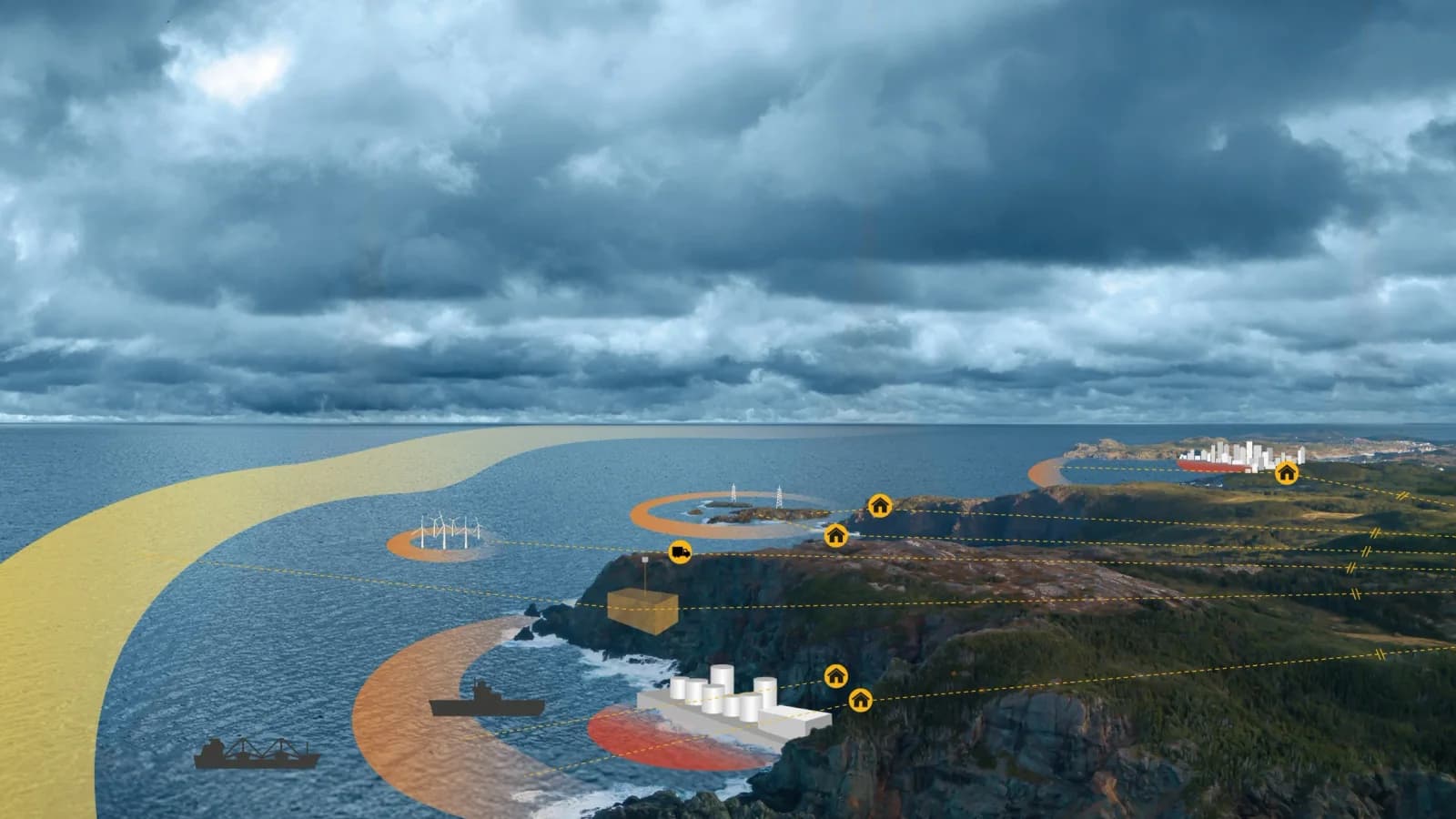
Ocean Barrier’s October 28 launch describes three defensive perimeters—Detect, Prevent and Protect—that can operate separately or together around harbours, offshore assets and coastlines.
The concrete integration claim is from REPMUS 2026. Saab says the system combined diverse sensor inputs and automatically handed tracked objects to the exercise’s central command system through a NATO-standard protocol. That is an attributed demonstration claim, with a more useful boundary than simply saying the sensors are connected.
For Canadian port and infrastructure protection, the comparison is the complete path from a contact to an operator’s decision. Sensor compatibility alone does not establish whether the alert reaches the right authority quickly enough to act. No Canadian purchase or operational deployment is announced.
What remains open
The release does not name the protocol or publish latency, detection or availability results.
What comes next
Ask for the REPMUS interface configuration and measured handoff results.
Evidence and assessment for Ocean Barrier puts the tracked-object handoff at the centre of underwater awareness
What the sources establish
Saab reports an exercise sensor-to-command handoff; the launch is not independent performance validation.
True North Map assessment
A useful evaluation would test the tracked-object handoff alongside false alarms, data ownership and response responsibility.
Original source (1)
- Saab: Saab launches Ocean Barrier for maritime border protection (opens in a new tab)Attributed statement · Three defensive perimeters and REPMUS2026 demonstration paragraphs
Two combat-air industrial propositions have different commitments behind them
Bombardier’s exploratory BAE framework and Saab’s conditional Canadian Gripen work packages should be read at their actual stages.
Bombardier’s October 28 MOU with BAE Systems covers potential cooperation in R&D, systems integration, workforce, supply chains, industrialization and lifecycle management. The next work is to build a practical framework against future requirements and government priorities. Its reference to Canada’s GCAP observer status does not award a Canadian workshare.
Saab’s October 27 announcement is more specific about a proposed industrial chain, but implementation depends on Canada selecting Gripen E. A new IMP teaming agreement covers Canadian final assembly, electrical assembly and in-service support. A Magellan MOU covers aerostructures, composites and structural assemblies. CAE’s earlier agreement addresses training and mission support.
These are useful leads for mapping where engineering and sustainment could sit. Neither announcement is a Canadian fighter order. Comparing the propositions means examining responsibility for interfaces, training and service support, alongside assembly jobs. The Bombardier framework is exploratory; Saab names work packages conditional on a procurement decision.
What remains open
Neither source establishes the resulting Canadian order value or delivery schedule.
What comes next
Look for a defined cooperation scope or a selection-linked contract before treating these plans as committed work.
Evidence and assessment for Two combat-air industrial propositions have different commitments behind them
What the sources establish
Bombardier announces an exploratory MOU; Saab names partners and conditional responsibilities.
True North Map assessment
Industrial participation becomes more assessable when the work package, design responsibility and through-life support are explicit.
Original sources (2)
- Bombardier: Bombardier Signs MOU with BAE Systems to Collaborate Toward Next-Generation Combat Air Programs (opens in a new tab)Attributed statement · MOU scope, next steps and GCAP-observer background
- Saab: Saab Announces Key Partners for Gripen Canada (opens in a new tab)Attributed statement · Conditional partner responsibilities and new IMP/Magellan agreements
49North’s drone-marketplace qualification includes integration and sustainment routes
Qualification across five DDI streams opens a route to compete; it does not announce a new order.
49North’s October 28 release reports admission across all five Defence Drone Initiative Marketplace streams. The scope extends from uncrewed and counter-uncrewed platforms to C2, communications, data, electronic warfare and cyber; engineering and interoperability; testing and training; and experimentation.
For smaller suppliers, that structure shows where a contribution may sit around the vehicle: integration, validation and continuing support are explicit lanes. 49North cites its Canadian military drone-program experience as the foundation for broader participation.
The Marketplace is a qualified supplier pool. The release identifies no new task order, revenue commitment or production quantity. A capability relationship still needs a specific requirement and a deliverable; qualification by itself supplies neither.
What remains open
Timing, scope and value of future awards remain unannounced.
What comes next
Follow the actual competition or task-order scope before matching a supplier to an opportunity.
Evidence and assessment for 49North’s drone-marketplace qualification includes integration and sustainment routes
What the sources establish
The company reports eligibility across five streams for future competitions.
True North Map assessment
The supplier chain includes the engineering and support needed to keep a system useful after its demonstration.
Original source (1)
- 49North: 49North Qualifies Across All Five Streams of Canada’s Defence Drone Initiative Marketplace (opens in a new tab)Attributed statement · Qualification announcement, five streams and forward-looking limitations
HAWCsat opens a Phase A spacecraft-bus and integration competition
CSA’s new notice creates an upstream engineering opportunity, with detailed fit questions still in the solicitation.
CanadaBuys published HAWCsat notice WS5954998755 on October 28. It seeks Phase A services for the spacecraft bus and integration, with offers due December 7 at 14:00 EST. The selection method is highest technical merit within a stipulated maximum budget.
An optional offeror conference is listed for November 6 at 13:00, labelled EDT by the notice. That timezone label warrants confirmation with the contracting authority.
This is a civil space engineering competition with dual-use relevance, not a defence contract or a satellite manufacturing award. The public notice directs bidders to SAP Business Network for the solicitation; instrument interfaces, deliverables and eligibility need to be read there before asserting supplier fit.
What remains open
The public notice does not supply the full statement of work or budget.
What comes next
Read the solicitation and confirm the conference time before investing in bid preparation.
Evidence and assessment for HAWCsat opens a Phase A spacecraft-bus and integration competition
What the sources establish
The official notice confirms Phase A scope, open competition and the December closing time.
True North Map assessment
The integration work deserves attention before a later build award defines the supplier chain.
Original source (1)
- CanadaBuys / Canadian Space Agency: Solicitation of Offers – HAWCsat Spacecraft Bus and Integration Phase A (opens in a new tab)Direct record · Notice description, conference, closing time and selection criteria
LoyalEye’s MQ-9B flight test advances the airborne sensing integration
Saab and GA-ASI report a representative airborne-warning test, with operational employment still to be established.
An October 28 release reports LoyalEye radar integrated with MQ-9B detecting, tracking and classifying airborne targets at GA-ASI’s Desert Horizon facility in Southern California. Stakeholders observed the flight in a representative operational scenario. The evaluation programme began with first flight in May 2026.
The useful advance is the integrated payload exercising its sensing functions in flight. The companies position it as a complement to crewed airborne early warning and control, potentially adding persistence and geographic reach. Those benefits remain programme claims rather than published operational results.
For Canadian readers, sharing an aircraft family does not establish a selected payload configuration. The next integration question is how the resulting tracks reach and remain usable within the wider air picture.
What remains open
No target-specific performance, network-handoff results or Canadian configuration is disclosed.
What comes next
Ask for the tested interfaces and end-to-end track-delivery evidence.
Evidence and assessment for LoyalEye’s MQ-9B flight test advances the airborne sensing integration
What the sources establish
The source is the developers’ flight-test account, not an independent operational evaluation.
True North Map assessment
Persistent sensing becomes useful when track quality, command links and operator workload work together.
Original source (1)
- Saab: Saab and GA-ASI successfully flight test LoyalEye AEW capability on MQ-9B (opens in a new tab)Attributed statement · Desert Horizon flight-test and evaluation-programme paragraphs