
Canadian Defence Signals
Delivery routes, test access and acoustic capacity
Editorial briefing snapshot
The Bottom Line
Getting capability to the point of use requires a delivery chain, a credible place to test and enough industrial capacity. Ask what changed in that chain, what the evidence establishes and which operating condition still needs to be proven.
In context
A Canadian wound-care product reaches Ukrainian medical users, the U.S. Army expands commercial testing access, and GeoSpectrum’s Dartmouth expansion addresses manufacturing and test space. Each exposes a practical dependency between a technology and its use.
In this edition
NanoTess’s Ukraine deployment puts a Canadian medical product inside a contested supply chain
NanoTess reports distribution to more than 6,000 people in Ukraine, including drone delivery. Reported use is a different evidence claim from comparative clinical effectiveness.
The operational problem is getting usable care to an injured person when evacuation and resupply are unreliable. NanoTess’s October 28 announcement describes its NanoSALV wound-and-burn product reaching Ukrainian soldiers and civilians through medical partners, with drone delivery used for frontline access. The company says partners have distributed it to more than 6,000 individuals.
That is a meaningful deployment statement, supported in the release by named clinicians and Ukrainian organizations. It is not a controlled comparison of outcomes. Claims about improved healing or faster return to duty remain attributed testimony; the announcement supplies no comparison group, treatment denominator or quantified recovery result.
The logistics details deserve attention on their own. NanoTess describes a compact, lightweight format and environmental stability. If those characteristics hold under the actual transport and storage conditions, they could reduce the burden on a constrained medical delivery chain. Establishing that fit requires packaging limits, shelf life, handling instructions, training and an accountable clinical protocol. Those requirements sit beside the formulation’s performance.
For Canada’s dual-use ecosystem, the example is a civilian healthcare product finding a role through distribution partners and local users. The next useful evidence would connect delivery conditions and clinical use to independently assessed results. Independent assessment would help determine how that experience transfers to Canadian care and procurement decisions.
What remains open
The release does not provide comparative clinical outcomes or independently audited distribution and frontline-use totals.
What comes next
Look for independent deployment evaluation covering supply conditions, patient follow-up and the product’s place in the existing treatment protocol.
Evidence and assessment for NanoTess’s Ukraine deployment puts a Canadian medical product inside a contested supply chain
What the sources establish
NanoTess’s October 28 issuer release reports Ukrainian medical partnerships, drone delivery and distribution to more than 6,000 individuals.
True North Map assessment
Delivery, storage, training and clinical governance are part of a medical capability; the product cannot be assessed in isolation from that chain.
Original source (1)
- NanoTess / CNW: NanoTess deploys Canadian wound care to Ukraine via drone delivery (opens in a new tab)Attributed statement · Distribution, medical partners, product format and supporting clinician statements
Indiana’s new range access offers an environment for proving a system
Two additional U.S. Army sites now offer commercial testing through a coordinated access process, with capacity limits and scheduling still explicit.
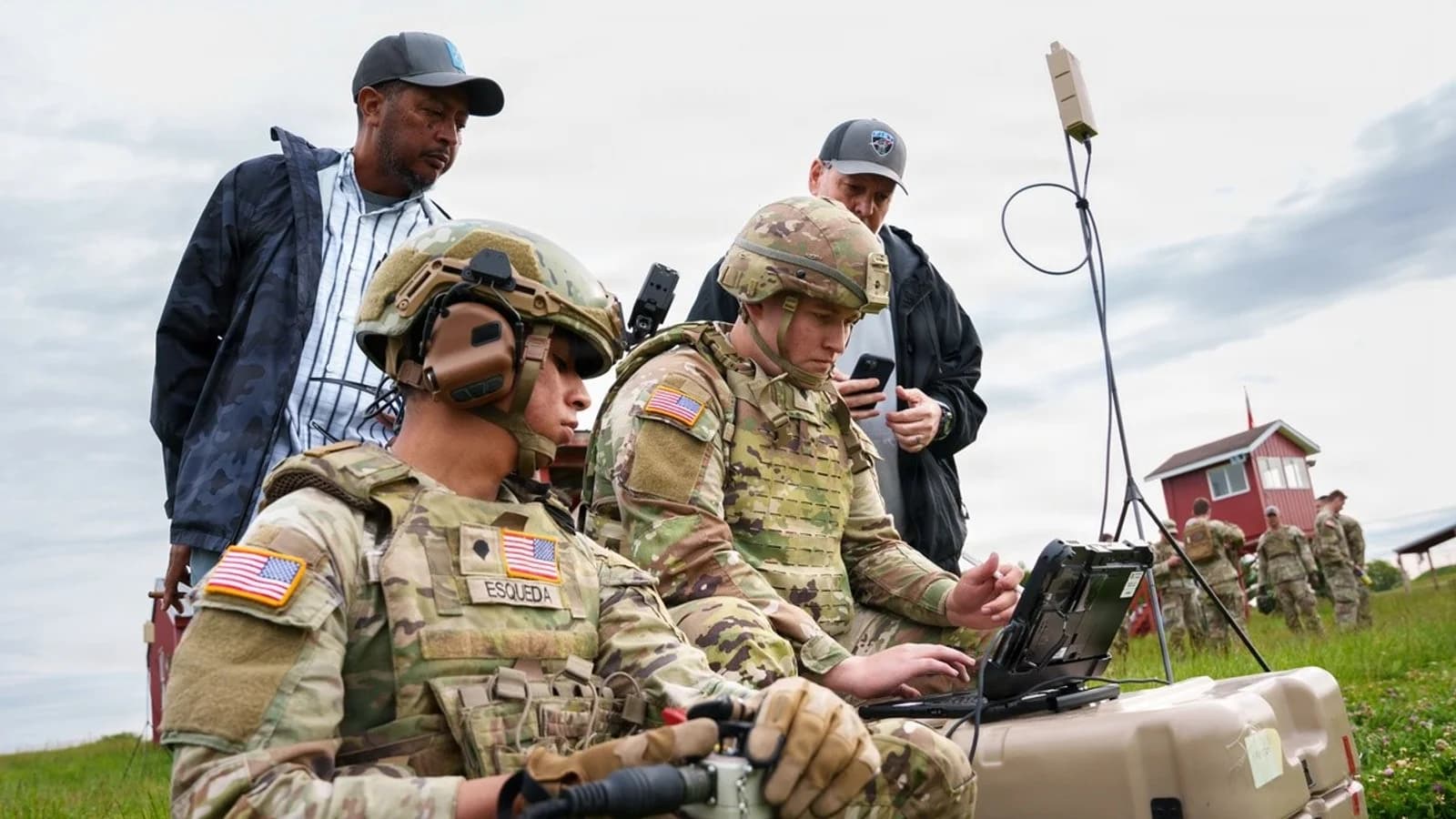
A drone that works above an empty field has not answered the same questions as one navigating around buildings or being tracked inside a defended airspace. The U.S. Army’s October 28 expansion of its permissive-range initiative adds two different environments: Camp Atterbury’s maneuver space and restricted airspace, and Muscatatuck’s configurable urban infrastructure.
The official announcement identifies more than 34,000 acres at Atterbury, with an airspace corridor up to 40,000 feet, and a 1,000-acre urban testing site at Muscatatuck. Vendors request access through the Army test-range portal and work with an ATEC concierge team on requirements and scheduling. A requested location or date is not guaranteed.
The practical change is the access mechanism around existing infrastructure. It gives developers a named route to conditions they may not be able to reproduce commercially. It does not award a purchase contract, certify a system or publish performance results. The release’s emphasis is on American innovators; Canadian companies should establish nationality, export and security requirements before treating it as an accessible opportunity.
Canada can usefully compare the service design: describe the environment, state the constraints, name the intake point and connect testing to evidence the eventual user needs. For any autonomy trial, the test plan should say what is being measured, what constitutes failure and how the result transfers to another operating setting. Range access is valuable when it produces decision-quality evidence, rather than another demonstration video.
What remains open
The announcement does not establish Canadian eligibility, a guaranteed booking, certification or a procurement commitment.
What comes next
Before a vendor commits effort, confirm access and export conditions and agree the test outputs required by its intended user.
Evidence and assessment for Indiana’s new range access offers an environment for proving a system
What the sources establish
The U.S. Army announced commercial testing designations for Camp Atterbury and Muscatatuck on October 28, with portal intake and ATEC scheduling support.
True North Map assessment
A usable test ecosystem pairs physical conditions with a clear access route and measurable user questions.
Original source (1)
- U.S. Army Public Affairs: Army expands permissive testing to Indiana National Guard sites (opens in a new tab)Direct record · Site capabilities and reservation process; publication date has day precision
GeoSpectrum’s Dartmouth expansion targets the space behind acoustic production
An overlooked October 26 announcement commits C$225,000 in repayable support to manufacturing, engineering and test-space improvements, alongside a broader expansion.
More sonar demand becomes an industrial constraint when engineering, assembly and testing compete for the same rooms. ACOA’s October 26 GeoSpectrum announcement addresses that physical part of scaling: C$225,000 in repayable support to reconfigure and modernize the company’s Dartmouth facility. We are recovering this development after the earlier edition’s publication.
The release describes a broader expansion expected to create 40 full-time jobs. It reports approximately 300 current employees and an intention to occupy roughly 104,000 square feet by year end, up from 81,000 in 2025. The federal amount is support for a defined facility project; it is neither the full expansion cost nor an order for acoustic systems. Planned jobs and floor area should remain plans until realized.
The immediate reader question is what the additional space enables. Hydrophones, transducers, sonar processing and complete sensing systems have different fabrication, calibration and acceptance needs. The release does not disclose a production-rate increase, a test-throughput target or the division of new space among those functions.
For customers and potential collaborators, the useful next conversation is therefore about available engineering and test capacity, delivery lead times and configuration responsibility. This expansion could ease a bottleneck in an important local subsea supply chain, but its effect on a specific programme needs evidence from the work being delivered.
What remains open
Public material gives no production-rate, calibration-capacity or delivery-lead-time improvement and does not identify the complete expansion cost.
What comes next
Ask which manufacturing and test bottlenecks the reconfiguration removes and what delivery or acceptance capacity changes after completion.
Evidence and assessment for GeoSpectrum’s Dartmouth expansion targets the space behind acoustic production
What the sources establish
ACOA announced C$225,000 of repayable REGI support on October 26 for GeoSpectrum facility improvements and described planned workforce and floor-space expansion.
True North Map assessment
Manufacturing and test capacity can be a dependency in scaling an acoustic system; funding alone does not quantify the resulting output.
Original source (1)
- Atlantic Canada Opportunities Agency: GeoSpectrum expands Dartmouth manufacturing and testing space (opens in a new tab)Direct record · Funding amount, project scope and Quick facts
Carry the signal forward
Continue in True North Map
Follow the edition into the organizations, technologies, Defence needs and Mission areas already connected to its record.