
Canadian Defence Signals
Surface relays, machine vision and the first production tranche
Editorial briefing snapshot
The Bottom Line
Look at the specific constraint each contribution addresses: underwater reporting, visual awareness, repeat production or satellite-independent motion measurement. Trial success, order options and development ambitions deserve different weights.
In context
Two REPMUS reports make different parts of maritime autonomy visible: an acoustic bridge for a mine-identification vehicle and a perception layer shared across several hulls. Canadian announcements add an initial aircraft order and new capital for inertial sensing.
In this edition
A surface drone keeps the mine-identification vehicle connected
MarinerX and CORAX 600 paired surface communications and position correction with close-range underwater inspection.
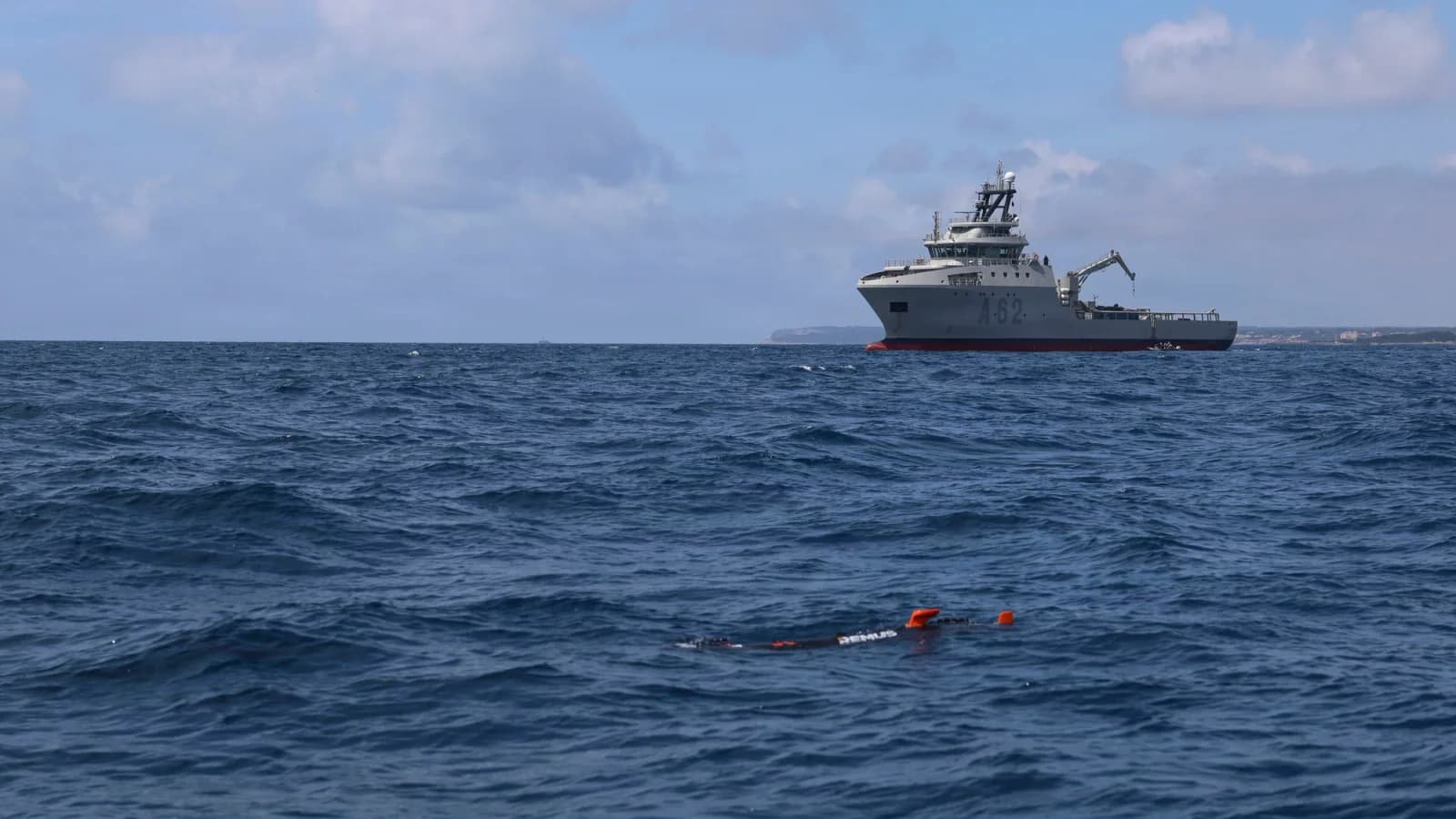
Skarv’s October 2 REPMUS account explains how its CORAX 600 hovering AUV worked with Maritime Robotics’ MarinerX surface vessel. The USV followed the underwater survey, supplied acoustic position corrections from its surface GNSS reference, and relayed status, contacts and retasking to shore through LTE and satellite links. CORAX is designed to process observations onboard and send contact reports, reducing the need to move raw imagery through the narrow underwater acoustic link.
The companies report successful combined operations and show a close-range optical image of a practice target. Their nine-metre surface vessel and 600-metre-rated hovering AUV can be moved by trailer or container and launched from a small slipway, an operating model that reduces dependence on a dedicated mother ship. This was the pair’s second deployment after June refinery-protection work in Norway.
The practical Canadian comparison is expeditionary mine identification and harbour or infrastructure inspection by a small team. The report describes the navigation and data handoffs clearly; it does not establish mine clearance or automatic neutralisation. Its surface-GNSS and shore-link dependencies remain relevant when choosing the operating area.
What remains open
Mine neutralisation and performance with unavailable GNSS or shore links are not established in this account.
Evidence and assessment for A surface drone keeps the mine-identification vehicle connected
What the sources establish
Skarv reports combined MarinerX/CORAX 600 operations, acoustic position correction and a shore communications relay, with practice-target imagery.
True North Map assessment
A surface node can make a compact underwater inspection vehicle usable from shore by carrying the positioning and radio links it lacks underwater.
Original source (1)
- Skarv Technologies: Skarv Technologies and Maritime Robotics Unlocked the Depths at NATO Exercise REPMUS 2026 (opens in a new tab)Attributed statementOctober2,2026 article: surface positioning/acoustic relay, LTE/satellite shore path, CORAX identification and trial boundary; entire body inspected.
FPDynamics reports 100 tactical ISR systems, with scale still optional
The Toronto supplier announces an initial 100-system order and options for 4,900 more; the C$25 million figure is a multi-supplier framework ceiling.
FPDynamics says it has won a five-year Canadian contract for low-cost tactical ISR aircraft under the Defence Drone Initiative. Its October 2 release identifies 100 initially ordered systems, plus options for up to 4,900 additional systems at the government’s discretion. The stated framework value, up to C$25 million, covers the suppliers selected under that procurement rather than a guaranteed FPDynamics purchase.
The initial tranche can put a production design in operators’ hands while leaving subsequent scale conditional. FPDynamics describes FP-X as a modular aircraft designed for surge manufacturing and says its approach is being patented. Those are manufacturer statements; the release supplies no accepted-delivery schedule or operational test results. The commercially consequential number today is the initial 100, with option exercise and repeatable output the evidence that could turn an award into sustained production.
What remains open
The inspected issuer release does not give accepted deliveries, per-system pricing or an exercised option.
What comes next
Actual accepted initial deliveries and later government option exercises would establish the production ramp.
Evidence and assessment for FPDynamics reports 100 tactical ISR systems, with scale still optional
What the sources establish
FPDynamics announces an initial 100-system order, optional 4,900 systems and a shared C$25 million procurement ceiling.
True North Map assessment
The order creates a route from a low-cost design into user evaluation and repeat manufacturing, while leaving volume risk with the supplier.
Original source (1)
- FPDynamics: FPDynamics Awarded Canadian Defence Contract for Tactical ISR Uncrewed Aircraft Systems for up to5,000 Systems (opens in a new tab)Attributed statementOctober2,2026 issuer release: initial100, options4900, framework scope and production claims. Attributed announcement, not independent acceptance record.