
Canadian Defence Signals
Readiness takes shape in airfields, workshops and working capital
Editorial briefing snapshot
The Bottom Line
The commercial opportunity is widening with that work. It includes engineering, servicing, maintenance, workforce development and the working capital that lets suppliers fulfil orders. Today’s new platforms and financing announcements sit beside a harder question from the AIA–Bain investment study: can capital reach the production stages and smaller suppliers where capacity is constrained? Progress becomes more convincing when the announcement identifies the next piece of work, the people who will use it and the conditions for getting it delivered.
In context
The infrastructure around a capability is becoming easier to see. Rankin Inlet has new funding for the airfield that serves communities and military operations. Kelowna is preparing utilities for future aerospace and industrial tenants. In Saskatchewan, an expanded aviation training centre has opened; at Gastops, a naval machinery-monitoring evaluation includes the installation, training and technical support needed to put the equipment to work. These are different stages of delivery, but each addresses something a larger fleet or faster-growing industry will depend on.
In this edition
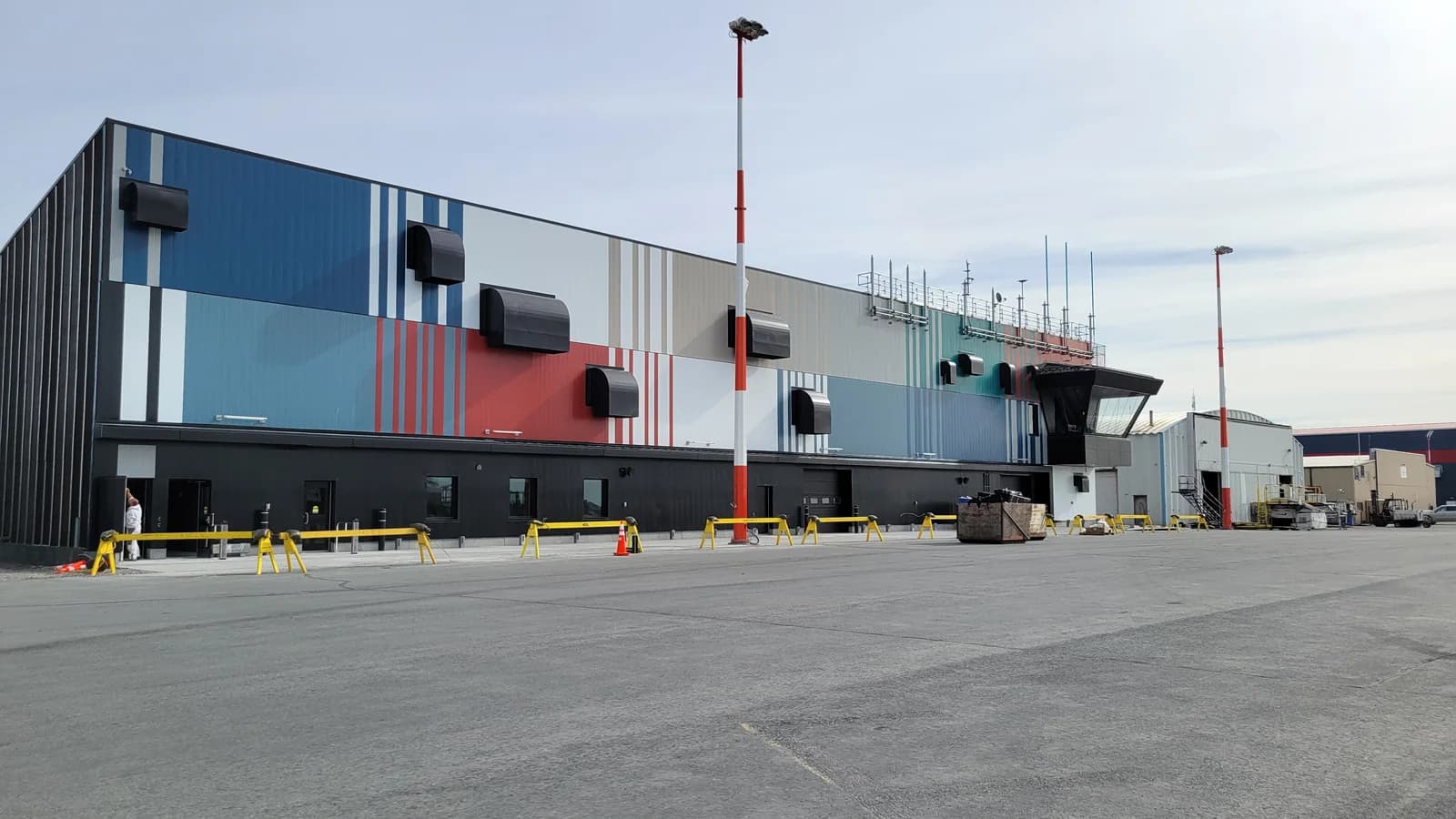
Rankin Inlet connects Arctic readiness to a working community airport
C$85.5 million for airfield rehabilitation addresses the shared infrastructure behind northern transport, emergency services and military access.
A runway that remains dependable serves several missions at once. At Rankin Inlet, the same airport moves food, medical supplies and passengers while supporting Canadian military access to the North. Transport Canada’s September 28 announcement puts C$85.5 million from the Arctic Infrastructure Fund into rehabilitating the airfield.
The scope is unusually tangible: roughly 141,000 square metres of runway, taxiway and apron pavement, with an intended service-life extension of 15–20 years. For engineering and construction firms, that points toward a defined rehabilitation job and the northern logistics needed to deliver it. For operators, the value lies in sustaining access through infrastructure that civilian users also depend upon.
Two milestones sit inside the announcement. Ministers celebrated the new terminal’s opening; the airfield rehabilitation is the newly funded work ahead. Earlier terminal funding and DND’s runway investment are separate contributions. Adding them indiscriminately would obscure which capacity is already available and which still has to be delivered.
That distinction is worth carrying into the wider Arctic buildup. More aircraft and more ambitious operating plans require dependable places to land, unload, maintain and turn around. Community infrastructure is part of that operating system.
What remains open
The release does not give a construction schedule, procurement packages or a contractor award.
What comes next
Watch the Government of Nunavut’s procurement notices for pavement works, staging and operating-continuity requirements.
Evidence and assessment for Rankin Inlet connects Arctic readiness to a working community airport
What the sources establish
Transport Canada announced C$85.5 million for Rankin Inlet’s airfield rehabilitation and celebrated the separately funded terminal opening.
True North Map assessment
Civilian and defence demand can support the same durable asset. Rehabilitation can improve the reliability of the access on which both depend.
Original source (1)
- Transport Canada: Canada invests $85.5 million in Rankin Inlet airfield rehabilitation (opens in a new tab)Attributed statement · Article body
Kelowna’s aerospace expansion starts below ground
Up to C$22.4 million would remove utility constraints on airport industrial land before new aerospace facilities can be built.
Water, sewers, power and communications can determine whether an industrial expansion is possible. The Kelowna airport announcement directs up to C$22.4 million toward servicing the East Lands, including an initial phase covering about 90 acres within a wider area of more than 165 acres.
The land is intended to accommodate aviation, logistics, manufacturing, technology and training facilities. Those uses need utilities before an employer can make a credible decision about a hangar, workshop or production building. The opportunity reaches well beyond an aircraft manufacturer: civil engineering, electrical distribution, communications and facilities delivery all sit ahead of the eventual tenant.
Canadian Defence Review’s account preserves an important condition: the contribution agreement still has to be signed, with applicable consultation and environmental requirements fulfilled. The announcement opens a path to developable land; it does not identify new tenants or establish that construction has begun.
What remains open
Named tenants, construction timing and the final contribution agreement are not supplied in the announcements reviewed.
What comes next
For a prospective tenant, the useful questions for YLW are servicing dates, available utility capacity and lease-ready parcels.
Evidence and assessment for Kelowna’s aerospace expansion starts below ground
What the sources establish
The announced federal contribution is up to C$22.4 million for airport utility infrastructure, subject to a contribution agreement and applicable conditions.
True North Map assessment
Serviced land can shorten the path from an expansion decision to a usable facility, creating opportunities for infrastructure firms alongside aerospace tenants.
Original sources (2)
- Canadian Defence Review: Canada invests $22.4M in Kelowna airport aerospace infrastructure (opens in a new tab)Attributed statement · Article body
- Kelowna International Airport via Skies: Kelowna International Airport receives up to $22.4M for infrastructure improvements (opens in a new tab)Attributed statement · Article body
Gastops takes continuous machinery monitoring into a naval evaluation

An ISC testing contract puts FluidSIGHT into a supported evaluation with DND, including laboratories and vessels in Atlantic Canada.
A machinery fault is most useful when it becomes visible early enough to act. Gastops says its new Innovative Solutions Canada contract will evaluate FluidSIGHT with DND for Royal Canadian Navy maintenance applications. The system monitors lubricant condition, contamination and signs of machinery wear continuously, addressing the intervals between conventional oil samples.
The evaluation includes laboratories in Ottawa and Montréal and marine vessels in Atlantic Canada. Gastops will supply the hardware and software as well as installation support, training and technical expertise. That support package makes the work more revealing than a sensor demonstration alone: it creates a setting in which crews and maintainers can test whether the information is useful in an actual maintenance routine.
An alert only changes readiness if somebody can interpret it and make a better decision about inspection, repair or continued operation. The valuable result would therefore be evidence that FluidSIGHT helps maintainers act earlier without creating an unmanageable stream of nuisance warnings. Those outcomes have yet to be reported.
TNM’s Gastops profile and condition-intelligence capability provide the broader company context. This is a distinct naval testing development from the company’s recently reported Vestas agreement.
What remains open
The contract value, participating ships, evaluation thresholds and results are not disclosed in the release.
What comes next
Look for the evaluation’s maintenance findings: useful warning time, false alerts and how the data enters work orders or inspection decisions.
Evidence and assessment for Gastops takes continuous machinery monitoring into a naval evaluation
What the sources establish
Gastops reports an ISC Testing Stream contract for a DND/RCN evaluation, with equipment, installation, training and technical support.
True North Map assessment
Condition data becomes operationally valuable when it changes a maintenance decision. The evaluation can expose the integration and support work needed to get there.
Original source (1)
- Gastops: Gastops FluidSIGHT selected for Royal Canadian Navy evaluation through Innovative Solutions Canada (opens in a new tab)Attributed statement · Article body
An opened training centre makes a procurement benefit tangible

SIIT’s expanded aviation centre gives Boeing’s C$17 million industrial-benefits investment a physical training venue.
The expanded Saskatchewan Aviation Learning Centre opened on September 25. Boeing and the Saskatchewan Indian Institute of Technologies describe upgraded classrooms, an avionics laboratory and more hands-on training space, including support for SIIT’s new avionics maintenance program.
The expansion draws on Boeing’s C$17 million investment in SIIT’s programs, services and operations, associated with Canada’s CP8A Poseidon procurement. That amount is the broader investment, not a stated construction price for this building.
There is a practical connection here between buying aircraft and sustaining an aviation workforce. Students need equipment, instructors and access to hands-on work before they become the technicians employers require. SIIT’s focus on Indigenous learners also broadens who can reach those careers. An opened centre gives that ambition a place to happen; graduate completion and employment will show how much workforce capacity follows.
See Boeing Canada and its manufacturing and sustainment capability for the wider industrial relationship.
What remains open
The release does not quantify incremental annual graduates or placement outcomes.
What comes next
Training partners and employers can look for the avionics program’s intake, practical-placement needs and graduate outcomes.
Evidence and assessment for An opened training centre makes a procurement benefit tangible
What the sources establish
SIIT and Boeing celebrated the expanded centre’s opening on September 25; the supporting C$17 million ITB investment covers SIIT programs, services and operations.
True North Map assessment
Procurement benefits can strengthen shared workforce capacity when they fund accessible, practical training connected to employer demand.
Original source (1)
- Boeing Canada: SIIT and Boeing celebrate expanded Saskatchewan Aviation Learning Centre (opens in a new tab)Attributed statement · Article body
Juno’s new platforms put disconnected operation at the centre of the pitch
GUARDIAN and LOGAN bring a Canadian sensor-and-command proposition into pre-commercialization, with degraded connectivity a central design claim.
Juno Industries’ GUARDIAN and LOGAN launch is aimed at a familiar operational problem: collecting useful information when connectivity and satellite navigation cannot be assumed. GUARDIAN combines a distributed sensor mesh with processing at the edge; LOGAN fuses information into an operating picture and is also offered as a standalone software platform.
On its product page, Juno describes GUARDIAN as able to operate disconnected and independently of GPS, with a modular approach to new sensors. The announcement says foundational research and beta field testing are complete and the platforms are entering pre-commercialization. An earlier version was tested by the Canadian Armed Forces, but the announcement supplies no published test results.
The interesting question for a northern site or dispersed operation is what remains useful locally when the wider network disappears. That includes how information is time-stamped, stored, presented to an operator and reconciled when links return. A coherent local picture could have value well before every node can communicate with headquarters. Demonstrating those behaviours under representative conditions is the work that can turn Juno’s architecture into operator confidence.
What remains open
Published performance data, customer acceptance, environmental limits and commercial delivery terms were not found in the launch material.
What comes next
A useful demonstration would deliberately remove connectivity and GPS, then show the operator picture and recovery of synchronized data.
Evidence and assessment for Juno’s new platforms put disconnected operation at the centre of the pitch
What the sources establish
Juno announced GUARDIAN and LOGAN after foundational R&D and beta testing, identifying pre-commercialization as the current stage.
True North Map assessment
A system designed to retain local usefulness during disconnection may fit remote security and Arctic operations, subject to representative testing.
Original sources (2)
- Canadian Defence Review: Juno Industries unveils GUARDIAN and LOGAN defence platforms (opens in a new tab)Attributed statement · Article body
- Juno Industries: Juno Industries: GUARDIAN and LOGAN (opens in a new tab)Attributed statementGUARDIAN System and LOGAN PLATFORM product sections
Draganfly brings a component supplier onto the financing side

The announced US$10 million equity financing links production ambitions with a strategic component supplier; closing was expected around today.
Draganfly’s September 28 release names Unusual Machines and an unnamed U.S. investment fund as equal US$5 million investors. The registered direct offering comprises 1,869,159 shares at US$5.35, for approximately US$10 million in gross proceeds before expenses. Closing was expected on or about September 29, subject to customary conditions.
Unusual Machines brings a component-supply relationship as well as money. Steve Ladurantaye’s reporting in Vanguard Defence examines that connection as Draganfly expands its defence activity. The issuer says proceeds will support capability development and working capital; the investment is financing, separate from customer orders.
For a growing hardware company, those functions are closely connected. Components, inventory and production preparation absorb cash before a finished system earns revenue. A supplier with an equity interest may have stronger reasons to coordinate that ramp, although this announcement contains no guaranteed component allocation or delivery improvement. TNM’s Draganfly profile and integrated uncrewed-systems capability give the company context.
What remains open
A closing confirmation and binding supply commitments were not present in the material reviewed.
What comes next
Check the closing release and securities filing before treating the proceeds as received; subsequent production disclosures would show what the relationship enables.
Evidence and assessment for Draganfly brings a component supplier onto the financing side
What the sources establish
Draganfly announced approximately US$10 million in gross equity proceeds, with a conditional closing expected on or about September 29.
True North Map assessment
Strategic investment can help align a component supplier with a manufacturer’s expansion and working-capital needs.
Original sources (2)
- Draganfly: Draganfly announces strategic investment from Unusual Machines and a U.S. investment fund (opens in a new tab)Attributed statement · Article body
- Vanguard Defence: Draganfly strategic investment reporting (opens in a new tab)Original reporting · Article body
The financing gap is between promising technology and dependable production
A new U.S. study identifies where investment struggles to reach the industrial base; a Canadian partnership targets an earlier part of that journey.
There can be plenty of investor interest in defence and still too little money reaching a supplier that needs a new machine, a second shift or a first production line. That is the useful distinction in the AIA–Bain study released September 28. Its interviews and industry research identify constraints in essential components and in the transition from prototypes to scaled production.
The full report describes smaller suppliers struggling to finance expansion without firm orders, alongside companies whose production risk fits neither early venture funding nor mature institutional investment. It also places responsibility on industry: delivery, quality and cost performance affect the willingness of customers and investors to commit. Valerie Insinna’s reporting adds the association’s explanation of why different pools of capital require different conditions.
Canada has a related, earlier-stage initiative worth connecting to this finding. MaRS and Vimy Forge’s September 22 partnership combines defence and procurement expertise with investor-readiness support and capital connections. It is a referral and development pathway; the announcement does not establish a new investment fund or guaranteed procurement.
Together, these point to a more demanding test of an industrial strategy: can a technically credible firm reach a buyer, finance its first repeatable production and keep delivering? Introductions can help at the start. Funded demand, realistic margins and demonstrated execution become decisive further along. The American findings offer questions for Canada to investigate, rather than a measurement of the Canadian financing gap.
What remains open
The study does not measure Canada’s gap, and the MaRS–Vimy announcement supplies no completed investment or procurement outcomes.
What comes next
Founders using the MaRS–Vimy pathway can identify the specific technical, customer or production milestone that would make their next financing credible.
Evidence and assessment for The financing gap is between promising technology and dependable production
What the sources establish
AIA and Bain published their U.S. investment study on September 28. MaRS and Vimy Forge announced their Canadian venture-support partnership on September 22.
True North Map assessment
A capital headline says little about whether the constrained supplier can finance the capacity a program actually needs.
Original sources (3)
- Aerospace Industries Association: U.S. defence investment gap reflects market barriers: Bain and AIA (opens in a new tab)Attributed statement · Article body
- Breaking Defense: As private investment in defense increases, some bottlenecks in funding: AIA-Bain (opens in a new tab)Original reporting · Article body
- MaRS Discovery District: MaRS and Vimy Forge partner to build a capital pipeline (opens in a new tab)Attributed statement · Article body
Sentinel’s battlefield factory has a first field-test story

Reporting on ForgeX adds a field-test account and a next-build milestone to the previously announced consortium and financing.
A deployable printer still needs power, material, approved designs and a way to establish that a finished part is usable. Steve Ladurantaye’s September 22 interview in Vanguard Defence explores how Sentinel Advanced Military Solutions is assembling those functions within StarForge.
The company describes an August exercise in California in which a team printed drone chassis, assembled components supplied in kits and flew missions with a partner unit over two weeks. Its next version was targeting production around mid-October. This is new operational detail alongside the consortium and industrial-benefits funding covered previously, rather than another presentation of the funding announcement.
ForgeX’s proposed value is the combination of manufacturing, onboard power, quality management and a controlled library of designs. In a remote operating location, that combination could make some replacement work possible closer to the point of need. The boundary matters: printing a chassis does not establish that every mission-critical part can be produced, inspected or authorized in the field.
TNM links the Sentinel AMS profile to edge manufacturing and digital stockpiles. This is Sentinel Advanced Military Solutions, a separate company from Sentinel R&D.
What remains open
The interview does not provide an independent test report, an approved-parts catalogue or customer acceptance.
What comes next
The next build should clarify which parts and processes are qualified, what inputs still need resupply and who authorizes field-made components.
Evidence and assessment for Sentinel’s battlefield factory has a first field-test story
What the sources establish
Vanguard’s interview reports Sentinel’s account of a two-week August field test and a second-generation build targeted for mid-October.
True North Map assessment
The support system around a printer determines whether local manufacturing can become a dependable sustainment option.
Original source (1)
- Vanguard Defence: Inside Sentinel’s bet on the battlefield factory (opens in a new tab)Original reporting · Article body
Britain gives submarine maintenance its own industrial commitment
Three floating docks for Clyde will go through a UK-only competition, placing maintenance facilities inside the shipbuilding agenda.
The UK government’s September 28 shipbuilding announcement commits to three floating docks for HM Naval Base Clyde under Programme Euston. They are intended to support inspections, upgrades and repairs for current and future nuclear submarines, with a UK-only competition for their construction.
This is an industrial decision about the facilities around a fleet. More boats create more demand for docking and specialist work; inadequate capacity can limit the availability of equipment already purchased. Canada’s submarine planning involves different technology and requirements, but the underlying capacity question travels: which maintenance facilities, workforce and support arrangements must be ready alongside the fleet?
The domestic competition also sets a clear commercial boundary. The announcement should not be read as an open Canadian shipyard opportunity. Its immediate Canadian value is as an allied benchmark for planning and funding through-life support.
What remains open
The announcement does not identify a winning yard, individual dock prices or delivery dates.
What comes next
The competition documents and eventual award should reveal the delivery sequence and technical scope; those are the useful planning comparisons.
Evidence and assessment for Britain gives submarine maintenance its own industrial commitment
What the sources establish
The UK announced a domestic competition for three Clyde floating docks under Programme Euston.
True North Map assessment
Maintenance infrastructure is a capital requirement in its own right and can determine how much availability a larger fleet delivers.
Original source (1)
- UK Government: Government backs British shipbuilding and submarine maintenance docks (opens in a new tab)Attributed statement · Article body
A counter-drone award turns on fitting the vehicle
A reported US$15.7 million Marine Corps award illustrates why integration constraints can decide a counter-drone purchase.
Drew F. Lawrence reports in DefenseScoop that the U.S. Marine Corps awarded US$15.7 million for Anduril’s Pulsar-Lite, with deliveries expected to begin in January. The intended host is the Amphibious Combat Vehicle.
The revealing detail is the buyer’s stated constraint: an electronic-warfare capability had to fit the vehicle’s available space, weight and power without undermining mobility. According to the award-notice reporting, this was central to the sole-source rationale. For Canadian counter-drone developers and integrators, it is a concrete reminder that a convincing effect has to fit somewhere, draw power from something and coexist with the host platform’s other functions.
The article establishes a reported purchase and delivery plan, not fielded performance across the vehicle fleet.
What remains open
The reported notice does not disclose the number of systems. Operational results after vehicle integration remain ahead.
What comes next
Use the January delivery milestone to look for integration and acceptance reporting, rather than assuming the award means fleet-wide protection is in place.
Evidence and assessment for A counter-drone award turns on fitting the vehicle
What the sources establish
DefenseScoop reports a US$15.7 million award for Pulsar-Lite integration into the Marine Corps’ ACV fleet.
True North Map assessment
Host-platform constraints belong in the product requirements from the start; they can shape which available technology a buyer can actually use.
Original source (1)
- DefenseScoop: Marine Corps awards Anduril nearly $16M for Pulsar-Lite EW system (opens in a new tab)Original reporting · Article body
Starship delivers satellites while the operating model is still being proven
The first orbital Starship deployment adds a real delivery milestone, with recovery and repeatability still central to the commercial question.
Marc Boucher reports in SpaceQ that Starship Flight 14 reached orbit on September 28 and deployed 26 Starlink V3 satellites. An engine shutdown prompted a hold before the orbital decision, and the mission finished after roughly two orbits with a Pacific splashdown. SpaceX expected the satellites to begin serving customers within weeks.
It is a substantial step from test payload deployment toward adding communications capacity. For Canadian users and companies building services around satellite connectivity, launch throughput is one part of the supply picture; usable service also depends on satellite commissioning, terminals, ground infrastructure and access arrangements.
The longer-term cost and cadence proposition still rests on repeatable operations and reuse. This flight supplies a concrete milestone without settling that larger economic case.
What remains open
This flight does not establish routine launch cadence, full vehicle reuse or a delivered improvement for a particular Canadian customer.
What comes next
Watch satellite commissioning and subsequent flight turnaround to distinguish added payloads from sustained service capacity.
Evidence and assessment for Starship delivers satellites while the operating model is still being proven
What the sources establish
SpaceQ reports Starship’s first orbital flight and deployment of 26 operational Starlink V3 satellites on September 28.
True North Map assessment
A higher-throughput launch system could change the pace at which communications capacity is added, once repeatable operations and service commissioning follow.
Original source (1)
- SpaceQ: SpaceX’s Starship Flight 14 reaches orbit, delivers Starlink satellites (opens in a new tab)Original reporting · Article body
Carry the signal forward
Continue in True North Map
Follow the edition into the organizations, technologies, Defence needs and Mission areas already connected to its record.