
Canadian Defence Signals
Signed, funded, launched: delivery is now the story
Editorial briefing snapshot
The Bottom Line
titanium capacity; new test infrastructure shortens the path from robotics concepts to evidence. At the same time, enterprise AI, frigates, layered air defence and an orbital-debris launch contract pull integration and service commitments into view.
The pattern matters because advantage now depends on the handoffs: infrastructure into access, capital into repeatable output, prototypes into accepted systems, and contracts into training, sustainment and operational use. Canadian teams should map the link they can own, identify the proof the next buyer will require and build relationships with the organizations controlling the following stage.
In context
Across these eight developments, defence delivery is advancing through connected layers rather than isolated products. Arctic port cooperation opens a logistics lane; targeted funding and task orders expand Canadian textile and U.S.
In this edition
FELLFAB funding puts defence-textile capacity on the factory floor
A $600,000 FedDev Ontario contribution supports a $2.16 million FELLFAB production-modernization project aimed partly at growth in aviation, rail and defence markets.
A modest federal contribution puts a measurable production task behind a broad tariff-response package. FedDev Ontario records a $600,000 contribution to FELLFAB within a $2,155,808 project to improve production, modernize operations and grow in aviation, rail and defence. The defence signal is specialized high-performance textile capacity, not the headline value of the nine-company package.
This narrows the question from whether support exists to what the factory can produce after the upgrade. The official backgrounder does not identify equipment, added throughput, qualification standards, jobs, defence customers, purchase orders or delivery dates. Verify the installed capability and accepted output before treating the contribution as new defence supply.
What the public record says
FedDev Ontario lists FELLFAB Limited for a $2,155,808 project with a $600,000 federal contribution to improve production, modernize operations and grow in aviation, rail and defence.
Why this may matter
The contribution targets a specific industrial-capacity step in a Canadian specialized-textile manufacturer, but the defence value will be established by qualified output and customer acceptance rather than funding alone.
Evidence limits
The backgrounder does not identify the equipment, throughput increase, qualification standards, workforce effect, defence customers, purchase orders, delivery dates or expected production volume.
Practical next step
Verify the installed equipment, production throughput, relevant qualifications and accepted defence orders after the project work is complete.
Original source (1)
- Federal Economic Development Agency for Southern Ontario: Nine Hamilton businesses receive Government of Canada support to strengthen Canadian supply chains and drive growth (opens in a new tab)Recipient table, FELLFAB Limited row, and introductory package paragraph
Army funding ties titanium scale to an acceptance test
A funded U.S. Army task order moves domestic titanium from general capacity building toward named powder-to-part work packages, finished components and planned government acceptance.
An $18.5-million U.S. Army task order turns titanium sovereignty into a production program with named work packages. IperionX says $11.5 million is obligated to expand continuous powder-to-part processing, add dehydride capacity and bring fastener finishing in-house at its Virginia facility. Inspection and acceptance are planned at Detroit Arsenal and Aberdeen Proving Ground for track pins, bolts and fasteners.
The Canadian decision is where domestic critical-mineral ambition should connect to finished, accepted defence parts. This award does not validate throughput, cost reduction or accepted output, and $6.9 million in options remains unfunded. Map Canadian material, machining and qualification capabilities against the powder-to-part chain now, then track the first acceptance evidence before treating the U.S. model as proven scale.
What the public record says
IperionX reports Task Order W911QX26FA097 with an $18.5-million base value, $11.5 million obligated and $6.9 million in unfunded options, supporting titanium powder-to-part equipment and Army-component production.
Why this may matter
The award links upstream material sovereignty to a downstream government acceptance path, exposing the industrial steps Canada would need to connect domestic resources to qualified defence parts.
Evidence limits
The release does not provide production-rate targets, unit costs, work-package dates, qualification results or accepted output, and the $6.9-million option value is not funded or exercised.
Practical next step
Map Canadian titanium, machining and qualification capacity against the powder-to-part chain, then track the first Detroit Arsenal or Aberdeen acceptance evidence.
Original source (1)
- IperionX Limited: IperionX Secures Second U.S. Army Task Order to Accelerate Industrial-Scale American Titanium Production (opens in a new tab)Opening award paragraphs and highlights on task value, obligated funding, work packages, component scope and planned acceptance locations
Build-and-test capacity shortens autonomy's evidence path
UNSW Canberra has opened a netted, motion-capture-enabled robotics arena beside a rapid-prototyping facility, joining build and test capacity inside a defence-linked precinct.
Testing capacity, not another showcase, is the meaningful part of UNSW Canberra City's expansion. The university has officially launched the Large-scale Indoor Robotics Test Arena and ProtoHub. LIRTA provides a fully netted, motion-capture-enabled environment for autonomous platforms, navigation and human-robot interaction, while ProtoHub adds 3D printing, laser cutting, computer-guided manufacturing and electronics. The precinct already hosts more than 35 defence and security partners and works with over 450 industry collaborators.
For Canada, the comparator is an integrated path from prototype to controlled test and validation, not the facility count. The announcement gives no utilization, throughput, funding, defence-customer outcomes or deployment evidence. Compare Canadian accelerators and ranges against this build-test handoff, then verify which programs produce repeat trials, accepted data and operational transitions.
What the public record says
UNSW says LIRTA and ProtoHub have officially launched; LIRTA is fully netted and motion-capture-enabled, while ProtoHub provides additive, laser-cutting, computer-guided manufacturing and electronics equipment.
Why this may matter
Putting fabrication beside controlled autonomy testing shortens the evidence path between a prototype, a repeatable trial and a deployable system, which is the useful comparator for Canadian test infrastructure.
Evidence limits
The release does not disclose facility funding, dimensions, utilization, throughput, access terms, test customers, accepted results or any transition into a defence program.
Practical next step
Compare Canadian accelerators and ranges with this build-test handoff, then verify repeat trials, accepted data and operational transitions from named programs.
Original source (1)
- UNSW Canberra: New facilities expand innovation ecosystem at UNSW Canberra City (opens in a new tab)Facility-launch paragraphs; LIRTA and ProtoHub capability descriptions; precinct partner and collaborator counts
GenAI.mil moves commercial models into secure enterprise work
ChatGPT Mil and Grok for Government are now available on GenAI.mil at Impact Level 5, moving commercial frontier models into controlled-unclassified enterprise work at Pentagon scale.
Scale has reached the operating layer in the Pentagon's enterprise AI program. The Department of War launched ChatGPT Mil and Grok for Government on GenAI.mil with Impact Level 5 authorization for controlled unclassified information. ChatGPT Mil is built for more than three million personnel and targets document-heavy planning, policy, logistics and administration. The Grok release reports more than 1.7 million unique GenAI.mil users.
The allied benchmark is controlled access to multiple commercial models inside defined security and workload boundaries. It does not establish accuracy, mission advantage, workforce savings or safe use in high-stakes decisions, and it says nothing about Canadian adoption. Compare authorization, auditability, data control and approved tasks before using scale as evidence of readiness.
What the public record says
Two August 31 Department of War releases say ChatGPT Mil and Grok for Government launched on GenAI.mil with Impact Level 5 authorization; the Grok release reports more than 1.7 million unique platform users.
Why this may matter
The launches shift enterprise AI from pilot access toward governed scale and make authorization, data control, workload selection and vendor dependence the consequential comparison points for Canadian defence.
Evidence limits
The releases provide no accuracy results, productivity measures, incident record, audit findings, model-evaluation evidence, contract values or proof of Canadian adoption.
Practical next step
Compare GenAI.mil's authorization, data-control, audit and task boundaries with Canadian requirements for secure enterprise AI.
Original sources (2)
- U.S. Department of War: Department of War Launches OpenAI's ChatGPT Mil on GenAI.mil (opens in a new tab)Release paragraphs beneath the August 31, 2026 dateline describing authorization, users and approved work
- U.S. Department of War: Department of War Launches Starshield AI's Grok for Government on GenAI.mil (opens in a new tab)Release paragraphs beneath the August 31, 2026 dateline describing authorization, use cases and platform reach
Sweden buys fleet speed from a live frigate line
Sweden signed an approximately SEK 47 billion contract for four FDI frigates, combining an active production line, Swedish subsystems and deliveries planned from 2030 through 2034.
Four frigates turn schedule into Sweden's central acquisition choice. FMV signed an approximately SEK 47 billion contract with Naval Group for four FDI frigates, training systems, spares and associated materiel, with deliveries planned from 2030 through 2034. The design is already in production, while the Swedish configuration integrates Aster 30, CAMM-ER and national weapons and sensors.
The Canadian lesson is not to copy the ship. It is to examine how a peer navy combined an active production line, domestic subsystems and a prime integrator responsible for a ready-to-operate platform. The contract does not prove on-time delivery, final cost or operational performance, and no Canadian role is disclosed. Compare integration ownership, workshare and acceptance evidence as construction advances.
What the public record says
FMV says its approximately SEK 47 billion Naval Group contract covers four FDI frigates, training systems, spares and associated materiel, with named ship deliveries planned for 2030, 2032, 2033 and 2034.
Why this may matter
Sweden is buying schedule confidence from a live production line while retaining national weapons and sensors, a concrete allied benchmark for balancing speed, integration control and domestic content.
Evidence limits
The public sources do not provide the detailed cost breakdown, complete industrial workshare, construction milestones, acceptance criteria, final operating configuration or evidence of on-time delivery.
Practical next step
Compare the Swedish integration, workshare, training, sustainment and acceptance model with Canadian naval delivery choices as construction advances.
Original sources (2)
- Swedish Defence Materiel Administration: FMV tecknar kontrakt om fyra nya fregatter (opens in a new tab)Lead contract paragraph; Advanced ships; Swedish systems and air defence; Deliveries 2030-2034
- Government Offices of Sweden: Sweden and France intensify defence cooperation (opens in a new tab)Procurement announcement and Four air defence frigates to be delivered starting in 2030 section
Achilles Shield ties layered defence to local production
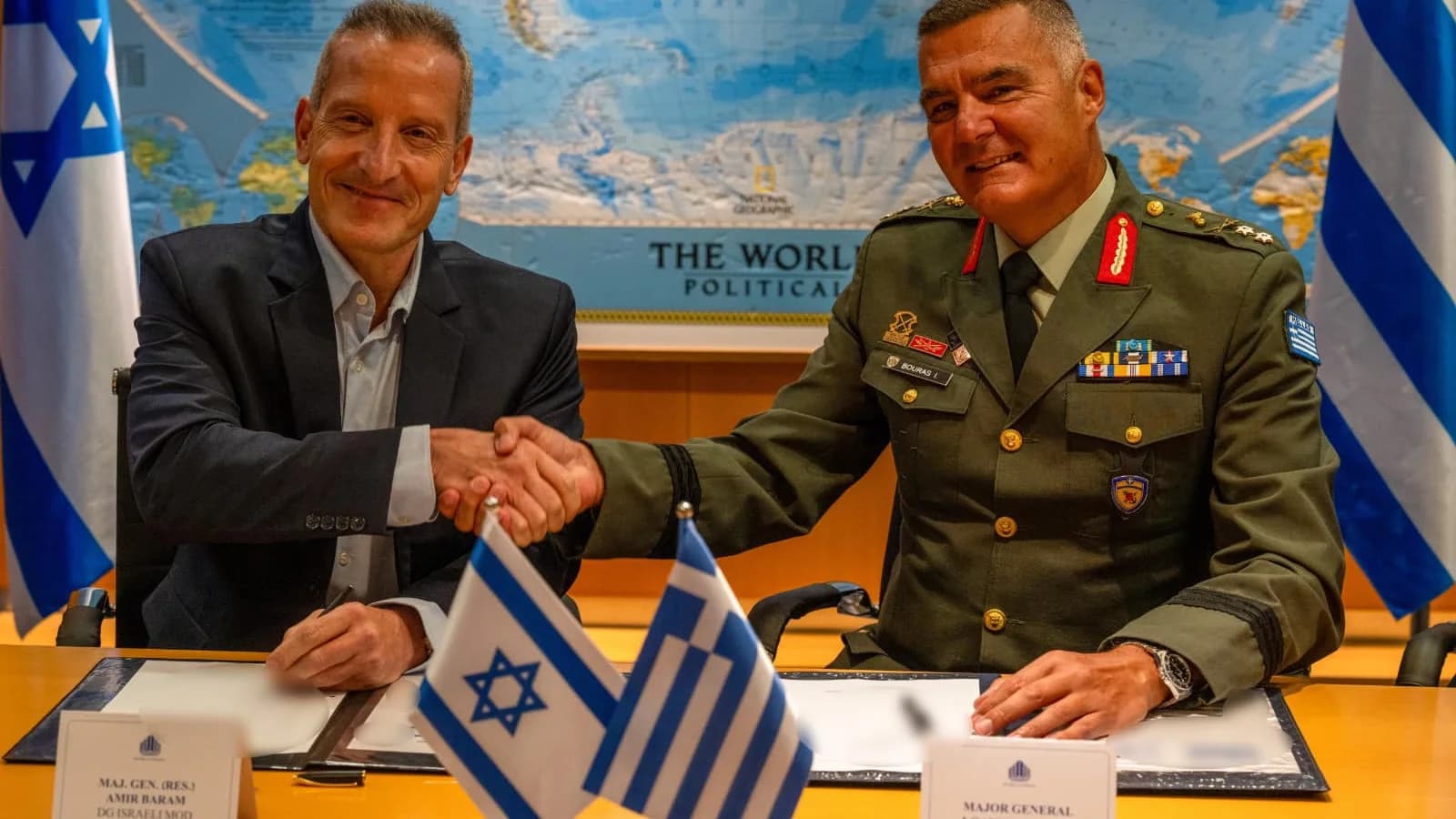
A €3.035 billion Greece-Israel agreement packages layered air and missile defence, unified command and control, and more than 25 percent Greek industrial participation.
The contract links systems, command and production in one national air-defence decision. Greece and Israel signed a €3.035 billion intergovernmental agreement for Achilles Shield, covering anti-aircraft, anti-ballistic and anti-drone defence with unified command and control. Official sources name David's Sling, BARAK MX, SPYDER, MMR radars and a new national command system. Greece says 19 domestic firms are involved, with participation above 25 percent and €750 million.
The useful Canadian comparator is the package logic: layered effects, shared command and local industrial participation are contracted together. The announcement does not disclose quantities, delivery schedule, allocation by system, acceptance tests or independently verified performance. Inspect the workshare and integration evidence before translating the model into Canadian requirements.
What the public record says
Greece says the Achilles Shield agreement has a €3.035 billion budget, begins implementation immediately and includes 19 Greek companies with participation above 25 percent and €750 million.
Why this may matter
The agreement treats layered defence as an integration and industrial-policy decision, not a collection of interceptors, which sharpens the questions Canada should ask about command ownership and domestic workshare.
Evidence limits
The ministries do not disclose system quantities, allocation of value by supplier, delivery milestones, acceptance tests, operating costs, integration results or independently verified performance.
Practical next step
Inspect Greece's published workshare, system-integration, delivery and acceptance evidence against Canadian layered-defence requirements.
Original sources (2)
- Hellenic Republic Ministry of National Defence: Achilles Shield Dome Agreement Signing in Tel Aviv (opens in a new tab)Agreement scope paragraph and budget and Greek-industry participation paragraph
- Israel Ministry of Defense: Israel and Greece have signed the massive Achilles Shield Agreement (opens in a new tab)Deal includes list and supplementary Drone Dome agreement paragraph
A debris-removal mission will test the launcher tied to Nova Scotia
Isar's ADRAS-J2 launch contract adds a demanding 2027-to-2028 mission to Spectrum's manifest, while a separate conditional agreement ties the same vehicle to Spaceport Nova Scotia.
The launch is in Norway, but the evidence matters in Nova Scotia. Isar Aerospace has signed to carry Astroscale Japan's ADRAS-J2 active-debris-removal mission on Spectrum between 2027 and 2028. The mission is intended to approach and capture a non-cooperative upper stage roughly 11 metres long, four metres wide and three tonnes, creating a demanding test of orbital insertion for a servicing mission.
Canada's connection is a separate July 7 facilities agreement for a dedicated Spectrum complex at Spaceport Nova Scotia, with build-out planned in 2026 and launches targeted for 2028. That agreement was conditional on a statement of work and milestones by September 1, plus later pad and infrastructure handovers. Verify those conditions now, then track Spectrum flight performance and ADRAS-J2 scheduling before treating Canadian launch capacity or debris-removal support as operational.
What the public record says
Isar says it signed to launch Astroscale Japan's ADRAS-J2 from Norway in 2027 or 2028; its July 7 release separately records a conditional agreement for a dedicated Spectrum complex at Spaceport Nova Scotia.
Why this may matter
Spectrum now has a mission whose orbital-insertion demands can produce evidence relevant to the same launcher's Canadian path, but the Nova Scotia agreement still has contractual and infrastructure gates.
Evidence limits
No contract value or confirmed launch date is disclosed, and the cited sources do not confirm whether the Nova Scotia statement-of-work and September 1 milestone condition has been satisfied.
Practical next step
Verify the Nova Scotia agreement conditions and handover milestones, then track Spectrum flight results and a confirmed ADRAS-J2 launch slot.
Original sources (2)
- Isar Aerospace: Isar Aerospace signs launch contract with Astroscale Japan (opens in a new tab)Contract announcement, target launch window, mission-object description and Spectrum capacity paragraphs
- Isar Aerospace: Sovereign space access for Germany and Canada: Isar Aerospace and Maritime Launch Services sign contract to advance orbital launch capability from Spaceport Nova Scotia (opens in a new tab)Dedicated launch-complex agreement, Canadian-entity and launch targets, commercial terms, and conditions precedent
Carry the signal forward
Continue in True North Map
Follow the edition into the organizations, technologies, Defence needs and Mission areas already connected to its record.