
Canadian Defence Signals
Operators are shaping the next capability cycle
Editorial briefing snapshot
The Bottom Line
At sea, HMCS Charlottetown completed a six-month Indo-Pacific deployment; in the Arctic, CCGS Louis S. St-Laurent reached the North Pole while collecting continental-shelf data; and MDA Space put its first eight Globalstar replenishment satellites into orbit.
Allied programs point in the same direction. Australia and the United States used RIMPAC to test autonomous undersea vehicles and acoustic communications against mission scenarios. The U.S. Air Force evaluated portable control prototypes before choosing an integrator, while the Pacific Submarine Force is examining UUVs as carrier extensions and submerged logistics tools. Canada will also host 32 invited countries at an Indo-Pacific chiefs conference, creating a near-term coordination checkpoint.
In context
Canada's defence ecosystem is moving closer to a model in which operators, infrastructure and production evidence shape capability before a formal award. At RED COBALT, Canadian Armed Forces users worked directly with more than 20 companies in live drone, counter-drone and uncrewed-ground-system scenarios.
In this edition
RED COBALT puts operators inside the drone cycle
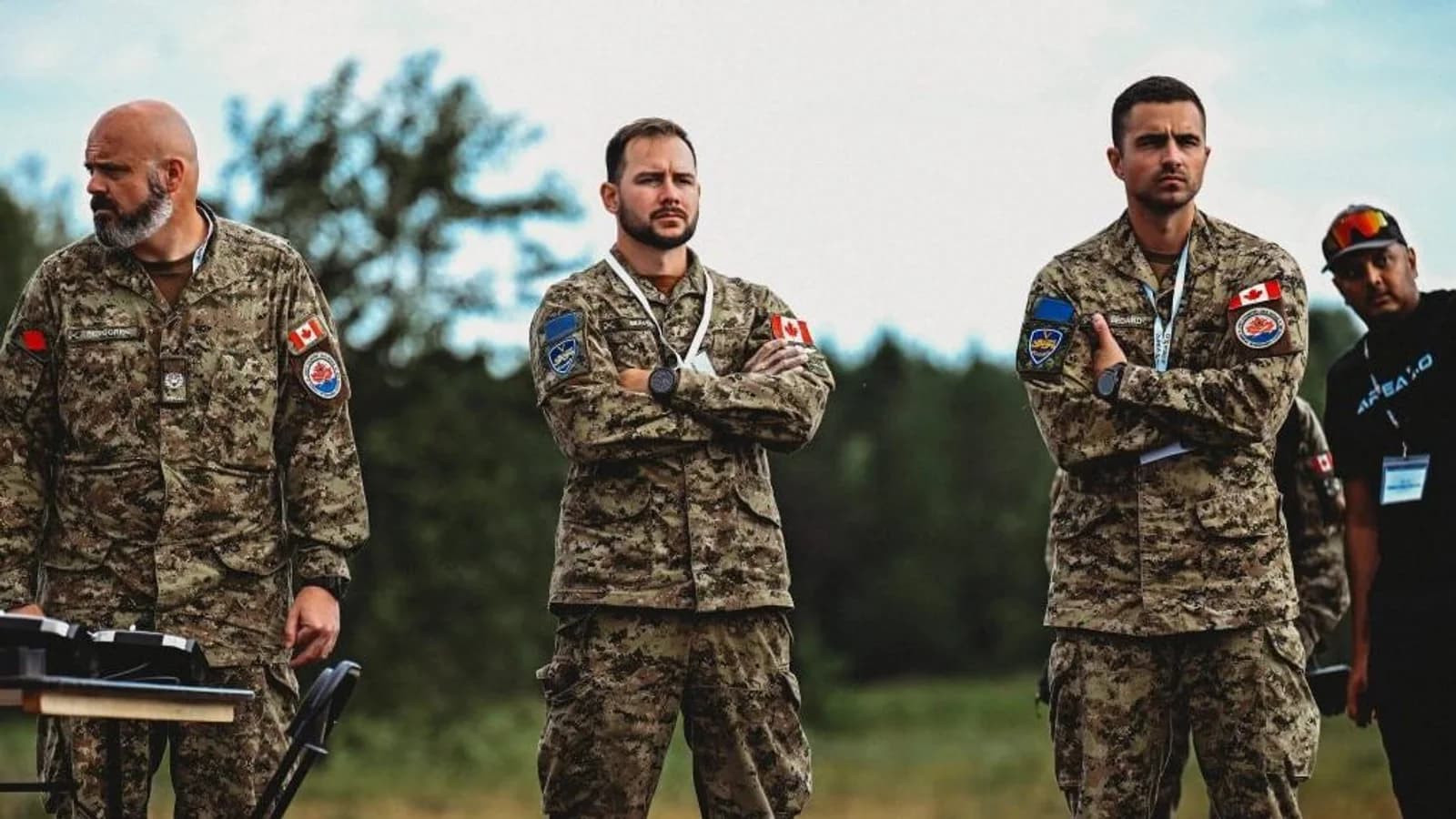
Roughly 200 Canadian Armed Forces personnel worked directly with more than 20 companies in live drone, counter-drone and uncrewed-ground-system scenarios at Area X.O Killaloe.
RED COBALT moved the drone conversation onto a 6,600-foot former military runway on August 11 and 12. Invest Ottawa reports that roughly 200 CAF personnel engaged with just over 20 companies, 18 of them Canadian, across live demonstrations that included FPV intercepts, counter-drone systems, robotic platforms and medical-evacuation concepts. DND described the purpose as testing emerging technologies in realistic scenarios and collecting feedback to guide future capability.
The important movement is structural: operators, developers and manufacturers shared the same test environment before a procurement outcome was announced. Area X.O's unrestricted Class G airspace gives that model repeatable infrastructure. The public sources do not publish comparative results, supplier rankings, contracts or a fielding decision, so the event is evidence of a faster learning loop, not evidence of an award.
What the public record says
Invest Ottawa and Area X.O report a two-day RED COBALT event with roughly 200 CAF personnel and more than 20 companies testing drone, counter-drone and uncrewed-ground-system technology in live scenarios at Killaloe.
Why this may matter
Direct operator access and realistic test infrastructure are becoming inputs to capability design, giving companies a clearer route to build evidence before a procurement gate.
Evidence limits
Public sources do not disclose participant-level results, evaluation criteria, supplier rankings, data rights, follow-on contracts or which systems will advance into another trial.
Practical next step
Track DND and Canadian Joint Forces Command for a RED COBALT readout, follow-on evaluation dates and any link to Defence Drone Initiative supplier decisions.
Original sources (4)
- Invest Ottawa: Canadian Armed Forces and Innovators Put Defence Technology to the Test at the New Area X.O Killaloe (opens in a new tab)Event scale, live-demonstration description, company participation and From pavement to procurement sections
- Area X.O: Inside Area X.O Killaloe: Where the Department of National Defence, Canadian Armed Forces and Industry Build Capability Together (opens in a new tab)A hangar, a classroom, and a lot of drones and What makes the site itself different sections
- National Defence: Commander of Canadian Joint Forces Command to host RED COBALT Uncrewed Systems Accelerator 2026 (opens in a new tab)Media advisory description and What event details
- National Newswatch / The Canadian Press: Canadian Armed Forces holds major drone testing event with manufacturers (opens in a new tab)Canadian Press report on RED COBALT and Lieutenant-General Darcy Molstad's industry-collaboration remarks
A six-month deployment turns presence into operating proof
HMCS Charlottetown returned after more than 150 days at sea, 45,000 nautical miles and exercises or engagements with 15 allied and partner nations.
HMCS Charlottetown returned to Halifax after a six-month Indo-Pacific deployment under Operations HORIZON and NEON. National Defence says the frigate spent more than 150 days at sea, sailed over 45,000 nautical miles, visited 13 ports in 10 countries and worked with 15 allied and partner nations. Activities included live-fire surface engagements, anti-submarine warfare, helicopter training, engineering diving and sanctions-monitoring support.
Those details turn an abstract presence commitment into observable operating evidence: distance, duration, mission variety and multinational integration. They do not reveal availability rates, maintenance demand, combat effectiveness or the cost of sustaining the deployment. The next decision signal will come from the ship's readiness reset and whether lessons from this rotation change force generation, sustainment planning or the configuration of follow-on Indo-Pacific deployments.
What the public record says
National Defence reports that HMCS Charlottetown spent more than 150 days at sea, covered over 45,000 nautical miles and strengthened interoperability with 15 allied and partner nations during a six-month deployment.
Why this may matter
The deployment supplies measurable proof of Canadian naval reach and interoperability, shifting the assessment from planned presence to sustained execution across several mission sets.
Evidence limits
The release does not publish ship availability, maintenance findings, exercise performance, deployment cost, lessons learned or the readiness timeline for the next tasking.
Practical next step
Track the post-deployment readiness reset and compare the next Operation HORIZON rotation for changes in mission mix, partners, duration and sustainment demands.
Original source (1)
- National Defence: HMCS Charlottetown returns from Operations HORIZON and NEON (opens in a new tab)Deployment results paragraphs and Quick facts
MDA moves constellation production from factory to orbit
MDA Space deployed the first eight of 17 Globalstar replenishment satellites, moving its first prime-led commercial communications constellation into in-orbit commissioning.
Eight Globalstar replenishment satellites developed, integrated and tested by MDA Space in Montréal were deployed to low Earth orbit on August 15. MDA calls them its first satellite deliveries as prime contractor for a commercial communications constellation. The spacecraft have entered in-orbit commissioning, while the remaining nine on order are in the final stages of integration.
The milestone is evidence that MDA's transformed production process can move a batch from factory integration to orbital test, not just through a contract announcement. That proof is relevant to defence-space buyers assessing Canadian industrial scale, but the source describes a commercial constellation and does not establish military access, reserved capacity or operational performance. Commissioning results and delivery of the final nine satellites remain the next gates before the program demonstrates full execution.
What the public record says
MDA Space says the first eight Globalstar replenishment satellites were developed, fully integrated and tested in Montréal, deployed to orbit and moved into commissioning, with nine more in final integration.
Why this may matter
Factory-to-orbit delivery gives MDA a concrete high-volume production reference that Canadian and allied space customers can inspect beyond backlog or facility-capacity claims.
Evidence limits
The release does not provide commissioning results, unit economics, final-nine delivery dates, sustained production cadence, spare capacity or any defence allocation for the manufacturing line.
Practical next step
Track the in-orbit test results and confirm the launch and commissioning schedule for the remaining nine satellites before treating the production transformation as complete.
Original source (1)
- MDA Space: MDA Space satellites for Globalstar successfully launched (opens in a new tab)Deployment, prime-contractor milestone and remaining-satellite paragraphs
North Pole mission ties Arctic presence to survey data
CCGS Louis S. St-Laurent reached the North Pole while collecting high-resolution geoscience and hydrographic data for Canada's continental-shelf work.
CCGS Louis S. St-Laurent reached the North Pole on August 16 during Canada's 2026 Arctic deployment. The Canadian Coast Guard says the icebreaker is collecting high-resolution geoscience and hydrographic data for Natural Resources Canada and Fisheries and Oceans Canada under the 2024-2027 continental-shelf missions. The voyage joins physical access, scientific sensing and a stated sovereignty purpose in one operation.
That combination matters because Arctic presence gains strategic weight when it produces durable data and demonstrates safe reach in difficult conditions. The release does not disclose survey coverage, data quality, system availability or how the evidence will change Canada's legal submission and operational planning. The decision value therefore sits in the mission output and follow-on analysis, not in the symbolic latitude alone.
What the public record says
The Canadian Coast Guard reports that CCGS Louis S. St-Laurent reached the North Pole while collecting high-resolution geoscience and hydrographic data to support continental-shelf mapping.
Why this may matter
The mission links Arctic access to a measurable national-interest output, providing stronger operating evidence than presence messaging without an associated sensing task.
Evidence limits
Public reporting does not state survey coverage, data quality, ice conditions, equipment availability, cost, legal impact or how the findings will inform future Arctic force planning.
Practical next step
Track Natural Resources Canada and Fisheries and Oceans Canada for survey results, then compare them with follow-on Arctic deployment and infrastructure decisions.
Original source (1)
- Canadian Coast Guard: Canada's largest icebreaker reaches the North Pole (opens in a new tab)Mission purpose and Arctic operations paragraphs
Victoria becomes the next Indo-Pacific coordination gate
Canada and the United States will co-host the 28th Indo-Pacific Chiefs of Defense Conference in Victoria from August 31 to September 2, with 32 countries invited.
Canada will host the 28th Indo-Pacific Chiefs of Defense Conference in Victoria from August 31 to September 2. General Jennie Carignan and U.S. Pacific Command's Admiral Samuel J. Paparo will co-host, and 32 countries have been invited. The stated agenda is collective security in a changing Indo-Pacific, with senior military leaders, practitioners and regional experts discussing defence alongside non-military perspectives.
The announcement creates a dated coordination gate rather than an outcome. Its value lies in the concentration of decision-makers and the opportunity to connect Canadian Indo-Pacific deployments with specific interoperability or cooperation priorities. The source does not publish the participant list, working agenda or expected commitments. A post-conference readout will show whether the event produces operational follow-through or remains primarily relationship maintenance.
What the public record says
National Defence says Canada and U.S. Pacific Command will co-host the August 31 to September 2 conference in Victoria and that 32 countries have been invited.
Why this may matter
The conference gives Canada a near-term venue to translate recent Indo-Pacific operating evidence into specific partner priorities, but the announcement itself contains no commitment.
Evidence limits
The public advisory does not list confirmed participants, agenda sessions, bilateral meetings, desired commitments, industry involvement or the form of any final readout.
Practical next step
Track the confirmed participant list and compare the final conference readout with Canada's stated interoperability, maritime-security and defence-cooperation priorities.
Original source (1)
- National Defence: Canada to co-host 28th Annual Indo-Pacific Chiefs of Defense Conference (opens in a new tab)Conference dates, hosts, theme and invited-country paragraphs
RIMPAC turns undersea interoperability into test data
Australia and the United States tested autonomous undersea vehicles, a remotely operated vehicle, an uncrewed surface vessel and an acoustic relay in RIMPAC mission scenarios.
Australian Defence reports that Australian and U.S. teams tested AUKUS Pillar II subsea and seabed capabilities during RIMPAC 26. A HUGIN Superior autonomous underwater vehicle worked with a Schilling work-class remotely operated vehicle on navigation and search, while the Lightfish Seasat uncrewed surface vessel and Rock Lobster acoustic relay demonstrated cross-national underwater communications. The scenarios focused on protecting critical undersea infrastructure.
The movement is from equipment compatibility claims to mission-based interoperability evidence. That is a useful benchmark for Canada as it develops ocean technology and allied undersea relationships: communications, launch-and-recovery support and shared tasking need to work as one system. The source does not publish performance measures, failure modes or acquisition decisions, so the result validates a test pathway rather than an operationally fielded architecture.
What the public record says
Australian Defence says the RIMPAC activity combined U.S. subsea capabilities with Australian autonomous and remotely operated vehicles and tested interoperable underwater acoustic communications.
Why this may matter
Mission-based trials make communications and systems integration visible as capability bottlenecks, offering a stronger allied benchmark than isolated platform demonstrations.
Evidence limits
The report omits performance thresholds, test failures, data-sharing arrangements, system quantities, procurement plans and the schedule for the next Maritime Big Play activity.
Practical next step
Track the next AUKUS Maritime Big Play test and compare which communications, payload and launch-and-recovery lessons progress into funded capability decisions.
Original source (1)
- Australian Department of Defence: Advancing high-tech undersea warfare capabilities (opens in a new tab)RIMPAC systems, mission scenario and interoperability paragraphs
Portable control becomes a separate autonomy competition
The U.S. Air Force completed initial evaluations of portable command-and-control prototypes for Collaborative Combat Aircraft before selecting a C2E integrator.
The U.S. Air Force completed initial prototype evaluations for the Collaborative Combat Aircraft Portable Command and Control Enclave. Industry systems were tested for mobility and footprint in simulated austere conditions, then demonstrated software agility and connectivity. The results will inform selection of a C2E integrator, and a second phase is expected to test cloud capabilities before the control system connects with production aircraft.
This separates the autonomy stack from the airframe competition and gives the control layer its own evidence and selection path. For Canadian teams, the benchmark is the complete deployable system: hardware footprint, network resilience, software integration and operator workflow. The source names no vendors, scores or schedule, and it does not establish a production award. The next test phase will reveal which attributes remain differentiators.
What the public record says
The Air Force says it tested prototype C2E systems for mobility, austere deployment, software agility and connectivity, with results informing integrator selection and a second cloud-focused phase.
Why this may matter
A separate competition for the portable control layer shows that autonomy programs are buying deployability and integration evidence, not only aircraft or algorithms.
Evidence limits
The Air Force has not disclosed participating vendors, evaluation scores, technical thresholds, acquisition value, integrator-selection timing or production-aircraft integration results.
Practical next step
Track the second prototype phase and compare the final integrator requirements for cloud operation, connectivity, mobility and production-aircraft integration.
Original source (1)
- U.S. Air Force Life Cycle Management Center: DAF Completes Key Prototype Evaluations for Collaborative Combat Aircraft Command and Control Enclave (opens in a new tab)Prototype evaluation, integrator selection and second-phase paragraphs
UUVs move from payloads toward submerged logistics
U.S. Pacific Fleet leaders are examining UUVs as carrier-strike-group extensions and as a way to transfer critical parts to submarines without surfacing or returning to port.
After RIMPAC's at-sea phase, U.S. Pacific submarine and carrier-strike-group commanders discussed expanding UUV roles. The official account describes autonomous systems as potential extensions for carrier operations and focuses on moving critical parts between aircraft carriers and submerged submarines. It links the concept to earlier Yellow Moray torpedo-tube launch and recovery and the Orca extra-large UUV's 1,000-nautical-mile transit.
The signal is a shift from treating UUVs mainly as sensors or payload carriers toward using them as a distributed operating and logistics layer. That concept would change endurance and support assumptions, but it remains exploratory. The source announces no funded program, payload capacity, transfer demonstration or fielding schedule. Canadian planners should treat it as an allied concept to inspect, not as a proven logistics capability.
What the public record says
U.S. Pacific Fleet says its submarine and carrier commanders examined UUV integration with carrier operations and the transfer of critical parts to submerged submarines.
Why this may matter
Extending UUVs into submerged resupply makes logistics part of the autonomy architecture and creates new requirements for payload handling, navigation, communications and recovery.
Evidence limits
No public evidence yet establishes a resupply demonstration, carrying capacity, transfer mechanism, compatible vehicle, funding line, operational concept approval or fielding schedule.
Practical next step
Track RIMPAC follow-on experiments and confirm whether carrier-based UUV operations or submerged parts transfer enters a funded test or acquisition program.
Original source (1)
- Commander, Submarine Force, U.S. Pacific Fleet via DVIDS: Pacific Submarine Force Commander visits USS Theodore Roosevelt as RIMPAC 26 Concludes (opens in a new tab)Carrier integration, unmanned logistics and prior UUV milestone paragraphs