
Canadian Defence Signals
Execution gates are separating capability from intent
Editorial briefing snapshot
The Bottom Line
The pattern is not simply faster acquisition. It is the conversion of intent into controlled action through political cover, production capacity, transferred work, sequenced contracts, preserved operator skills, live experimentation and recovery under fault. Spain's looming carrier-aircraft gap shows the cost of letting a decision window close, while South Korea's mine-warfare trial and Katalyst's spacecraft recovery show how evidence improves when systems meet operational friction.
In context
Canada's defence-procurement debate is moving from calls for speed to the conditions that let people take accountable risk. The same execution test is visible across allied programmes: Washington has given industry 21 days to propose faster delivery, Indonesia has cut first steel under a local submarine build, Malaysia has launched the final corvette in a three-ship batch, and a Franco-Italian contract amendment now clears the way for shipboard modernization work.
In this edition
Accountability is the missing enabler for procurement risk
A new Canadian analysis argues that officials will not take faster procurement decisions unless ministers visibly accept accountability when controlled risks fail.
Canada's procurement constraint is not only process density. Philippe Lagassé argues that officials face legal exposure, internal veto points and career incentives that reward caution, even as new legislation and the Defence Investment Agency signal a demand for speed. The decision is whether political leaders will give officials explicit cover to take bounded risks, not merely direct them to move faster.
That distinction changes how an accelerated programme should be assessed. A shorter approval path without a named risk owner can shift delay or blame rather than remove it. Teams evaluating opportunities should look for ministerial direction, delegated authorities and transparent failure tolerances before treating a faster process as a more executable one.
What the public record says
Lagassé identifies dense rules, veto points and career incentives as drivers of Canadian procurement caution, and argues that renewed ministerial accountability is needed to support controlled risk-taking by officials.
Why this may matter
The most useful indicator of procurement acceleration is not a new organization alone. It is whether decision authority and political accountability travel with the direction to accept risk.
Evidence limits
The analysis does not establish how ministers will exercise accountability, which authorities the Defence Investment Agency will delegate, or how risk tolerance will be measured in individual programmes.
Practical next step
Test each priority procurement for a named decision owner, delegated authority and explicit failure tolerance before assuming that institutional reform will shorten delivery.
Original source (1)
- Debating Canadian Defence: Risk Aversion and Ministerial Responsibility (opens in a new tab)Sections on rules, career incentives and ministerial responsibility
Production urgency now has a 21-day clock
The Pentagon has asked defence-industry leaders for plans to deliver critical capabilities faster, turning stockpile pressure into a dated production test.
Industrial urgency has acquired a deadline. The Associated Press reports that Deputy Defense Secretary Steve Feinberg gave industry leaders no more than 21 days to propose faster delivery schedules or increased production for critical capabilities. Pentagon officials confirmed the effort as depleted interceptor inventories sharpen the demand for output.
A request for plans is not new capacity. It does, however, expose the variables that can be tested next: funded orders, qualified suppliers, long-lead materials, plant throughput and delivery dates. Canadian firms connected to allied munitions or air-defence supply chains should separate demand rhetoric from the work packages and capital decisions that can change monthly production.
What the public record says
The Associated Press reports that a confirmed Pentagon memo gave industry leaders no more than 21 days to submit proposals for faster delivery schedules or increased production of critical capabilities.
Why this may matter
The 21-day response window turns a broad industrial-base concern into a near-term evidence point: credible proposals should identify the bottleneck, investment and contracting action that changes output.
Evidence limits
The public record does not identify the full capability list, supplier proposals, funded contract changes, Canadian participation, achievable production rates or delivery schedules.
Practical next step
Watch for funded contract actions and supplier-level capacity commitments, then map Canadian inputs only where a specific bottleneck and delivery schedule are public.
Original source (1)
- Associated Press: Pentagon pushes defense companies to boost weapons production after concerns of depleted stocks (opens in a new tab)Pentagon memo and industry-response deadline paragraphs
Local submarine ambition has entered physical build
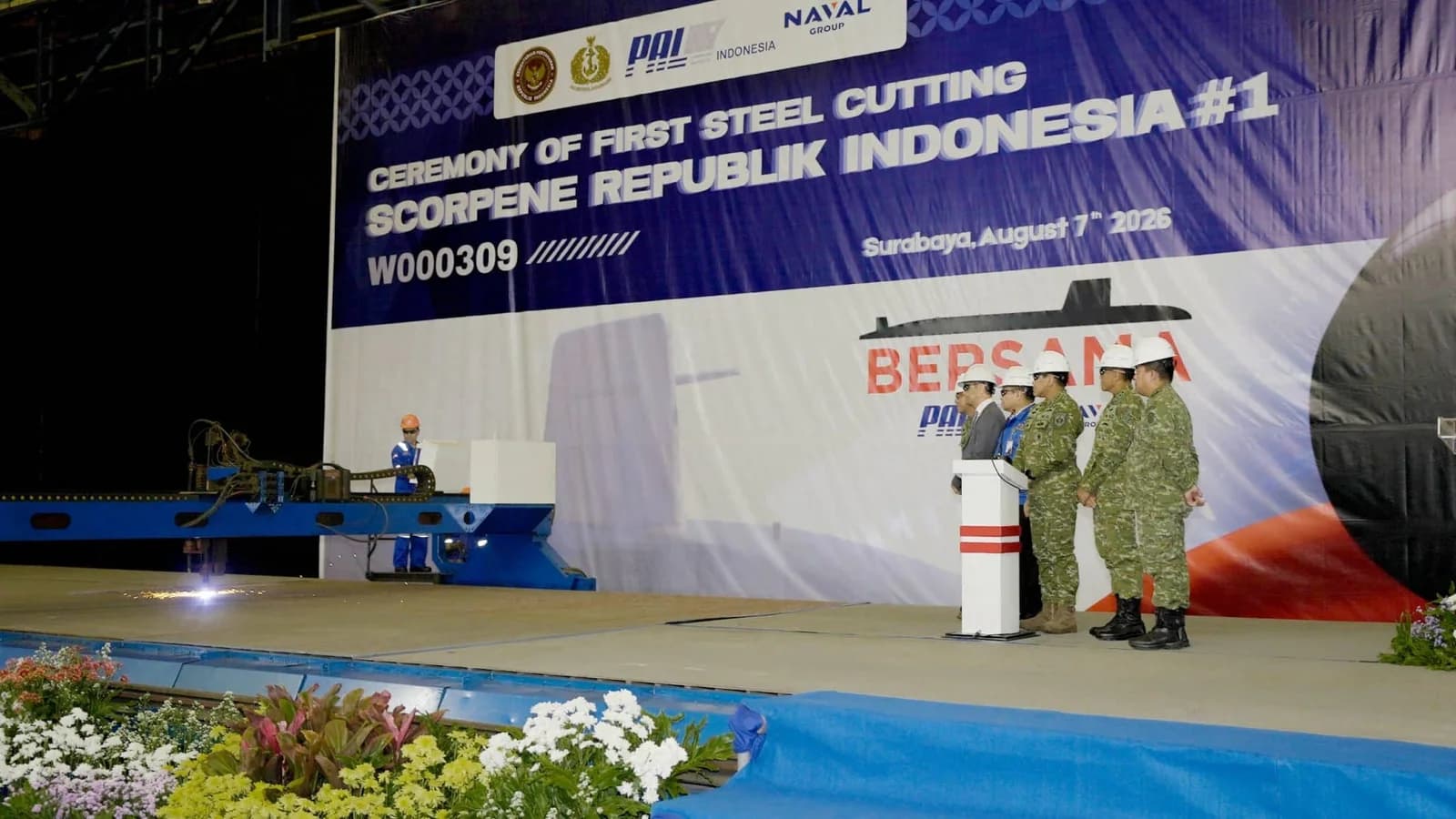
PT PAL has cut first steel for Indonesia's first Scorpene Evolved submarine under a transfer package that extends into integration, testing and trials.
Indonesia has moved its submarine-sovereignty claim into physical production. PT PAL cut first steel in Surabaya for the first of two Scorpene Evolved boats, with delivery targeted for 2032. The disclosed transfer scope covers hull outfitting, machinery, electrical integration, weapons-system assembly, harbour acceptance and sea trials at the local yard.
For Canada, the benchmark is the work package, not the ceremony. Domestic benefit becomes strategically durable when local teams own integration, test infrastructure, skilled labour and acceptance evidence across the platform life cycle. Any Canadian submarine industrial plan should therefore be compared against the specific work retained at home and the milestone at which that capability becomes independently demonstrable.
What the public record says
Naval News reports that PT PAL began construction on August 7 and that the Naval Group transfer package includes local outfitting, machinery and electrical integration, weapons assembly, harbour tests and sea trials.
Why this may matter
First steel makes local industrial participation auditable. The stronger benchmark is whether transferred work reaches integration and acceptance, where knowledge and schedule control accumulate.
Evidence limits
Public reporting does not establish final programme cost, the depth of design authority, the share of locally sourced components, workforce readiness or whether 2032 delivery will hold.
Practical next step
Compare Canadian submarine proposals by sovereign work package, test authority, infrastructure, workforce ramp and first physical milestone rather than by headline industrial-benefit value.
Original source (1)
- Naval News: PT PAL Cuts First Steel for Indonesia's Scorpene Evolved Submarine (opens in a new tab)First-steel, technology-transfer scope and timeline sections
A three-ship batch now has three launched hulls
The launch of Malaysia's third LMS Batch II corvette gives a compact naval programme a visible production-cadence milestone across its full ordered batch.
Istanbul Shipyard has launched Tunku Osman Jewa, the third and final corvette in Malaysia's LMS Batch II order. The event does not establish delivery or operational acceptance, but it means every ordered hull has crossed a public physical milestone. That creates a clearer basis for testing outfitting, trials and handover cadence.
The Canadian comparison is useful because production credibility accumulates across repeated units. A lead ship can expose design problems; later hulls show whether the yard converts learning into steadier throughput. Teams assessing small-combatant or patrol-vessel options should track interval, remaining work and acceptance performance across the batch instead of treating each launch as a standalone success.
What the public record says
Naval News reports that the Royal Malaysian Navy's third and final LMS Batch II corvette was launched at Istanbul Shipyard on August 9, placing all three ordered hulls past launch.
Why this may matter
The completed launch sequence creates a programme-level benchmark. Delivery confidence now depends on whether outfitting, trials and acceptance preserve the cadence established in hull production.
Evidence limits
The source does not establish completion percentage, final delivery dates, trial results, combat-system acceptance, cost performance or operational readiness for any of the three ships.
Practical next step
Track launch-to-delivery intervals and acceptance results across all three hulls before using the programme as evidence of repeatable small-combatant production.
Original source (1)
- Naval News: Malaysia's Third LMS Batch II Corvette Launched in Turkiye (opens in a new tab)Launch announcement and programme-status sections
Contract sequencing unlocks the first shipboard upgrade
A Franco-Italian contract amendment creates the framework for work to begin on the first Italian Horizon frigate at the end of September.
Modernization has crossed from design intent into an executable shipboard sequence. OCCAR, EUROSAM and NAVIRIS signed a second amendment to the Horizon mid-life upgrade contract, enabling work on the first Italian ship to start at the end of September. The programme covers air warfare, electronic warfare, radar, command-and-control and survivability upgrades across four frigates.
The overlooked capability is contractual readiness. Complex integration cannot start simply because components exist; technical scope, commercial terms, yard access and national requirements must align first. Canadian surface-combatant teams should treat the signed work-enabling instrument and confirmed installation window as evidence gates separate from system selection or design maturity.
What the public record says
Naval News reproduces the OCCAR announcement that Amendment No. 2 supplies the contractual framework for work on the first Italian Horizon frigate to begin at the end of September.
Why this may matter
The amendment exposes a practical modernization gate: integration becomes real only when the contract, ship availability and installation sequence align around a dated work period.
Evidence limits
The public record does not give amendment value, detailed installation schedule, integration risk, trial plan, ship downtime or final operational-acceptance dates.
Practical next step
Map each Canadian fleet upgrade to its work-enabling contract, platform-availability window, integration owner and acceptance test before treating selected technology as scheduled capability.
Original source (1)
- Naval News: OCCAR signs Horizon Mid-Life-Upgrade Contract Amendment No. 2 (opens in a new tab)OCCAR release, amendment objective and technology-upgrade list
Delay can erase a carrier-aviation option
Spain's Harrier replacement debate shows that an acquisition delay can dissolve operator, maintenance and deck skills before a future platform is chosen.
Spain faces a decision in which waiting is itself a capability choice. Naval News assesses that retiring the AV-8B Harrier without an immediate successor would interrupt fixed-wing naval aviation and begin eroding pilots, maintainers, procedures, deck culture and doctrine. The F-35B preserves short-takeoff continuity; a CATOBAR path demands a different ship, air wing and support system.
This is a workforce and operating-model warning, not only an aircraft comparison. Once a specialist community disperses, a later platform decision must rebuild the human system as well as buy hardware. Canadian programmes with ageing fleets should identify the last responsible decision date for preserving crews, training, maintenance and certification before treating a deferred replacement as reversible.
What the public record says
Naval News identifies the Harrier's approaching retirement and argues that a gap would cost Spain not only aircraft but also pilots, maintainers, procedures, training and deck-level operating continuity.
Why this may matter
Option value decays before a platform retires. The decisive schedule is the point at which operator and support continuity can no longer be preserved through the replacement transition.
Evidence limits
Spain has not publicly fixed the replacement path, procurement schedule, carrier conversion plan, budget, interim operating model or acceptable duration of a capability gap.
Practical next step
Identify the last responsible decision date for each Canadian fleet transition by tracing operator, maintainer, training, certification and infrastructure continuity, not hardware delivery alone.
Original source (1)
- Naval News: Spain's Naval Aviation Crossroads: The F-35B, the Harrier, and a Capability Gap (opens in a new tab)Harrier retirement, F-35B and CATOBAR continuity analysis
Mine-warfare autonomy has met a live task group
South Korea has tested AI-assisted mission planning and mine detection across a crewed minehunter, aerial drone, surface vessels and an autonomous underwater vehicle.
South Korea has put a multi-domain mine-warfare concept into a live task group. The ROK Navy and Hanwha Systems tested a crewed minehunter with an aerial drone, two uncrewed surface vessels and an autonomous underwater vehicle at Busan. The trial covered AI-assisted planning, cross-domain integration, underwater detection, image analysis and neutralization procedures.
The signal is the end-to-end test chain. Individual autonomy or sensor demonstrations do not establish a mine-countermeasures system; mission planning, data movement, target analysis, command authority and effect must work together. Canadian maritime-autonomy programmes should demand evidence across that chain and identify the human decision points before comparing platform specifications.
What the public record says
Naval News reports a live ROK Navy trial that linked a crewed minehunter, an aerial drone, two uncrewed surface vessels and an autonomous underwater vehicle through AI-assisted mine-countermeasure tasks.
Why this may matter
The trial advances the benchmark from vehicle performance to mission-system performance, where autonomy, sensors, datalinks, command decisions and neutralization procedures must remain connected.
Evidence limits
The report does not publish detection accuracy, false-alarm rate, communication resilience, human-authorization rules, trial conditions, adversarial testing or a fielding date.
Practical next step
Test Canadian mine-warfare trials against an end-to-end evidence plan covering detection, classification, command authority, communications, neutralization and operator workload.
Original source (1)
- Naval News: ROK Navy Tests AI Uncrewed Mine Warfare in Sea GHOST Trial (opens in a new tab)Trial configuration and validated operational phases
Recovery evidence is now part of space readiness
Katalyst reduced an uncontrolled spacecraft spin with one electric thruster and is preparing a major software update before attempting a first-of-kind orbital reboost.
An anomaly is producing evidence that a nominal demonstration could not. Katalyst says it reduced the Link servicing spacecraft's body rate from about nine degrees per second to 1.47 using one electric thruster and less than 100 grams of fuel. Two reaction wheels remain unavailable, thruster capability is partial, and a significant flight-software update is planned before the spacecraft proceeds toward NASA's Swift observatory.
The mission is still high risk, but the recovery sequence tests fault management, software authority and propellant discipline under real constraints. Canadian space-resilience assessments should ask how a system detects, controls and recovers from degraded configurations, then separate that evidence from whether the later servicing mission succeeds.
What the public record says
SpaceNews reports that Katalyst slowed Link's spin from roughly nine to 1.47 degrees per second with one electric thruster, while preparing a software update for continued recovery and rendezvous.
Why this may matter
Readiness evidence now includes recovery behaviour. A platform that preserves control authority, fuel and software options during a fault provides a different resilience case than one tested only in nominal operation.
Evidence limits
Katalyst has not disclosed the root cause, remaining propellant, full recovery result, updated rendezvous date, grapple performance or whether Swift can be reboosted before its altitude threshold.
Practical next step
Verify degraded-mode detection, recovery authority, software-update controls and propellant margin in Canadian space qualification plans before relying on nominal mission demonstrations.
Original source (1)
- SpaceNews: Katalyst Space makes progress in restoring control of Swift servicing spacecraft (opens in a new tab)Recovery status, spacecraft configuration and mission-timeline paragraphs