
Canadian Defence Signals
Defence qualification gates are shaping capacity decisions
Editorial briefing snapshot
The Bottom Line
Marines put first-person-view attack drones through their first live-fire series, and the U.S. Army split a Hydra-70 warhead prototype requirement among four firms. Canada, meanwhile, opened a secure quantum transition hub and industry reporting shifted the shipbuilding debate toward the production system behind the fleet.
The common signal is that capacity now has to arrive with proof. Test evidence, government-owned technical data, an accountable acquisition owner, secure validation space and a durable supplier base are becoming the mechanisms that connect technology to repeatable delivery. Australia reinforces the pattern by pairing access to a new allied missile with a sovereign rocket-motor flight test.
In context
Defence buyers are turning demonstrations into harder qualification gates. A long-range JDAM moved into initial production after powered flight testing, U.S.
In this edition
JDAM LR crosses from company-funded proof into initial production
A US$75 million U.S. Air Force action clears Boeing to begin producing long-range JDAM payload-delivery units for the U.S. Navy after a powered flight test.
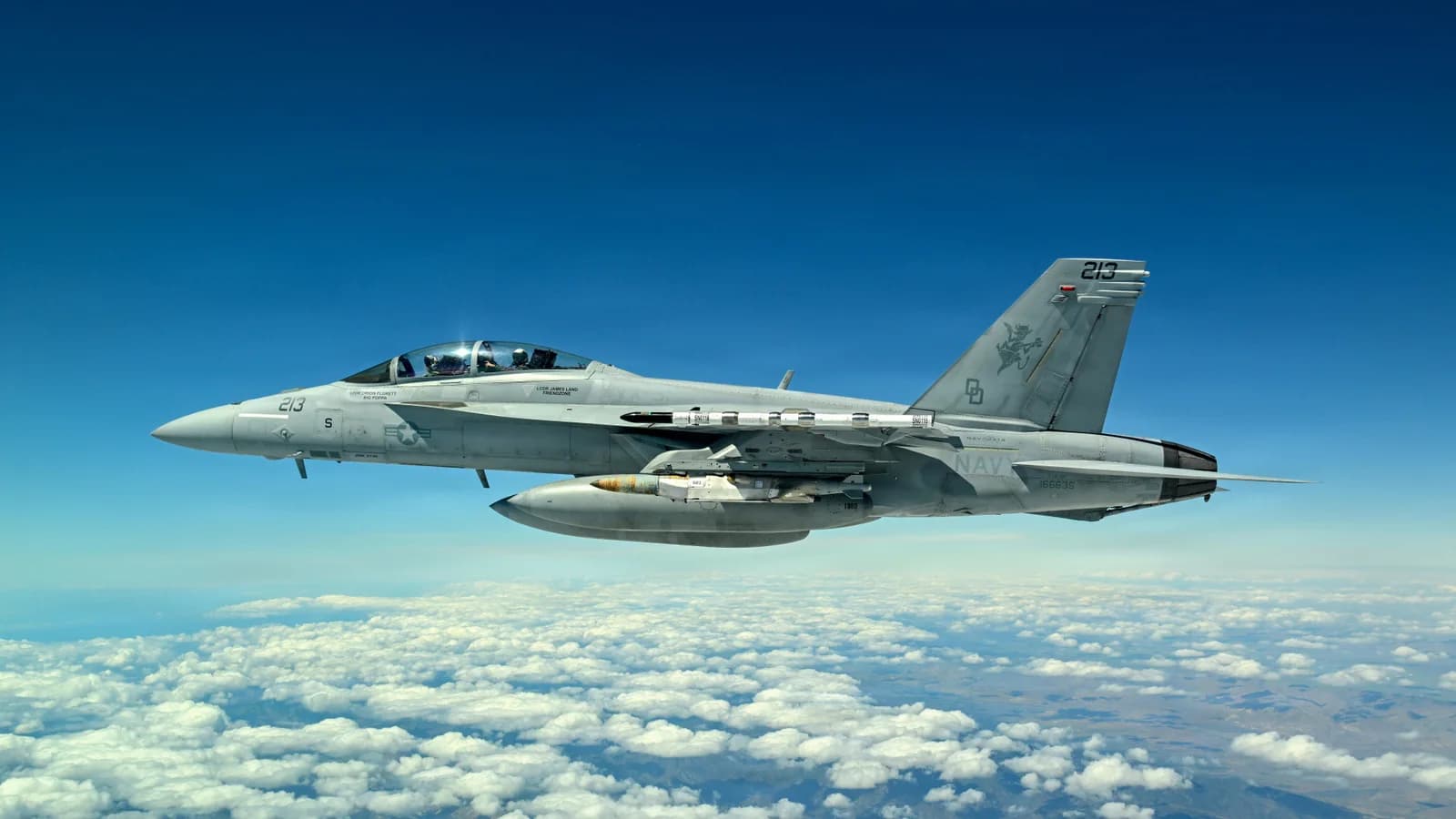
Production approval changes the JDAM LR story from a company-funded development effort into an initial government buying decision. Boeing says a US$75 million undefinitized contract action covers the BSU-111/B payload-delivery unit for a 500-pound-class weapon with a stated range above 300 nautical miles, beginning with U.S. Navy production. The design combines established JDAM interfaces with a wing kit and compact turbojet.
The useful benchmark is the sequence: private investment, powered flight against a defined profile, military-code GPS navigation, then an initial production vehicle. Range and affordability remain company claims until broader government evidence is available. Canadian teams should compare their own transition plan against that chain and identify the test result, interface proof and manufacturing decision that would move a capability beyond demonstration.
What the public record says
Boeing says the U.S. Air Force awarded a US$75 million undefinitized contract action for JDAM LR payload-delivery units, clearing initial production for the U.S. Navy after a powered flight test met its stated objectives.
Why this may matter
The market signal is the conversion mechanism: familiar aircraft interfaces and a completed flight profile reduced enough programme risk to support an initial production action.
Evidence limits
Public records do not disclose production quantity, unit cost, delivery schedule, full government performance data, integration funding, export availability or Canadian requirements.
Practical next step
Compare one long-range effect or payload capability against the same transition chain: funded owner, flight evidence, aircraft interface, production decision and delivery measure.
Original sources (2)
- Boeing: Air Force greenlights long-range JDAM production (opens in a new tab)Contract, configuration and flight-test paragraphs
- Breaking Defense: Air Force signs off on production of long-range JDAM (opens in a new tab)Production decision, disclosed funding, test history and image caption
Canada gives defence quantum work a secure transition hub
A University of Calgary-led consortium will receive up to C$20.3 million over two years to operate Canada's first Quantum DISH under BOREALIS.
Canada has created a protected place to move quantum work closer to defence use. The Department of National Defence says the University of Calgary-led consortium will receive up to C$20.3 million over two years to launch the first Quantum Defence Innovation Secure Hub, or Quantum DISH, under the BOREALIS programme. The hub is intended to develop, test, validate and transition work in sensing, communications, algorithms and hardware assurance.
The opportunity is not the funding headline. It is access to a secure validation environment tied to operational problems such as GPS spoofing. That creates a clearer route for evidence, but the announcement does not publish project calls, selection rules, intellectual-property terms or transition commitments. Teams should identify which experiment requires the secure setting and what result a defence user needs before treating hub participation as a route to procurement.
What the public record says
DND launched Canada's first Quantum DISH in Calgary and said a University of Calgary-led consortium will receive up to C$20.3 million over two years for secure development, testing, validation and transition.
Why this may matter
A secure hub can close the gap between laboratory performance and defence-use evidence when projects enter with a defined operational question and a measurable transition result.
Evidence limits
The announcement does not publish the first project portfolio, intake process, security eligibility, intellectual-property model, test milestones, follow-on procurement path or regional participation terms.
Practical next step
Identify one quantum sensing, communications or assurance experiment that requires secure validation, then map the evidence and access conditions needed to run it through Quantum DISH.
Original source (1)
- Department of National Defence: Minister McGuinty launches Canada's first Quantum Defence Innovation Secure Hub to strengthen defence capabilities (opens in a new tab)Funding, consortium, technical focus and operational-challenge sections
Canada's shipbuilding debate moves from vessel count to production system
Canadian Defence Review's industry survey frames the next National Shipbuilding Strategy phase around sustained yard, workforce, supplier and production-system capacity.
Ship count is only the visible part of Canada's next naval-capacity decision. Canadian Defence Review's industry survey argues that the next phase of the National Shipbuilding Strategy depends on sustained facilities, a skilled workforce, qualified suppliers and production systems that can carry work across programmes. It describes three Tier 1 shipyards and a growing domestic base, while emphasizing the cumulative capability built through continuous work.
This is specialist industry reporting, not a new government policy or procurement notice. Its value is the test it sets for any NSS 2.0 proposal: does the plan preserve learning, supplier qualification and throughput between hulls, or reset them programme by programme? Suppliers should inspect where their evidence fits the production system, especially recurring quality, integration, digital, training and sustainment interfaces rather than treating fleet ambition as an undifferentiated opportunity.
What the public record says
Canadian Defence Review reports that industry views sustained infrastructure, workforce, qualified suppliers and production systems as the cumulative capacity that the next NSS phase must preserve.
Why this may matter
The defensible opportunity sits in repeatable production-system contributions that improve throughput and continuity across programmes, not in headline vessel demand alone.
Evidence limits
The article does not establish an official NSS 2.0 policy, approved fleet plan, procurement schedule, yard workshare, supplier competition, programme budget or measurable productivity target.
Practical next step
Map one proven contribution to a recurring shipbuilding bottleneck, then identify the yard, tier, qualification evidence and throughput measure needed to test the claim.
Original source (1)
- Canadian Defence Review: Canada's National Shipbuilding Strategy prepares for NSS 2.0 (opens in a new tab)Industry survey sections on shipyards, workforce, suppliers and production continuity
Marine FPV live fire moves attack drones into operational learning
U.S. Marines completed the service's first series of live-fire first-person-view attack-drone flights in South Korea, placing rapid fielding inside a Western Pacific operating context.
Operational context now joins the attack-drone evidence chain. The U.S. Department of War says Marines completed their first series of live-fire first-person-view attack-drone flights in South Korea and presented the event as evidence of rapid fielding in the Western Pacific. The public record establishes the milestone and setting, but not detailed performance.
For Canada, the immediate comparison is wider than the air vehicle. Credible fielding depends on training, range safety, spectrum management, payload integration, sustainment, operator workload and counter-drone lessons. A first live-fire series opens an evidence path; it does not prove combat effectiveness or scalable supply. Teams should inspect which operational measure changed during the series and which support function would have to repeat before drawing a procurement conclusion.
What the public record says
The U.S. Department of War says Marines concluded the service's first live-fire series of first-person-view attack-drone flights in South Korea, demonstrating rapid fielding in the Western Pacific.
Why this may matter
Attack-drone opportunity is shifting from platform availability toward the full fielding system: safe employment, operator learning, payload integration, sustainment and countermeasure adaptation.
Evidence limits
The public item does not disclose system suppliers, quantities, accuracy, range, failure rate, training hours, unit cost, spectrum conditions, countermeasure exposure or follow-on procurement.
Practical next step
Inspect the live-fire evidence for one repeatable operational measure, then map the training, safety, sustainment and counter-drone interfaces required to reproduce it.
Original source (1)
- U.S. Department of War: Marines Make History With First Attack Drone Live-Fire Series in South Korea (opens in a new tab)Official news-story summary and RSS publication record
Four prototype awards test whether Hydra can gain surge depth
The U.S. Army gave four firms prototype agreements for M151 warheads, asking each for 24 units and a modernized government-owned Hydra-70 technical data package within 18 months.
Competition is being inserted at the warhead and production-data level, not only around a complete rocket. The U.S. Army awarded prototype agreements to Firehawk, iRocket, Nammo Perry and Albers for M151 high-explosive fragmentation warheads. Reporting says each firm must deliver 24 prototypes and a modernized government-owned Hydra-70 technical data package within 18 months, with surge capacity and competitive pricing as stated objectives.
The consequential asset is the ability to reproduce qualified output from usable technical data across more than one supplier. Prototype delivery alone will not establish cost, quality or sustained throughput, and follow-on production depends on results. Canadian munitions analysis should inspect which drawings, processes, materials and acceptance evidence create the real bottleneck before describing a second source as resilient capacity.
What the public record says
Breaking Defense reports four Army prototype agreements for M151 Hydra-70 warheads, each requiring 24 prototypes and a modernized government-owned technical data package within 18 months.
Why this may matter
Industrial resilience is being tested as a reproducibility problem: qualified suppliers must turn shared production knowledge into acceptable output before surge claims become credible.
Evidence limits
Award values, prototype acceptance criteria, baseline technical-data quality, government-furnished equipment, follow-on quantities, unit prices, incumbent workshare and sustained production rates are not public.
Practical next step
Identify the production-data, material, tooling and acceptance bottlenecks for one munition component, then verify which can support a genuinely independent second source.
Original source (1)
- Breaking Defense: Army awards contracts to four companies to boost Hydra-70 rocket production (opens in a new tab)Vendor, prototype quantity, technical-data package, schedule and surge-capacity paragraphs
Australia pairs missile access with sovereign propulsion proof
Australia will become the first AIM-260 operator outside the United States while a separate domestic programme has flight-tested a fully Australian-designed and manufactured 100-kilogram-class solid rocket motor.
Australia is pursuing allied access and sovereign depth in parallel. Its government announced almost A$736 million for up to 450 AIM-260 missiles, with planned integration first on the F/A-18F Super Hornet, then the F-35A and EA-18G. On the same day, it reported a successful flight of a fully Australian-designed and manufactured 100-kilogram-class solid rocket motor, including real-time monitoring and post-flight recovery for validation.
The two records do not show that the domestic motor supports AIM-260, and they must not be joined as one programme. Together they illustrate a portfolio choice: buy near-term allied capability while proving a separate sovereign production building block. Canada should compare where foreign access is sufficient and where propulsion, energetics, testing or data ownership requires domestic evidence before assigning industrial-policy value.
What the public record says
Australia announced almost A$736 million for up to 450 AIM-260 missiles and separately reported that its 100-kilogram-class Koonibba Rising 3.0 solid rocket motor performed as designed in flight.
Why this may matter
A credible sovereign-capability strategy can combine allied procurement with a separate domestic proof path, provided the records and programme relationships remain explicit.
Evidence limits
The releases do not disclose missile delivery dates, unit price, Australian workshare, integration milestones, domestic motor production cost, scale-up plan or any technical connection between the two programmes.
Practical next step
Compare one priority effect across allied access and domestic depth, then identify which interface, component or test capability requires sovereign evidence rather than policy language.
Original sources (2)
- Australian Defence Ministers: Delivering new advanced missiles for Australia's Air Force (opens in a new tab)Investment, quantity, export-customer and aircraft-integration paragraphs
- Australian Defence Ministers: Australian rocket motor takes flight (opens in a new tab)Motor class, Australian design and manufacture, flight monitoring and performance paragraphs