
Canadian Defence Signals
Canada’s European turn needs capital, customers and capacity
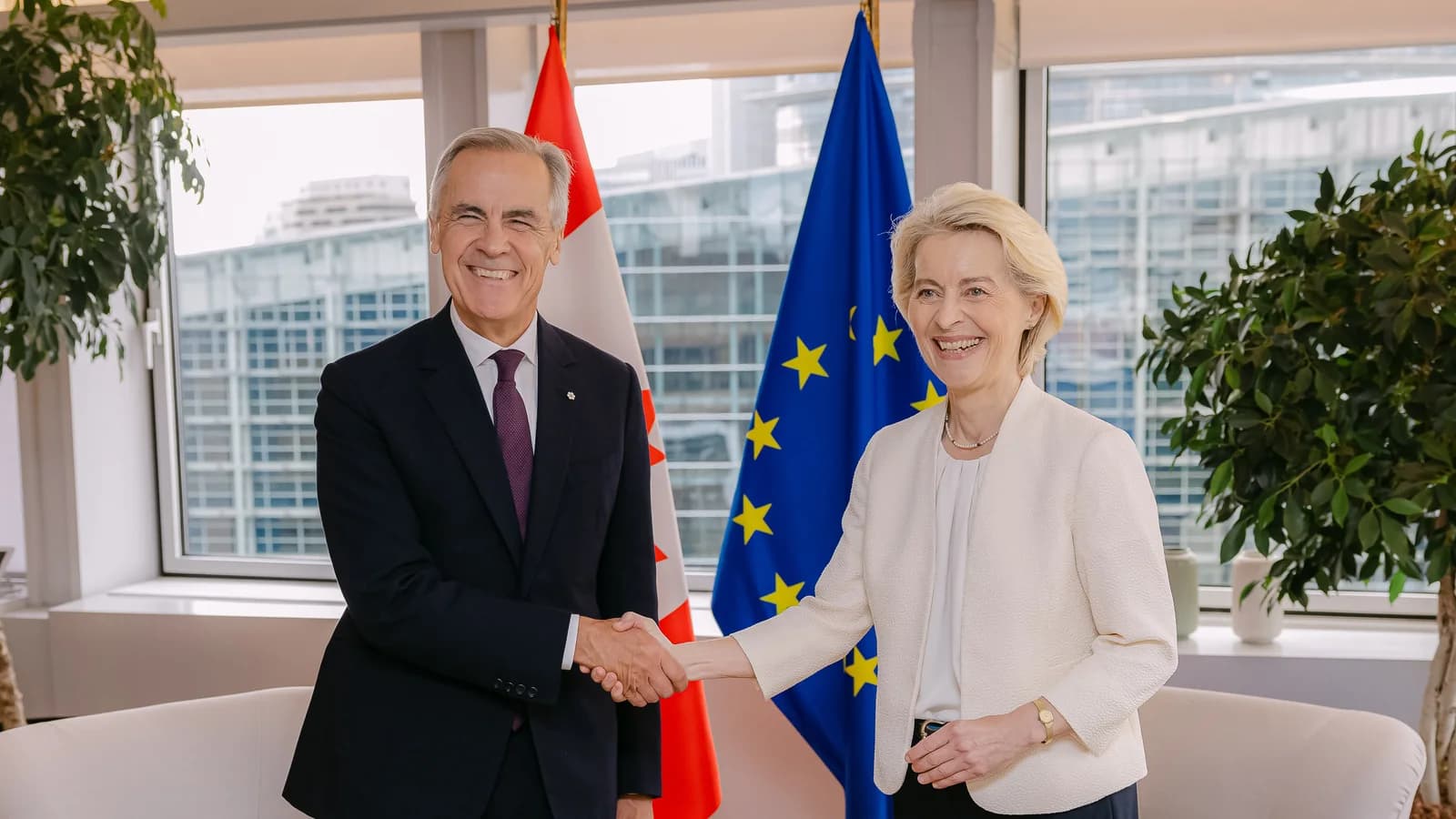
Editorial briefing snapshot
The Bottom Line
The European opening becomes valuable when political alignment produces eligible projects, credible demand, suitable finance and Canadian work that can be delivered and sustained.
In context
Canada’s discussion of a closer relationship with Europe is becoming an industrial story. The associate-membership proposal remains a political ambition, but the developments around it are increasingly specific: Carney’s response, a formal application to the Joint Expeditionary Force, complementary defence-financing initiatives, a Quebec factory expansion and new Canadian–German AI commitments.
The opportunity for industry comes from connecting three things that are often announced separately. Companies need access to customers, financing that fits the work, and the capacity to deliver. A bigger potential market does little for a supplier that cannot qualify its product. A financing institution cannot manufacture an order book. An alliance becomes commercially meaningful through the systems, training, logistics and support its members actually require.
Today’s edition follows those connections into named companies and technologies: Rheinmetall Canada’s land autonomy, Cohere and OpenText’s enterprise AI, LawZero’s assurance research, and Telesat’s ground infrastructure. It also follows the opportunity back to Manitoba, where a new readiness programme addresses the practical requirements that smaller suppliers must meet.
The encouraging trend is a widening set of routes through which Canadian capability could reach allied customers. The measure of success will be the work that those routes bring into production, integration and sustained service.
In this edition
Canada’s European opening needs an industrial route
Carney has welcomed a relationship beyond CETA; the immediate industrial task is to connect that ambition with buyers, eligible supply chains and control of technology.
The associate-membership discussion has moved from a European proposal to an explicitly welcomed Canadian ambition. In their September 16 bilateral readout, Mark Carney and Ursula von der Leyen describe a stronger future alliance spanning defence industrial capacity, critical minerals, energy, AI and computing, space, and financial services. They also discuss easier digital trade. The relationship is still to be defined together; the readout does not create a new membership status.
For Canadian industry, the attraction is scale with a clearer strategic purpose. A domestic manufacturing line becomes more viable when it can serve several compatible customers. A Canadian software or sensor company gains more than an export destination if a European partner can help it integrate into a programme, qualify its product and maintain it locally. Those are TNM’s potential consequences, not benefits already conferred by the proposal.
There is a practical starting point in the existing Canada–EU SAFE agreement. Article 5 permits Canadian component content above 35%, while retaining at least 20% content from the EU, EEA EFTA states or Ukraine. Other third-country components face additional limits. Company control, production resources and, for specified advanced products, freedom to change the design also matter. The commercial question is therefore more precise than whether a technology is Canadian: can this particular supplier and product fit the intended procurement?
For autonomy, secure communications and advanced electronics businesses, an ownership-and-components map can reveal where a European integration partner would help and where a restricted dependency would remain. It can also prevent an investor from treating political access as an assured order. Product-level review against the agreement and actual tender conditions is still necessary.
The October 29–30 Canada–EU summit is a concrete point to watch for an agreed programme of work. A useful advance would identify what changes for companies, who implements it and when. Today’s strongest signal is the alignment of industrial priorities; the next test is whether that alignment makes specific cross-border projects easier to deliver.
What remains open
The proposed associate relationship has no settled package of new rights or implementation dates in the readout.
What comes next
Choose one European customer programme and review the product’s ownership, component origins and design restrictions against its procurement requirements.
Evidence and assessment for Canada’s European opening needs an industrial route
What the sources establish
Carney welcomed a stronger future Canada–EU alliance on September 16. Existing SAFE rules provide a separate, conditional procurement route.
True North Map assessment
TNM inference: allied market scale can strengthen the case for Canadian production when a firm has a buyer, eligible inputs and sufficient control of its technology.
Original sources (3)
- Prime Minister of Canada: Carney meets European Commission President Ursula von der Leyen, September 16 (opens in a new tab)Attributed statementBilateral readout: proposed alliance and strategic capabilities
- Global Affairs Canada: Text of the Canada–EU SAFE Agreement (opens in a new tab)Direct recordArticle 5, paragraphs 2–10: control, resources, components and design authority
- Prime Minister of Canada: Prime Minister Carney to strengthen ties with European partners (opens in a new tab)Attributed statementSeptember 12 release: next Canada–EU summit
Defence financing and joint buying solve different problems
Canada and the UK now explicitly describe their defence-financing initiatives as complementary: one could help suppliers finance capacity, another could make allied demand more coherent.
The UK account of the September 16 leaders’ meeting explicitly links the complementary work of the Multilateral Defence Mechanism and the Defence, Security and Resilience Bank. That is consequential because these initiatives are often compressed into a general story about a new defence bank. Their intended functions deserve separate treatment.
Canada’s DSRB initiative is intended to provide long-term, lower-cost financing for member governments and defence supply chains, including smaller companies. April’s Montreal charter negotiations were a step toward establishment; participating countries supported a Canadian headquarters once the charter is ratified. Finance Minister François-Philippe Champagne was still discussing the next phase with interested partners on September 1. These records do not establish an operating bank with an open loan window.
The UK-backed Multilateral Defence Mechanism combines financing with demand aggregation and joint procurement. Its July statement, involving the UK, Netherlands, Finland and Poland, set an ambition to establish the mechanism by 2027, following treaty negotiations and national ratification processes. The UK’s Defence Investment Plan funding explainer allocates £400 million toward its contribution. That is a budget commitment, not evidence that the mechanism has already placed orders or lent that sum.
The distinction matters on a factory floor. Affordable capital can help a supplier buy tooling, carry inventory or expand a production line. A larger, more predictable order book can justify making that investment in the first place. TNM sees the greatest potential where financing and pooled purchasing reinforce each other: common specifications, credible volumes and delivery schedules make productive investment easier to assess.
There is also a commercial discipline here. A firm seeking plant finance needs a different proposition from one seeking entry into a joint procurement. Neither initiative automatically follows from EU associate membership, and the leaders’ discussion does not establish Canadian membership in the MDM or British membership in the DSRB. The opportunity is emerging through parallel negotiations whose eventual membership, mandate and purchasing rules will determine who benefits.
What remains open
Final participation, governance, eligible borrowers, procurement access and launch arrangements still need authoritative confirmation.
What comes next
Separate the company’s financing requirement from its customer opportunity: prepare costed capacity milestones for lenders and a programme-specific offer for prospective purchasing partners.
Evidence and assessment for Defence financing and joint buying solve different problems
What the sources establish
The UK readout calls the DSRB and MDM complementary. Both remain initiatives under development in the records reviewed.
True North Map assessment
TNM inference: finance addresses a supplier’s ability to build; coordinated demand improves its reason to build. The combination could matter more than either headline alone.
Original sources (5)
- UK Prime Minister’s Office: UK–Canada leaders meeting, September 16 (opens in a new tab)Attributed statementDefence cooperation and complementary financing mechanisms
- Department of Finance Canada: Progress towards establishing the Defence, Security and Resilience Bank (opens in a new tab)Attributed statementApril 29: charter negotiations, headquarters and intended lending role
- Department of Finance Canada: Minister Champagne advances Canadian interests at G20 meeting (opens in a new tab)Attributed statementSeptember 1: advancing the next phase of the DSRB
- UK Ministry of Defence: Joint statement from member countries of the Multilateral Defence Mechanism (opens in a new tab)Attributed statementJuly 6 statement: joint procurement, treaty negotiations and 2027 ambition
- HM Treasury: Defence Investment Plan funding explainer (opens in a new tab)Attributed statementJune 30 funding package: MDM contribution
Canada’s JEF application connects northern operations and industry
A formal application to the Joint Expeditionary Force creates a more specific military-cooperation story than the broader EU debate—and points toward interoperability, testing and sustainment work.
Canada has formally applied to join the Joint Expeditionary Force, with UK support, according to the Canadian readout of Carney’s September 16 meeting with Andy Burnham. Steve Ladurantaye’s reporting in Vanguard Defence places that step in the context of a northern European military grouping with which Canada has already engaged. An application is a meaningful advance; it is not completed admission.
The industrial significance becomes clearer alongside the Royal Navy’s Battle for the Atlantic speech, delivered September 16 and published today. First Sea Lord Sir Gwyn Jenkins describes work toward a Northern Navies agreement this year, with closer integration of systems, networks, doctrine, logistics and stockpiles. That is a UK account of intended cooperation, rather than a Canadian procurement announcement, but it identifies the supporting capabilities that make an alliance operational.
TNM’s reading is that the ecosystem opportunity extends beyond new ships and aircraft. Shared operations require compatible communications, maintainable sensors, information exchange, trained technicians, spares and dependable resupply. A supplier that can demonstrate integration with allied equipment and support it in northern conditions may have a stronger proposition than one offering an isolated platform specification. The test is operational usefulness across a force, including the unglamorous work of repair and sustainment.
The Canadian readout adds two distinct pathways. Canada joined the Global Combat Air Programme as an observer in July; that opens a cooperation conversation without establishing full programme membership or an aircraft purchase. The BATUS Future Project remains work toward a permanent arrangement to modernise British Army Training Unit Suffield for developing and testing equipment. It should be watched for concrete trial access and industrial participation terms.
Together these developments make Canada’s European turn more tangible: military relationships can define common problems, testing can establish whether a solution works, and procurement can follow where a customer has a funded requirement. The missing link for any particular company is still the named programme, integration task or trial it can actually enter.
What remains open
JEF admission terms, Canadian commitments and specific industry-access arrangements are not settled in these announcements.
What comes next
Identify one allied interoperability or northern-support problem the company can demonstrate, and follow the responsible programme for a published trial or purchasing route.
Evidence and assessment for Canada’s JEF application connects northern operations and industry
What the sources establish
Canada has applied to join JEF. The same readout confirms GCAP observer status and continuing work on the BATUS Future Project.
True North Map assessment
TNM inference: common operations create demand for integration, testing, logistics and support as well as major platforms.
Original sources (3)
- Prime Minister of Canada: Carney meets UK Prime Minister Andy Burnham, September 16 (opens in a new tab)Attributed statementJEF application; GCAP observer status; BATUS Future Project
- Steve Ladurantaye / Vanguard Defence: Canada formally applies to join UK-led Joint Expeditionary Force (opens in a new tab)Original reportingSeptember 16 reporting: application and northern military cooperation
- Royal Navy / UK Ministry of Defence: Battle for the Atlantic (opens in a new tab)Attributed statementSpeech delivered September 16, published September 17: Northern Navies and shared support
Quebec land autonomy gains capacity and European reach
Rheinmetall’s Quebec expansion is a concrete example of Canadian technology gaining an allied delivery network, with opportunities extending into local partners and sustainment.
Rheinmetall broke ground on a Saint-Jean-sur-Richelieu expansion on September 16, adding 4,830 square metres of production space and 2,230 square metres of warehousing. The company connects the project to producing, integrating and sustaining autonomous uncrewed ground systems, including its Canadian-developed PATH technology and Mission Master family.
The wider commercial route was already becoming visible. In its August announcement of a UK land-autonomy centre, Rheinmetall described a local hub for integration, testing and deployment of PATH-based systems, while sustaining advanced manufacturing in Canada. PATH supplies perception, navigation and decision-making; the company says it has been demonstrated on more than 40 wheeled and tracked vehicles. Those are manufacturer-reported capabilities, not proof of a new customer order.
The combination illustrates a practical model for allied industrial cooperation. Canadian engineering and production can serve a larger market when a partner supplies local integration, support and customer relationships. Some work will occur close to the overseas customer. That does not inherently erase Canadian value; the relevant questions are where the technology is developed, what Canada continues to manufacture and which activities expand as orders grow.
The Quebec release names Zeal Motor, Quaze Technologies, Université de Sherbrooke and the Centre d’Innovation du Haut-Richelieu among collaborators. This makes the opportunity more specific than a generic call to join the defence boom. Vehicle integration, power, software assurance, testing and through-life support are plausible areas for further work, but the announcement does not allocate new contracts to those partners.
TNM sees a useful distinction between a technology demonstration and the industrial system needed to deliver it repeatedly. Factory space, warehousing and an overseas integration centre help address that second problem. The next evidence to watch is commissioned capacity tied to actual customer programmes, with Canadian workshare and support responsibilities made clear.
What remains open
The expansion announcement does not disclose its cost, commissioning date or the customer orders assigned to the additional space.
What comes next
Follow customer awards and supplier work packages; approach the relevant integration team with a defined capability, qualification evidence and delivery capacity.
Evidence and assessment for Quebec land autonomy gains capacity and European reach
What the sources establish
Rheinmetall announced production and warehouse additions in Quebec after opening a UK centre to integrate and deploy Canadian-developed PATH autonomy.
True North Map assessment
TNM inference: local support in an allied market can expand the reach of Canadian engineering and manufacturing when workshare is explicit.
Original sources (2)
- Rheinmetall: Rheinmetall breaks ground to expand Quebec facility (opens in a new tab)Attributed statementSeptember 16: production and warehouse additions; Canadian partners
- Rheinmetall: Rheinmetall establishes UK-based autonomous systems centre of excellence (opens in a new tab)Attributed statementAugust 14 release, pages 1–2: PATH and transatlantic integration
Cohere’s European combination meets an enterprise delivery route
A definitive Aleph Alpha agreement and an OpenText partnership connect Canada’s sovereign-AI ambition with two practical needs: European institutional reach and integration into existing enterprise systems.
Cohere and Germany’s Aleph Alpha signed a definitive business combination agreement on September 16, advancing the partnership announced in April. The proposed combined company would operate as Cohere, with headquarters in Toronto and Berlin and a research centre in Heidelberg. Final regulatory approvals remain outstanding, with completion expected later this year.
The significance for government and regulated customers is the attempt to combine model development, deployment capability and established relationships on both sides of the Atlantic. It is also a specific corporate development alongside the wider Canada–Europe discussion. It should not be represented as a result of a new associate-membership agreement that does not yet exist.
A second announcement supplies a customer-facing route. Cohere and OpenText plan to integrate North and Cohere’s models with OpenText Aviator AI agents. Their stated deployment options include on-premises installations and private, public or sovereign clouds. Existing information-management systems are often where a useful AI project encounters its hardest problems: permissions, incomplete records, data location and accountability for actions.
For defence suppliers and supporting public agencies, TNM sees potential in bounded workflows such as searching maintenance documentation, assembling procurement evidence and helping staff navigate controlled internal knowledge. Those are proposed use cases, not announced defence deployments. A supplier would still need to demonstrate accurate retrieval, access controls, auditability and the ability to contain or reverse an agent’s actions.
The commercial opportunity may therefore sit with integration and assurance teams as much as with a model provider. The combination still needs to close, and the OpenText integration needs to become a delivered product with clear support terms. Sovereignty will be judged through operational control and customer requirements, rather than through the partnership label alone.
What remains open
Closing approvals, integration availability and any certification or suitability for classified defence workloads remain unestablished by these releases.
What comes next
Define a narrow support workflow and its data-handling requirements, then request product availability, deployment controls and evidence of performance on representative documents.
Evidence and assessment for Cohere’s European combination meets an enterprise delivery route
What the sources establish
Cohere has signed a conditional combination agreement with Aleph Alpha and separately announced an integration partnership with OpenText.
True North Map assessment
TNM inference: the combination of European relationships, enterprise data access and deployment choice could make Canadian AI easier to procure and operate in regulated settings.
Original sources (2)
- Cohere: Cohere and Aleph Alpha sign business combination agreement (opens in a new tab)Attributed statementSeptember 16: definitive agreement and regulatory conditions
- Cohere: Cohere and OpenText partner on trusted agentic AI (opens in a new tab)Attributed statementSeptember 16: North, OpenText Aviator and deployment options
LawZero turns AI assurance into a bilateral investment
Planned Canadian and German support puts AI assurance, scientific talent and computing infrastructure into the same strategic-technology relationship.
Canada and Germany announced plans on September 16 to invest C$150 million and €100 million respectively in Montreal’s LawZero. Germany’s funding remains subject to European Commission notification. The two currencies and their conditions should remain visible; a converted headline is less useful than knowing what each government has actually announced.
LawZero’s Scientist AI research aims to build systems that reason transparently without pursuing their own objectives, initially including tools to assess and oversee other AI systems. These are research aims, not a completed demonstration of safe frontier AI. Alex Riehl’s BetaKit reporting describes a Berlin office and a Canadian computing partnership with Hypertec and 5C, connecting the scientific work to a physical infrastructure and talent base.
For the defence ecosystem, TNM sees a relevant supporting capability: better ways to test, monitor and challenge AI used in consequential decisions. Assurance can become part of procurement and deployment rather than an afterthought. A research programme does not yet supply an accredited military product, but it can help define what a buyer should demand from one.
The industrial implication reaches beyond a single model. Compute providers, research teams and organisations with difficult evaluation problems can all contribute. Useful progress will be measured through published methods, reproducible evaluations and demonstrated oversight of real systems.
What remains open
Funding completion, research milestones and demonstrated performance remain distinct from the programme’s safety ambitions.
What comes next
Track technical releases and evaluation results; identify a concrete failure mode or oversight requirement that the research could help test.
Evidence and assessment for LawZero turns AI assurance into a bilateral investment
What the sources establish
The governments plan separate Canadian-dollar and euro contributions; the project includes Canadian compute partners and expansion in Germany.
True North Map assessment
TNM inference: assurance research could become useful infrastructure for buyers who need evidence that an AI system behaves reliably within a defined task.
Original sources (2)
- Innovation, Science and Economic Development Canada: Canada and Germany invest in LawZero (opens in a new tab)Attributed statementSeptember 16: planned financing, computing partners and EC notification
- Alex Riehl / BetaKit: Yoshua Bengio’s LawZero receives Canada and Germany backing (opens in a new tab)Original reportingSeptember 16: research roadmap and Canadian compute partnership
Telesat’s ground-network deal makes sovereignty physical
The SatPort agreement turns allied connectivity into a question of landing sites, financing and operational control—not just satellites.
Marc Boucher’s September 16 SpaceQ article draws attention to a useful part of the Telesat Lightspeed story: the ground network. In a September 15 master services agreement, Telesat and EQT-backed SatPort Infrastructure set out a non-exclusive framework for developing, building and hosting landing stations to Telesat’s specifications.
The arrangement is intended to convert ground-segment capital spending into operating costs while preserving Telesat’s ownership, control and operation of network elements. SatPort supplies a route to physical sites and hosting; Telesat retains the network responsibilities described in the release. This is a framework for expansion, not a disclosed order for a specified number of completed sites.
That distinction is particularly relevant to governments and defence users. A communications service can depend on where traffic lands, who controls the equipment and which jurisdiction governs the facility. The announcement explicitly addresses sovereign and in-country data-landing requirements. TNM’s assessment is that these practical arrangements may matter as much as the nationality of the spacecraft operator when a customer evaluates a service.
Boucher also connects the deal with an earlier transaction involving EQT and Eutelsat’s ground infrastructure. EQT’s own termination notice confirms that the proposed carve-out did not proceed after closing conditions were not fulfilled. It is a useful reminder that a signed infrastructure transaction and an operating network are separate milestones; it does not establish that the Telesat agreement faces the same obstacle.
For Canadian suppliers, potential work could include secure site engineering, power resilience, terrestrial connectivity, cyber protection and maintenance. Those are TNM’s examples of supporting requirements, not announced subcontracts. The next commercial evidence will be named locations, local approvals, site delivery schedules and purchasing packages.
What remains open
The release does not disclose the agreement’s value, committed site count, first delivery schedule or local supplier packages.
What comes next
Follow named landing-site announcements and clarify which party procures the relevant site, power, network-security or maintenance work.
Evidence and assessment for Telesat’s ground-network deal makes sovereignty physical
What the sources establish
Telesat and SatPort signed a non-exclusive landing-station framework; Telesat says it retains ownership, control and operation of network elements.
True North Map assessment
TNM inference: site jurisdiction, resilient infrastructure and clear operational responsibility can be decisive parts of a sovereign-connectivity offer.
Original sources (3)
- Marc Boucher / SpaceQ: SatPort signs on to build Telesat Lightspeed ground network (opens in a new tab)Original reportingSeptember 16: agreement and earlier Eutelsat transaction context
- Telesat: Telesat and SatPort sign global build-to-suit agreement (opens in a new tab)Attributed statementSeptember 15: non-exclusive framework, site hosting and network control
- EQT: EQT and Eutelsat ground-infrastructure transaction will not proceed (opens in a new tab)Attributed statementJanuary 29 transaction update: closing conditions not fulfilled
Manitoba builds a practical bridge into defence supply
A new supplier-readiness programme offers a practical domestic response to the allied opportunity, with a September 23 event companies can use now.
PrairiesCan has announced more than C$3.2 million for a two-year Manitoba defence and dual-use initiative led by RRC Polytech with Manitoba Aerospace and Canadian Manufacturers and Exporters. Its projected reach is 100 small and medium-sized enterprises, with 90 jobs expected; these are programme objectives rather than results already delivered.
The Manitoba Defence and Dual-Use Innovation Bridge focuses on the work that can keep an otherwise capable company out of a defence supply chain: understanding government purchasing, strengthening cyber practices, meeting controlled-goods and technology-security requirements, and connecting with larger companies and buyers. It also helps businesses identify dual-use applications for their existing capabilities.
This is a useful counterpoint to the international headlines. A broader allied market is valuable only if companies can meet a buyer’s requirements and deliver reliably. TNM sees readiness support as part of industrial capacity: qualification, testing and workforce development can unlock more value from an existing factory or engineering team before it undertakes a major expansion.
There is an immediate way to investigate fit. RRC’s TACAM open house on September 23 runs from 9 a.m. to 1 p.m. at its Notre Dame Campus. The college lists demonstrations and discussions covering manufacturing, robotics, inspection, electronics and related technologies; attendance is free with registration requested. Its programme announcement explicitly identifies the event as an opportunity to learn about accessing the new bridge initiative.
A useful visit starts with a specific gap: a test the firm cannot perform, a qualification it needs, or a customer requirement it cannot yet satisfy. The programme is a route to preparation and connections, not a promise of a defence contract.
What remains open
Company-level eligibility, service availability and subsequent contract outcomes require follow-up with the programme team.
What comes next
Register for the September 23 open house and bring a short capability statement, a target customer requirement and the most important qualification or testing gap.
Evidence and assessment for Manitoba builds a practical bridge into defence supply
What the sources establish
PrairiesCan is funding an RRC-led readiness initiative; the September 23 TACAM event offers a concrete route to investigate its support.
True North Map assessment
TNM inference: helping capable suppliers meet buyer requirements can turn allied-market ambition into a more credible Canadian delivery base.
Original sources (3)
- Prairies Economic Development Canada: Manitoba initiative strengthens Canada’s defence industrial base (opens in a new tab)Attributed statementSeptember 16: funding, two-year project and projected outcomes
- RRC Polytech: RRC Polytech awarded $3.2M for defence readiness (opens in a new tab)Attributed statementSeptember 16: practical support and September 23 open house
- RRC Polytech: TACAM Industry Open House, September 23 (opens in a new tab)Attributed statementSeptember 15 invitation: time, place, demonstrations and registration