
Canadian Defence Signals
Underwater trial evidence and the industrial support behind capability
Editorial briefing snapshot
The Bottom Line
A usable capability needs evidence from the right test, capital for the project, and people trained for the work; progress in one does not establish delivery of the others.
In context
This weekend edition examines summer underwater trials as labelled background, then follows two recent enabling developments: conditional TSX approval for Maritime Launch and matched funding for Scottish defence colleges.
In this edition
Older trials show two different jobs for underwater autonomy
June’s BALTOPS counter-UUV demonstration and July’s Sea Breeze mine-reconnaissance training illustrate distinct harbour-protection tasks, with public evidence limits still important.
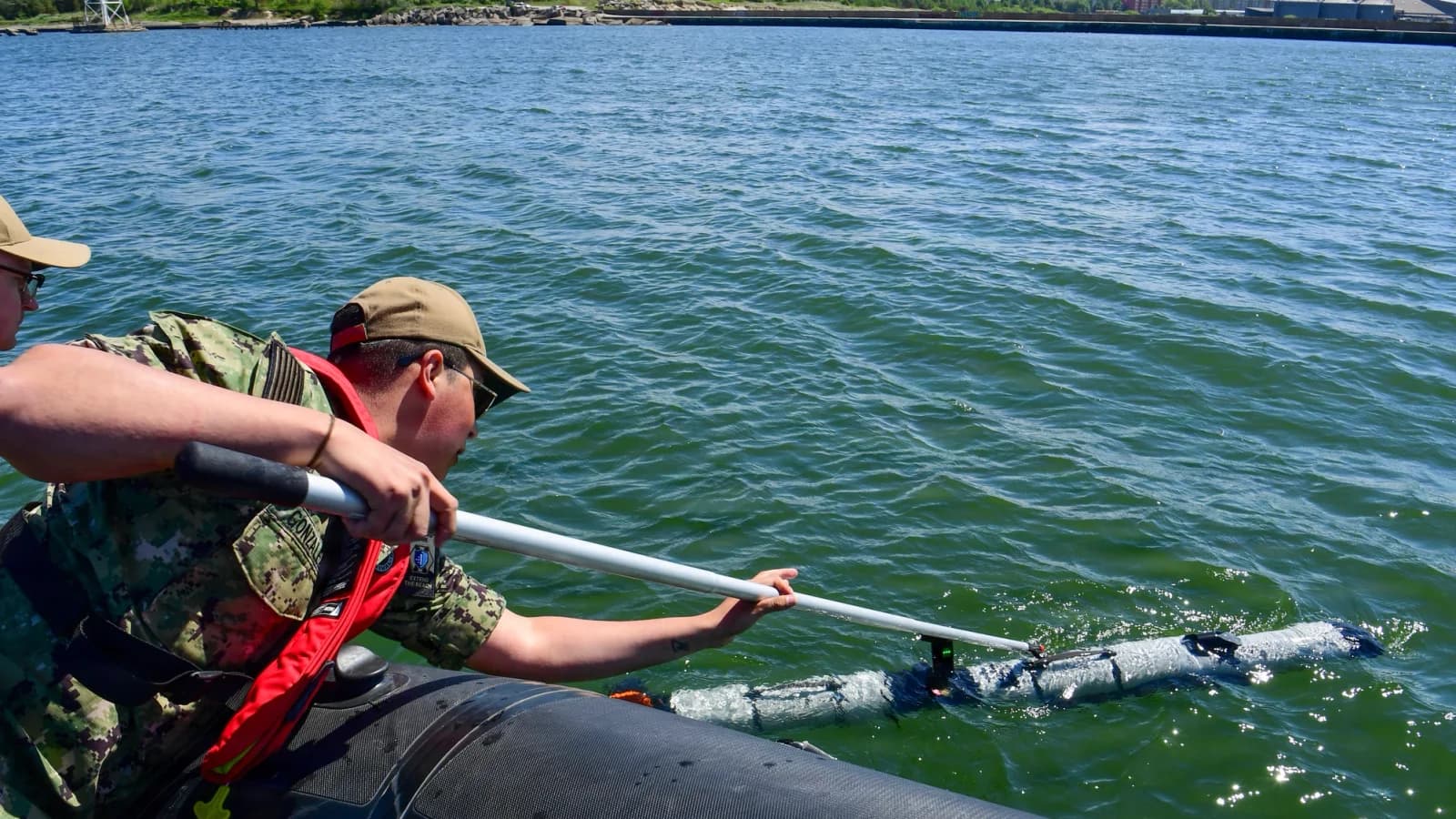
Older trial background: at BALTOPS in June, U.S. Navy teams and allied partners used an Iver3 underwater vehicle to test an expeditionary air curtain intended to interfere with hostile UUV operation. The demonstration also included an artificial-kelp barrier and seawater neutralization technology. The June account describes collecting vehicle metrics and examining affected sensors; it publishes no quantified defeat rate.
That is a different job from mine reconnaissance. During July’s Sea Breeze training, described in an August U.S. Navy report, uncrewed vehicles scouted hazardous waters before crewed vessels or divers were committed. The account emphasizes shared procedures and information reaching command teams. It gives a credible operational sequence, without publishing a comparative safety or clearance-speed dataset.
The distinction matters for Canadian harbour and mine-countermeasures work. One use puts a friendly robot into a test environment to measure a defensive system’s effect on an underwater vehicle; the other sends a robot ahead to reduce exposure while locating hazards. Procurement and evaluation need to identify which job is being purchased, what information reaches an operator, and what measured result supports the claim. These are summer examples reviewed for context, not new October exercise outcomes.
What remains open
Neither public account provides a controlled comparison or a quantified operational effectiveness result.
Evidence and assessment for Older trials show two different jobs for underwater autonomy
What the sources establish
The two original U.S. Navy accounts describe a June counter-UUV demonstration and July reconnaissance training with different operating purposes.
True North Map assessment
An underwater vehicle can be a test instrument or a reconnaissance asset; those uses require different evidence of effectiveness.
Original sources (2)
- U.S. Navy / DVIDS: Technology plays a Crucial Role in Harbor Defense during BALTOPS 2026 (opens in a new tab)Direct record · Full June original, explicitly older trial background; test mechanism and metric collection distinguished from quantified operational success.
- U.S. Naval Forces Europe-Africa / U.S. Sixth Fleet: Enhancing Safety in Underwater Ordnance Reconnaissance at Sea Breeze 26-2 (opens in a new tab)Direct record · Full original posted August 18 about July 12–24 training; contextual comparison, not an October result. Prior October 9 composite mention acknowledged in private dedup review.
Maritime Launch reaches a conditional capital-market milestone
The October 15 issuer announcement records conditional TSX approval; final requirements and a trading date remained outstanding.
Maritime Launch Services received conditional approval to list its common shares on the Toronto Stock Exchange, the company announced on October 15. Final TSX requirements still had to be met, and the release said Cboe Canada trading would continue until the move. A later announcement was to confirm the transition dates.
For the developer of Spaceport Nova Scotia, this is a financing-infrastructure milestone. Management expects a TSX presence to improve visibility in Canadian capital markets while the spaceport develops its civil and defence launch business. It does not itself raise new capital, commission a launch range or establish orbital readiness. The distinction keeps the Canadian industrial picture useful. A company building expensive physical infrastructure needs both an operating project and access to capital; a changed listing venue can support the latter while construction, regulatory and customer-delivery milestones remain separate. The announcement establishes conditional market access at the stated date, rather than the eventual completion or financial benefit of the move.
What remains open
Final approval, transition dates and any financial benefit were not established in this release.
What comes next
A final approval and confirmed trading transition would complete this specific stage.
Evidence and assessment for Maritime Launch reaches a conditional capital-market milestone
What the sources establish
The issuer confirms conditional approval, remaining requirements and continued Cboe trading pending a dated transition.
True North Map assessment
Capital-market access is part of the support structure for a launch project, with physical and regulatory delivery still separate.
Original source (1)
- Maritime Launch Services: Maritime Launch Services Receives Conditional Approval To List On The Toronto Stock Exchange (opens in a new tab)Attributed statement · Full October 15 issuer release including conditional approval, continuing Cboe trading, future final dates and forward-looking caveats.
Scotland matches defence-college funding to its industrial geography
Matched funding for two Defence Technical Excellence Colleges connects training plans with eastern and western defence clusters.
The UK’s October 16 announcement confirms that Scotland will match the UK government’s £10 million commitment to two Defence Technical Excellence Colleges. The original UK offer had been conditional on that match. One college is planned for each side of the country, aligned with established eastern and western defence clusters.
The stated pathways cover defence engineering, advanced manufacturing and maritime technology, alongside engineering and innovation centres in the wider Scottish Defence Growth Deal. The change is therefore more specific than a general call to train more workers: a funding condition has been met, and the planned institutions are connected to the places where employers need those skills. For Canadian shipbuilding and defence-manufacturing regions, the useful allied comparison is the relationship among public funding, a training institution and an industrial cluster. Canada has its own institutions and access rules; this announcement creates no Canadian training entitlement or supplier award. It offers a design worth examining as the colleges move from funded plans to actual courses, employer participation and graduates.
What remains open
Opening dates, course capacity, employer commitments and graduate outcomes are not provided.
What comes next
Published course and employer-partnership details would show how the funded plan becomes a usable workforce route.
Evidence and assessment for Scotland matches defence-college funding to its industrial geography
What the sources establish
The government release confirms the match and the two-college geography and technical pathways.
True North Map assessment
Training investments become more concrete when funding conditions, locations and employer needs are connected.
Original source (1)
- Scotland Office / Ministry of Defence: Douglas Alexander welcomes defence skills investment boost (opens in a new tab)Direct record · Full October 16 original; two technical colleges and matched funding, cluster scope and prior conditional offer; typographical inconsistent £10 body avoided.