
Canadian Defence Signals
Canadian surveillance work reaches data, patrols and software security
Editorial briefing snapshot
The Bottom Line
The information chain has several demanding jobs: collect representative data, share operational observations with the right partners, and secure the software that handles them.
In context
A new airborne-data contract gives Canada’s RPAS programme a specific domestic work package. The Coast Guard reports completed Arctic security patrols with new sensors, while Cohere’s proposed AISLE combination addresses software security around sovereign AI.
In this edition
49North buys the airborne data behind automated vessel classification
TerraSense, UBC and KF Aerospace will collect EO/IR vessel imagery over the Strait of Georgia for Canada’s RPAS classification development.
A Canadian airborne lab has an identifiable job inside the RPAS programme: collect the maritime imagery needed to develop automated target classification. On October 15, 49North awarded the work to Airborne Sensing Lab, a consortium led by TerraSense Analytics with UBC’s STAR initiative and KF Aerospace. The aircraft-based collection will capture electro-optical and infrared imagery of vessels over the Strait of Georgia.
This is a useful view of where domestic capability enters a large foreign-platform purchase. Aircraft operation, sensor collection, data quality and classification development form a Canadian contribution around the CQ-9B Guardian. The lab supports development; the announcement is not a published result for classification accuracy or performance in a contested mission.
49North places the subcontract within its C$78.2 million agreement with General Atomics. It does not disclose the lab’s own award value. Keeping those numbers separate avoids attributing an entire parent contract to one work package. Representative collection and evaluation data will matter as the programme moves toward the announced delivery of 11 aircraft by 2028.
What remains open
The subcontract value, dataset characteristics and classification-performance results are not disclosed.
What comes next
An evaluation record showing representative vessel coverage and classification performance would clarify what the collected imagery enables.
Evidence and assessment for 49North buys the airborne data behind automated vessel classification
What the sources establish
49North’s original names the consortium, collection area, imagery types and development purpose, and separates the parent contract from the new award.
True North Map assessment
A sovereign contribution can lie in the data and evaluation chain surrounding the aircraft, with operational flying expertise part of that chain.
Original source (1)
- 49North: 49North awards contract to TerraSense-led airborne sensing lab (opens in a new tab)Attributed statement · Full October 15 original; consortium scope, Strait of Georgia imagery, automated target classification, parentC$78.2m contract distinct from undisclosed subcontract.
New Coast Guard sensors reach Arctic patrols and a security handoff
Two ships completed initial security patrols, and their collected information was shared through Marine Security Operations Centres.
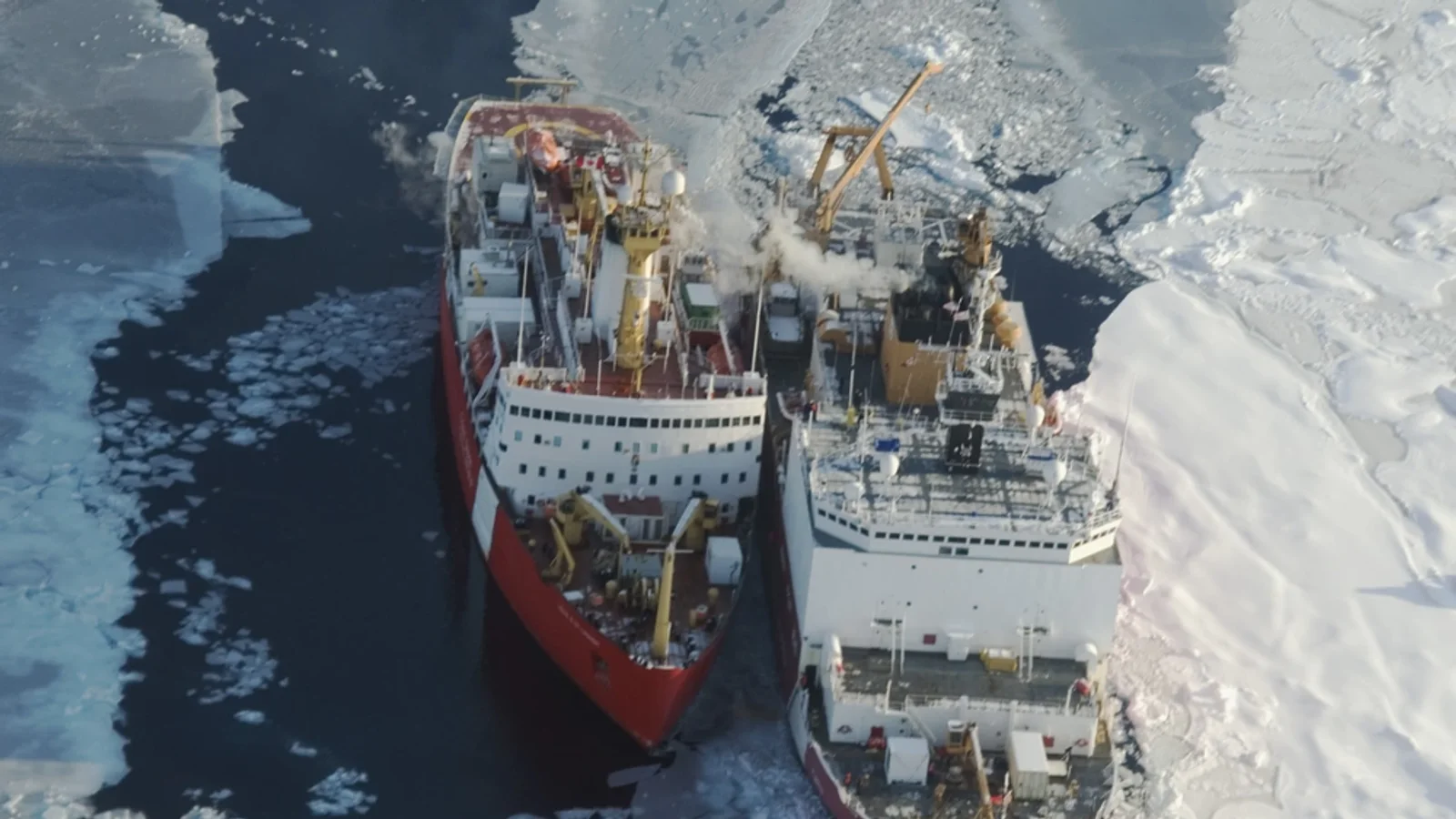
The Coast Guard’s expanded surveillance role now has a completed operating example. Des Groseilliers and Louis S. St-Laurent conducted their first maritime security patrols in Arctic waters south of Victoria Island near Cambridge Bay, the service announced on October 15. Des Groseilliers also participated in Exercise ARCTIC GHOST.
The release identifies the sensor hosts: two helicopters with MX-10 EO/IR systems, Dash-8 aircraft with MX-15 systems, and a larger CMX-15 aboard Louis S. St-Laurent. The aircraft equipment was used during the patrols and exercise. Eight more Arctic-capable vessels are to receive systems in the near term, so that expansion remains planned.
The operating handoff is as important as installation. The Coast Guard says information collected during the patrols was shared with Canada’s Marine Security Operations Centres for distribution to security and enforcement partners. The new equipment is therefore reaching an existing interagency workflow. The account supplies neither a detection-rate result nor a particular enforcement action, but it does establish collection and onward sharing in northern operations.
What remains open
The release provides no detection-performance dataset or attribution of a specific enforcement outcome.
Evidence and assessment for New Coast Guard sensors reach Arctic patrols and a security handoff
What the sources establish
The service’s original release confirms completed patrols, sensor-equipped hosts, a planned further rollout and the information transfer.
True North Map assessment
The useful capability is an operating chain from ship or aircraft collection to partners able to use the information.
Original source (1)
- Canadian Coast Guard: Canadian Coast Guard ships complete first security patrols in Canada’s Arctic waters (opens in a new tab)Direct record · Full October 15 original; completed patrols, installed sensor hosts, planned eight vessels, information handoff and expanded mandate.
Cohere’s AISLE plan puts software security inside its AI proposition
A letter of intent would bring AISLE’s vulnerability-research team into a new Cohere Cyber business; completion is still ahead.
Cohere announced a proposed acquisition of AISLE on October 15, and AISLE’s own statement specifies the instrument: a signed letter of intent. The founders are due to take leadership roles across a new Cohere Cyber business, corporate security and AI-security research. Prague is planned as a larger centre for that work once the transaction is completed.
The companies’ technical argument is that an autonomous security system can improve the models it uses, while stronger models can improve vulnerability discovery, validation and repair. Cohere also intends to connect those capabilities to private-cloud, on-premises and isolated deployments. Those are the planned integration and deployment directions, rather than evidence that a combined defence security service is already operating.
For Canadian defence and critical-infrastructure buyers, the development broadens the question around sovereign AI. Control over data and deployment must coexist with the security of the software underneath the system. The proposed team combination offers a route to investigate that problem, while transaction completion, product integration and customer assurance remain distinct milestones.
What remains open
Transaction terms, completion and the performance of the future combined offering are not established.
What comes next
Completion and a documented integrated security offering would show how the planned combination changes a customer’s deployed assurance.
Evidence and assessment for Cohere’s AISLE plan puts software security inside its AI proposition
What the sources establish
Both companies describe a proposed combination; AISLE explicitly confirms a signed letter of intent and future completion.
True North Map assessment
Sovereign deployment and software assurance are connected requirements when AI enters sensitive operational workflows.
Original sources (2)
- Cohere: Cohere to acquire AISLE to advance cyber-resilient sovereign AI (opens in a new tab)Attributed statement · Full substantive October 15 announcement including proposed transaction, planned leadership and deployment aims. Later related links excluded.
- AISLE: AISLE and Cohere to Join Forces (opens in a new tab)Attributed statement · Full counterparty original; letter of intent and when-complete wording; founders’ future roles and customer continuity.