
Canadian Defence Signals
Defence capital meets the work of readiness
Editorial briefing snapshot
The Bottom Line
Follow where capital becomes additional productive capacity, where demonstrations become integrated systems, and where operating experience changes the next requirement. Those transitions identify useful opportunities for Canadian suppliers and better questions for buyers.
In context
A bank financing framework, a satellite-terminal test and an underwater drone loss look like different stories. Read together, they expose some of the work between announcing a capability and sustaining it: allocating capital to useful assets, integrating the equipment that reaches the user, and preparing for systems that fail in service.
Scotiabank’s new defence framework is the clearest Canadian financial development in this edition. Its potential extends beyond large military platforms, but the underlying rules matter. It can finance existing loans as well as new activity, making future allocation reports more informative than a labelled issuance total alone. The U.S. quantum agreements offer another financing model, connecting public capital and equity interests to technical scaling. Their Canadian origins raise a separate question about where valuable industrial work will take place.
On the capability side, independent journalist Marc Boucher’s SpaceQ reporting brings the ground terminal into the Lightspeed discussion. CAE and WB’s new memorandum puts training beside unmanned hardware. UBC’s drone initiative offers the operational detail that promotional announcements often lack: weather, technical reliability and service arrangements shaped its earlier trial, and its new funding can be judged against those lessons.
Two other investigations widen the picture. Vanguard’s original reporting identifies the selection stage of DND’s human–AI trust competition; allied navigation testing provides a result whose comparison baseline deserves close attention. Finally, the reported Dive-LD loss is a reminder that readiness includes what happens after equipment stops working. These developments create different opportunities for Canadian organizations, but each rewards attention to the specific next piece of work.
In this edition
Scotiabank gives defence lending a financing framework
A new framework could connect labelled bank funding to Canadian defence suppliers; its allocation rules will determine how much genuinely additional lending follows.
Scotiabank published its Canadian Defence Issuance Framework on September 8, creating a structure for future bonds and other labelled instruments linked to eligible defence financing. The announcement establishes the framework. It does not announce a bond sale, its proceeds or a new lending commitment to a particular supplier. Sustainable Fitch has assessed the framework’s alignment with emerging market practices; that assessment concerns the framework, rather than a guarantee of a borrower’s credit quality.
The underlying document is more informative than the headline. Eligible assets include both new and existing loans. Companies of different sizes can qualify, with a Canadian headquarters or Canadian stock-exchange listing among the entity requirements. The activity categories extend beyond finished military platforms to components, critical infrastructure and strategic technologies, including quantum and semiconductors, where they support the specified defence and security purposes. A dual-use label alone does not establish eligibility.
General corporate lending can count in full when at least half of a relevant business measure—such as revenue, capital expenditure or operating cash flow—relates to defence. Below that threshold, the framework permits a proportionate allocation. Proceeds enter the bank’s general account, with an equivalent amount earmarked to the eligible portfolio; the bank targets allocation within 24 months. Investors’ principal and interest remain obligations funded from the bank’s general resources, rather than payments tied to the performance of a particular defence asset.
TNM’s assessment is that this could make defence a more legible financing category inside a large Canadian bank. It gives suppliers and investors a concrete eligibility discussion, extending beyond the handful of prime contractors. Its economic effect will emerge through allocation: refinancing an existing loan and funding new productive capacity both qualify, but they do different things for industrial expansion. The useful measure will be additional lending reaching capable businesses, alongside the mix of existing assets and smaller borrowers. The framework envisages annual allocation reporting and a best-efforts SME breakdown, subject to confidentiality. Those disclosures could make the difference visible.
Evidence and assessment for Scotiabank gives defence lending a financing framework
What the sources establish
The bank’s framework permits financing and refinancing of eligible assets, with portfolio allocation and subsequent reporting; the release announces the framework itself.
Original sources (3)
- Scotiabank: Scotiabank Publishes Canadian Defence Issuance Framework (opens in a new tab)Attributed statement · Announcement and scope of planned instruments
- Scotiabank: Scotiabank Canadian Defence Issuance Framework 2026 (opens in a new tab)Direct record · Pages 6–9 and 12–13: eligibility, management of proceeds and reporting
- Sustainable Fitch: The Bank of Nova Scotia — Defence Issuance Framework Assessment (opens in a new tab)Direct record · Pages 1–2: assessment scope and alignment
Farcast’s live satellite link moves the terminal question forward
An antenna demonstration supports the engineering case for Telesat’s ground equipment; integrating the modem and preparing a production terminal remain the next steps.
Independent journalist and SpaceQ founder Marc Boucher’s September 8 report draws attention to an important part of Telesat Lightspeed that is easy to overlook: the equipment connecting the user to the satellites. Farcast and Telesat announced on September 2 that an over-the-air demonstration maintained an end-to-end link through Telesat’s LEO 3 test satellite, with measured performance close to their predicted link budget. The shared-aperture antenna transmits and receives through the same panel, reducing hardware complexity.
The original announcement defines the next stage as an integrated terminal combining the antenna with the Lightspeed modem. Telesat’s November 2025 investment announcement provides the commercial baseline: US$5 million in equity, a board seat and an enterprise-class terminal intended to be ready for volume production, with availability then planned for 2027. Boucher usefully notes that the latest release does not supply a date for the integrated test or restate that availability target.
TNM’s reading is that the demonstration advances a real dependency in the service, without resolving the complete terminal program. A satellite network becomes useful to a mobile or remote customer through equipment that can be installed, powered, supported and integrated with that customer’s systems. Antenna performance is one part of that chain; modem integration and repeatable production are other parts.
For Canadian communications and integration businesses, the practical conversation is therefore moving toward the user installation. Which operating environments will the finished terminal support, what will its power and integration demands be, and when will a representative unit be available for customer testing? Those answers will help distinguish a credible service opportunity from a broad claim about participating in a new constellation.
Evidence and assessment for Farcast’s live satellite link moves the terminal question forward
What the sources establish
Telesat reports a successful LEO 3 antenna demonstration; its earlier investment release and Boucher’s reporting establish the remaining integration and timing questions.
Original sources (3)
- Marc Boucher / SpaceQ: Farcast clears Telesat Lightspeed antenna milestone (opens in a new tab)Original reporting · Original reporting: milestone, prior commitment and missing updated timetable
- Telesat: Farcast completes Telesat Lightspeed antenna technology demonstration milestone (opens in a new tab)Attributed statement · Over-the-air demonstration and next integration stage
- Telesat: Telesat invests US$5 million in Farcast (opens in a new tab)Attributed statement · Investment, board seat and intended terminal availability
U.S. quantum agreements put capital and industrial location together
D-Wave and Rigetti have finalized U.S. funding agreements with equity conditions, sharpening the Canadian question of where research becomes manufacturing capability.
D-Wave and Rigetti announced definitive agreements with the U.S. Department of Commerce on September 8. D-Wave describes access to up to US$100 million under the CHIPS and Science Act, advancing its earlier letter of intent. Rigetti’s subsidiary has signed for a US$100 million award supporting superconducting quantum research and development. Both arrangements include a minority, non-controlling Commerce equity interest; an executed agreement should not be read as confirmation that every dollar has already been disbursed.
The technical work is specific. Rigetti identifies smaller readout electronics, greater cryogenic capacity and fabrication capabilities for more highly connected chips. D-Wave links its support to both annealing and gate-model development. These are efforts to overcome scaling and manufacturing constraints, rather than announcements that the eventual machines already exist.
BetaKit supplies the Canadian connection: D-Wave began as a UBC spin-out and retains a Burnaby presence, while moving its headquarters to California in 2023. Rigetti is California-based and was founded by Canadian-born Chad Rigetti. Those connections matter, but they do not turn the U.S. awards into Canadian industrial investment.
TNM’s assessment is that the funding model ties technological development to a national industrial relationship. For Canada, tracking company origin or a headline quantum total will miss part of the story. The more useful questions concern the location of fabrication, specialist employment, intellectual property and the suppliers involved in scaling the machines. A company can retain valuable Canadian activity while building its next manufacturing capability elsewhere. That makes the allocation of work—not just the nationality of the founder—the consequential follow-up.
Evidence and assessment for U.S. quantum agreements put capital and industrial location together
What the sources establish
The two issuers announce definitive Commerce agreements; BetaKit identifies their different Canadian connections.
Original sources (3)
- D-Wave Quantum: D-Wave finalizes agreement with U.S. Department of Commerce for up to $100 million (opens in a new tab)Attributed statement · Definitive agreement, access to funding and equity condition
- Rigetti Computing / GlobeNewswire: Rigetti signs definitive agreement for $100M with U.S. government (opens in a new tab)Attributed statement · Award and three R&D projects
- BetaKit: US government invests $200 million USD in Canadian-founded quantum firms (opens in a new tab)Original reporting · Canadian origins and D-Wave headquarters relocation
CAE and WB put operator readiness beside unmanned hardware
A Polish–Canadian training memorandum points to Canadian work around unmanned platforms, with customer programs and revenue still to be established.
CAE and WB Electronics signed a memorandum of understanding at MSPO in Kielce on September 8. They will explore combining CAE’s simulation, synthetic training and mission-rehearsal capabilities with WB’s unmanned platforms and mission systems, addressing opportunities in Poland, Canada and allied markets. The announcement establishes an industrial collaboration at the exploration stage; it names no awarded customer program or contract value.
This is a tangible company-level development alongside the renewed Canada–Poland Defence Cooperation Agreement reported by DND after the visit. It should not be substituted for the separate drone-related transaction flagged in earlier Polish ministerial remarks: the CAE release is about training cooperation and does not settle the equipment, quantity or terms of a Canadian purchase.
The opportunity for Canada is nevertheless concrete enough to investigate. A growing fleet of unmanned systems needs trained operators, instructors and a way to rehearse missions as software and equipment change. That creates potential work around the platform even where the aircraft or vehicle is developed abroad. TNM’s assessment is that training can be an important part of a Canadian industrial position in such programs, provided the partnership reaches a defined customer requirement.
The next useful disclosure will identify the first training application and how it connects to an operating system: who will use it, which competencies it develops and how the training environment stays current with the platform. Those details would turn a broad collaboration into an offer a buyer can assess.
Evidence and assessment for CAE and WB put operator readiness beside unmanned hardware
What the sources establish
CAE describes an MoU to explore training and readiness opportunities; DND separately reports the renewed bilateral cooperation agreement.
Original sources (2)
- CAE / CNW: CAE and WB Electronics advance Polish-Canadian collaboration in unmanned systems training and readiness (opens in a new tab)Attributed statement · MoU scope and intended markets
- Department of National Defence: Minister McGuinty concludes visit to Poland (opens in a new tab)Attributed statement · Renewed Defence Cooperation Agreement and visit outcomes
UBC’s new drone funding meets the lessons of the earlier trial
A $2.86 million commitment is more informative when read beside the project’s earlier weather, technical and service-design problems.
PacifiCan’s September 4 backgrounder allocates $2,861,053 to UBC’s drone initiative through its Community Economic Development and Diversification program. The work involves Stellat’en First Nation and Fraser Lake, combining testing and deployment with workforce and youth skills. BetaKit’s September 8 coverage brings the initiative back into view. This is community and economic-development funding, with useful dual-use lessons; it is not an announced Canadian Armed Forces drone procurement.
UBC’s own account of its earlier phase adds the operational substance. Its cancellation analysis attributes 47.7% of cancelled flights to weather and 30.7% to technical causes. These are shares of cancellations, not of all scheduled flights. Reported technical problems included connectivity, overheating and battery-related issues. The account also describes a need for more responsive, on-demand arrangements and technology better suited to winter conditions. The partnership rests on longstanding relationships with the community, which are part of the operating system rather than an incidental prelude to flying.
TNM’s assessment is that the value of the next phase will lie in the service it can sustain. More flights can produce useful evidence, but a community needs to know when a delivery will happen, who responds when it cannot, and whether the operating arrangements fit local needs. Aircraft capability, communications, dispatch and people have to work together. Funding that improves those interfaces can be more consequential than another isolated demonstration.
There is a relevant comparison for remote defence logistics, without assuming that a health-delivery trial reproduces military conditions. Weather tolerance, communications reliability, local support and recovery from interrupted service are questions a buyer can carry into its own testing. The project's published phase-two findings page currently offers no results. That leaves a valuable next question: which limitations from the earlier trial will the newly funded work measurably improve?
Evidence and assessment for UBC’s new drone funding meets the lessons of the earlier trial
What the sources establish
PacifiCan specifies the UBC allocation; UBC’s phase-one lessons identify weather and technical cancellation drivers, while its phase-two findings page has no results yet.
Original sources (4)
- Pacific Economic Development Canada: Northern B.C. investments backgrounder (opens in a new tab)Attributed statement · UBC allocation under Community Economic Development and Diversification
- Jesse Cole / BetaKit: Feds pump $11 million into BC tech, including solar and drone delivery (opens in a new tab)Original reporting · Reporting connecting the funding to drone delivery
- University of British Columbia: Phase I Project Findings & Lessons Learned (opens in a new tab)Direct recordCancellation drivers; implementation and service lessons
- University of British Columbia: Phase II Project Findings & Lessons Learned (opens in a new tab)Direct recordStatus of published phase-two results
DND’s trust competition is approaching the selection decision
Original reporting identifies 71 proposals and decisions expected this month for research on how operators judge autonomous systems.
David George-Cosh’s original reporting in Vanguard Defence establishes a useful development beyond the original call for proposals: DND says it received 71 submissions and expects funding decisions this month. The research concerns how to measure and adjust an operator’s trust in an autonomous system as a task unfolds.
DND’s challenge document sets the underlying terms: Canadian university-led, multidisciplinary networks, funding of up to $1 million per selected network and work ending by March 31, 2028. The official call is closed, so this is a selection-stage development rather than an open application opportunity.
George-Cosh also reports on Calian’s earlier small pilot involving two RCAF operators and a simulated NORAD setting, while including University of Calgary researcher Henry Leung’s doubts about the maturity of such approaches. That combination is useful: a demonstration and a counterargument illuminate what the competition still has to establish. The pilot should not be treated as evidence of a fielded trust-measurement system.
For TNM, the important distinction is between increasing trust and making it appropriate. An operator who confidently accepts a poor recommendation can be as problematic as one who rejects a sound recommendation. A useful system would help people recognize uncertainty and respond when performance changes. That is a different objective from simply making automation feel more reassuring.
The award decisions should reveal which teams and approaches DND considers promising. After that, the meaningful evidence will concern whether measurements work across people and conditions, and whether they improve decisions rather than merely recording a physiological response. That gives Canadian human-factors, simulation and AI specialists a specific research relationship to follow.
What comes next
Follow the expected September award decisions for named teams, research approaches and planned evaluation settings.
Evidence and assessment for DND’s trust competition is approaching the selection decision
What the sources establish
Vanguard reports DND’s submission count and expected decision timing; the official challenge establishes eligibility, funding and the closed deadline.
Original sources (2)
- David George-Cosh / Vanguard Defence: DND trust research draws 71 proposals, funding decisions expected this month (opens in a new tab)Original reporting · Original DND response, Calian pilot and researcher counterargument
- Department of National Defence: Cognition and Trust: Real-Time Dynamic Calibration for Human-Autonomy Teams (opens in a new tab)Direct recordChallenge terms, network eligibility and project period
The Dive-LD incident puts recovery and loss into the readiness question
An underwater vehicle reportedly recovered by Iran was already malfunctioning, according to CENTCOM; the incident makes the support assumptions around autonomous fleets more visible.
Iran’s September 8 claim to have captured an American underwater drone near the Strait of Hormuz is accompanied by a materially different account of its condition. CENTCOM spokesperson Captain Tim Hawkins told DefenseScoop’s Brandi Vincent that the older Anduril Dive-LD had malfunctioned for more than a day before the reported seizure. He said it was surveying the waters and carried no classified sonar or radar systems or collected sensitive data. Those are attributed U.S. statements, rather than independently established findings about everything aboard the vehicle.
Anduril emphasized the vehicle’s attritable design and described extensive prior operations. That is relevant manufacturer context, but it does not settle why this vehicle failed or establish that the loss had no consequences. The reporting supports neither a claim that Iran defeated the system electronically nor a blanket judgment that the wider program has failed.
TNM’s assessment is that the incident brings an often less visible part of autonomy into a procurement discussion. A fleet needs an operating concept for equipment that stops responding, becomes unavailable or cannot be recovered. Purchase price and endurance tell only part of the story; support, replacement capacity and continuity of the service also affect its value.
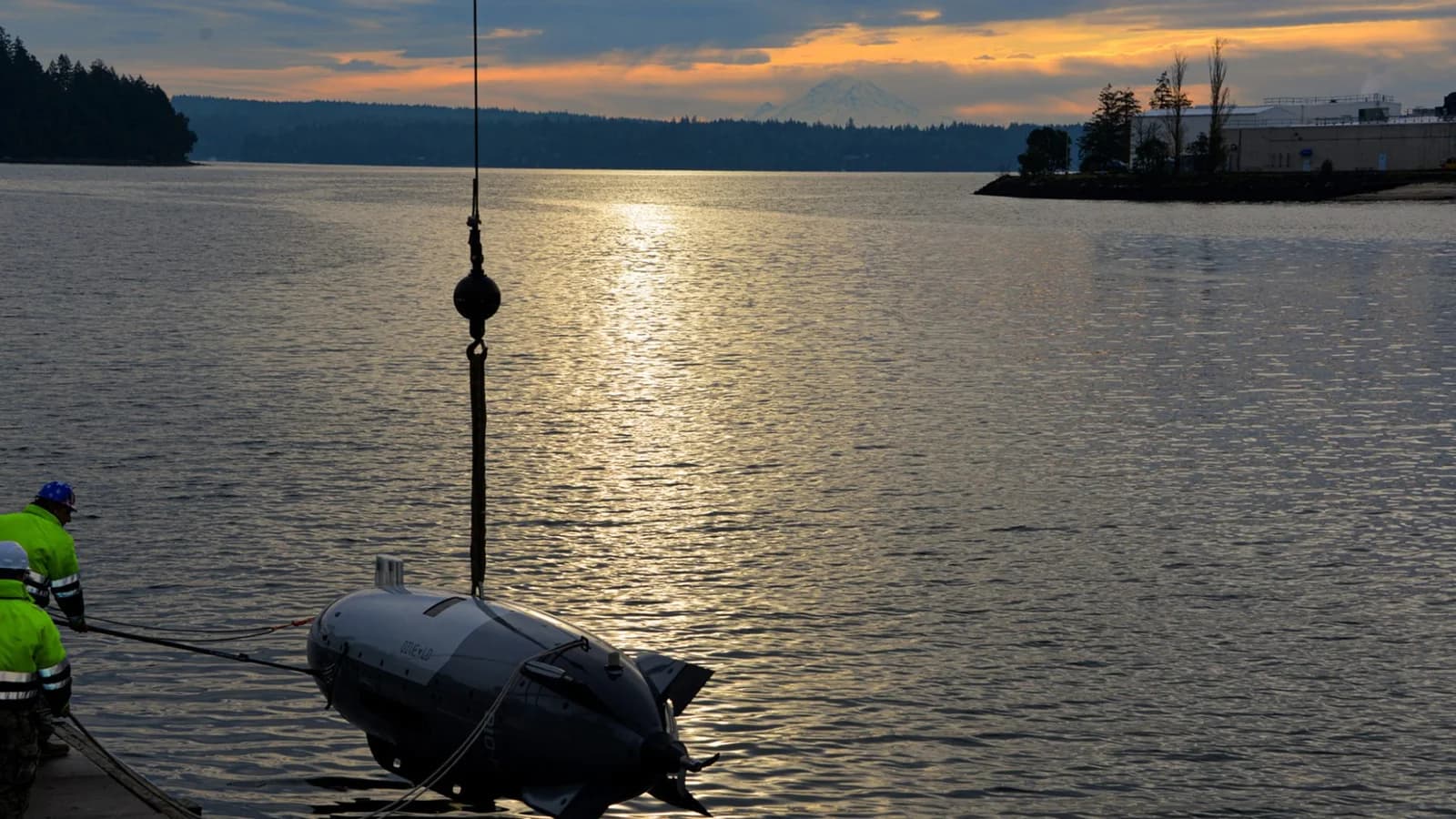
For Canadian organizations evaluating uncrewed maritime capability, that makes realistic failure and recovery assumptions worth examining alongside successful demonstrations. The useful lesson is to ask how the overall service performs when individual assets are lost. The heading photograph shows Dive-LD training at Keyport in December 2024; it is historical context, not an image of this incident.
Evidence and assessment for The Dive-LD incident puts recovery and loss into the readiness question
What the sources establish
DefenseScoop attributes the vehicle-condition and payload statements to CENTCOM and separately reports Anduril’s response; DVIDS supplies the historical image provenance.
Original sources (2)
- Brandi Vincent / DefenseScoop: U.S. military’s Anduril Dive-LD drone was dead in the water before Iran nabbed it (opens in a new tab)Original reporting · Original CENTCOM and manufacturer responses
- Loren Nichols / U.S. Navy / DVIDS: Unmanned Undersea Vehicle Group 1 Sailors Train with Large Unmanned Undersea Vehicle (opens in a new tab)Direct record · Photo 8950379: Keyport training, taken December 11, 2024; public-domain designation
Southern Ontario’s expanded tariff-support window is open
Eligible tariff-affected manufacturers can now seek liquidity support, with application limits and cost sharing more useful than the national headline total.
FedDev Ontario announced on September 8 that applications are open for expanded Regional Tariff Response Initiative support, including liquidity assistance. The current program page allows up to $2 million in liquidity funding, covering up to half of eligible costs over a period of up to 12 months ending no later than March 31, 2028. Combined non-repayable support can reach $3 million; the liquidity amount is included in that ceiling, not added on top.
The eligibility details narrow the opportunity. The page identifies a minimum annual revenue of $1 million and requires a demonstrated tariff impact and need. A company’s connection to defence manufacturing does not by itself qualify it. Larger repayable project support is a separate part of the initiative, and an application remains subject to assessment.
For a qualifying industrial supplier, this is a more immediate cash-flow conversation than the future labelled instruments in Scotiabank’s new framework. TNM’s assessment is that the two developments address different parts of industrial capacity: one can help a business manage present disruption; the other could broaden the financing base for defence-related lending. A capable supplier needs both a viable operation today and a path to fund tomorrow’s work. The practical next step here is to test the business’s actual costs and tariff exposure against the published application guide.
Evidence and assessment for Southern Ontario’s expanded tariff-support window is open
What the sources establish
FedDev’s announcement opens expanded applications; its live program page defines the liquidity, combined funding and eligibility limits.
Original sources (2)
- FedDev Ontario: Eligible businesses and organizations in southern Ontario can now apply for enhanced RTRI support (opens in a new tab)Attributed statement · Applications opening and enhanced support
- FedDev Ontario: Regional Tariff Response Initiative in southern Ontario (opens in a new tab)Direct recordLiquidity funding, combined non-repayable ceiling and eligibility